49 works in this view — arrow keys or swipe to move between them.
Dance in Art
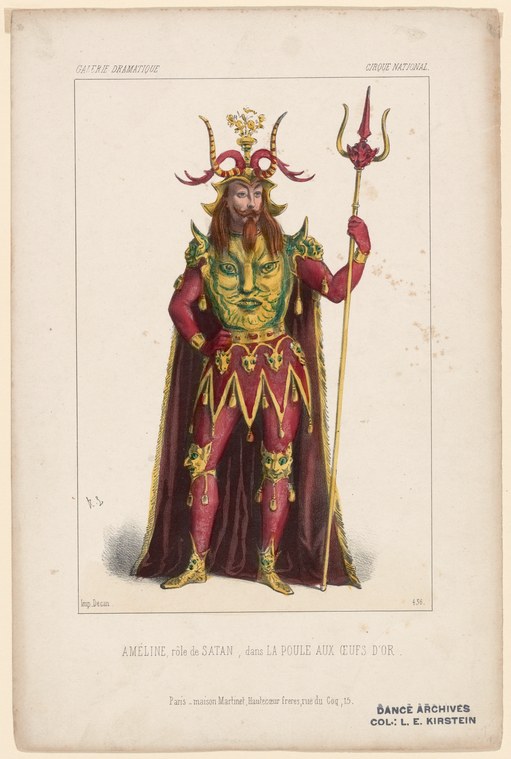
Améline, rôle de Satan, dans La poule aux oeufs d'or
Unknown artist
- Collection:
- Prints depicting dance
- Source:
- New York Public Library
- Rights:
- Public domain — free to use, share and adapt.
- Recorded as:
- Public Domain
This work preserves a record of how a specific performer appeared in a well-known production, and how demonic and supernatural characters were realized theatrically in 19th-century Paris. It illustrates the intersection of dance, opera, and visual spectacle at a moment when Paris was the center of European theatrical fashion, and when costume and makeup were crucial tools of performance character.
What you are looking at
A theatrical figure dominates the center of the composition, posed frontally and monumentally against a plain background. The figure wears a striking costume: a long robe of burgundy-red velvet trimmed with gold braid in a sawtooth or lightning-bolt pattern, and a yellow-green bodice or breastplate shaped like a grotesque face with a fixed smile. The head above is human but crowned with an elaborate headdress of burgundy horns or antlers, tilted upward, with golden ornaments and a small human face visible within the crown. The figure holds a long trident-like staff or spear upright in the right hand, painted in burgundy with a sharp fork-shaped head. The left hand rests on the hip. The overall effect is demonic and theatrical—a costume portrait rather than a dance action captured mid-movement. The figure is rendered in hand-colored engraving or lithograph, with careful attention to textile pattern and ornament.
The dancing
This is a single standing figure in a stark, frontal pose—not a representation of dance as movement but of a costume and character. The body is upright and still, legs together or barely apart, arms positioned to display the costume rather than to suggest dancing gesture. The figure occupies the full height of the frame and is presented as a specimen or portrait of theatrical dress rather than as an active dancer in mid-phrase.
The dance depicted
The title identifies this as Améline, taking the role of Satan in the opera-ballet *La poule aux œufs d'or* (The Golden Egg), a work of the 19th-century French theatrical repertory. This is a costume portrait from a theatrical production, not a representation of dance itself. The figure depicts the character and makeup rather than a moment of choreographed action. The costume is designed for spectacle and demonic character work, typical of theatrical roles in Paris during the 19th century when spectacular supernatural and diabolic characters were staple elements of opera and ballet.
How it was made
This is a hand-colored engraving or lithograph (the technique is not recorded in the catalogue but is evident from the image). The line work and stippling are characteristic of 19th-century theatrical prints intended for circulation as costume documents and souvenirs. The precise hand-coloring suggests a work produced for a relatively affluent audience or for theatrical archives. Such prints were distributed to publicize productions and served as records of famous performers in celebrated roles.
About this work
This is a theatrical costume portrait from the 19th-century Parisian stage, documenting the demonic costume and makeup worn by a performer named Améline in a supernatural role. The work belongs to a tradition of theatrical documentation through prints—a practice that recorded star performers, celebrated roles, and the visual spectacle of opera and ballet productions. Though the figure is labeled as a dancer, the image itself is not a representation of choreography or movement, but a static record of costume and character design. It is significant as a historical document of 19th-century theatrical practice and the visual culture surrounding Paris's most popular entertainments.
How to look at it
This is not a dance image in the sense of captured choreography. Instead, attend to the costume itself: the color choices, the ornamental patterns, the symbolic elements (the horns, the demonic face-mask, the trident), and how they communicate theatrical character. The frontality and stillness are intentional—the figure is presented as a specimen of costume design, for theater historians and enthusiasts to study and remember. The hand-coloring technique preserves what the stage lighting and distance would have revealed.
The artist
The artist is not recorded. The work is credited only to the Bibliothèque de l'Opéra and was published by Martinet in Paris. Such theatrical costume prints were often created by specialized theatrical engravers and were distributed through opera house bookshops and Parisian print merchants.
The period
This work dates from the mid-19th century, when Parisian opera and ballet were at the height of their influence and when spectacular costume and set design were principal attractions. The supernatural and demonic roles—diabolic creatures, sorcerers, witches—were popular additions to light operas and ballets of this period. Améline was known in Paris theatrical circles, and this print documents a celebrated performance. The technique and style are consistent with theatrical documentation practices of the 1860s–1880s.
Where it lives
This is a print from the collections of the New York Public Library, part of a collection of dance-related prints. It was published by Martinet, a major Parisian theatrical print publisher of the 19th century, and is preserved in the Library's holdings of theatrical documentation.
Questions about this work
Is this a record of an actual dance?
Not of choreography itself. This is a costume and character portrait from a theatrical production—*La poule aux œufs d'or*—that may have included danced passages, but the image shows the costume and makeup, not movement. It is a document of how a performer and role appeared visually on the stage.
Who was Améline?
The historical record is limited. She is known through theatrical prints and records as a performer in 19th-century Paris who was celebrated enough for her costume to be documented and sold as a theatrical souvenir. This print is part of her legacy.
What is *La poule aux œufs d'or*?
It is a 19th-century French theatrical work—a light opera or opera-ballet with a title translating to *The Golden Egg*. It belongs to the tradition of spectacular theatrical entertainments popular in Paris, often with supernatural or comic elements. Améline's role as Satan suggests it included demonic comic or supernatural characters.
Why does this look so demonic?
Supernatural and demonic roles were stock elements in 19th-century French theater, used for spectacle, comedy, and dramatic effect. The costume—with its green-faced mask, devil horns, and trident—is designed to be immediately recognizable as a theatrical demon and to stand out from the stage, even to spectators far from the action.
More dance artwork





