49 works in this view — arrow keys or swipe to move between them.
Dance in Art
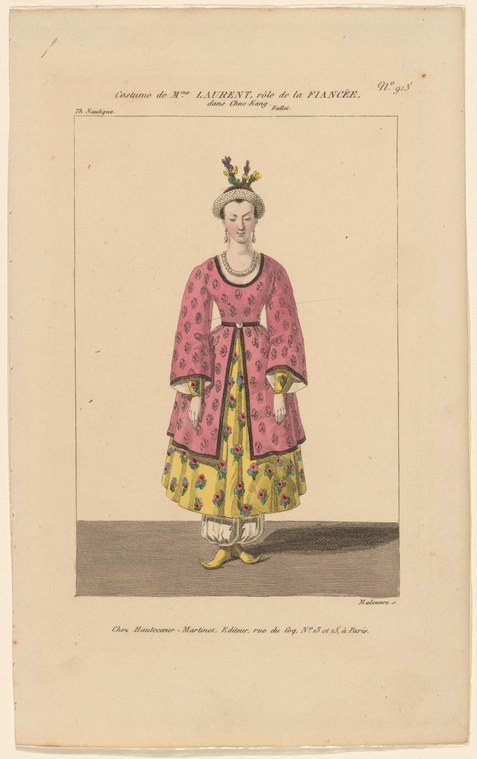
Costume de Mme. Laurent, rôle de la Fiancée, dans Chao-King. Ballet
Unknown artist
- Collection:
- Prints depicting dance
- Source:
- New York Public Library
- Rights:
- Public domain — free to use, share and adapt.
- Recorded as:
- Public Domain
Costume documentation prints like this are among the primary surviving records of early 19th-century theatrical dress and performer identity. Where choreography disappeared or was never notated, costume prints preserve evidence of how dancers appeared onstage and what aesthetic codes their dress communicated to audiences. For researchers tracing the history of Orientalism in European ballet, and for historians studying women performers and their professional visibility, this image and its inscription offer concrete documentation of an individual artist's identity and career.
What you are looking at
A single female figure stands centered against a neutral gray ground, posed frontally with relaxed shoulders and a direct gaze toward the viewer. She wears an elaborate costume consisting of a rose-pink silk or damask robe with an all-over floral or geometric pattern, trimmed in contrasting dark edging and worn open over a mustard-yellow patterned skirt. Her hair is styled in an elaborate arrangement topped with a decorative feathered or jeweled headdress typical of early 19th-century court dress. A pearl necklace drapes at her neck. Her feet, in soft yellow slippers or shoes, are positioned naturally apart. The figure is rendered with careful attention to textile detail and color—the patterned fabrics are minutely worked, suggesting this is a costume documentation rather than a scene of actual movement. The clean, brightly lit presentation against the gray ground and the absence of other figures, props, or spatial recession all emphasize the work as a costume record.
The dancing
The single figure exhibits a standing posture with weight distributed evenly on both feet, arms at ease, shoulders relaxed and level. There is no suggestion of balletic turnout or dynamic movement; the pose is essentially neutral and presentational. The body is upright and frontal, with no weight transfer, arm flourish, or the asymmetrical frame characteristic of theatrical dance. This is a costume display rather than a movement study.
The dance depicted
The catalogue identifies this as the costume of Mme. Laurent in the role of 'la Fiancée' (the Bride) in a ballet titled 'Chao-King.' 'Chao-King' does not appear to be a major work in the surviving ballet canon, suggesting it was either a minor production, a short divertissement, or a dance in an opera-ballet. The costume itself—an elaborately patterned Eastern-inspired robe worn over a contrasting skirt with ornamental headdress—indicates an Orientalist or exoticist theme typical of early 19th-century European ballet. The work functions as a record of stage costume design and performer identity rather than as a documentation of choreographic movement or style.
How it was made
This is a hand-colored engraving or possibly a colored lithograph, judging from the fine linear detail visible in the feathering and pattern work, combined with areas of flat color wash. The technique allowed for precise rendering of textile patterns and construction details, making it an ideal medium for costume documentation. The inscription in French at the base (citing the printmaker and Paris bookseller) suggests this was published as part of a series of costume or theatrical prints distributed through commercial channels in Paris. Hand coloring indicates a higher-end product for collectors or theater professionals.
About this work
This is a costume documentation print from the early 19th century, recording the stage dress worn by a performer named Mme. Laurent in a ballet titled 'Chao-King.' The work serves as both a historical record of theatrical costume design and a portrait of an individual performer in role. It belongs to a widespread European practice of publishing colored engravings of celebrated dancers and their costumes—a practice that circulated information about contemporary performance, established reputations, and served as a souvenir or promotional material for theater audiences.
The image reflects the aesthetic and ideological world of Romantic-era European ballet: an embrace of exotic, non-European costume as a marker of fantasy and otherness, combined with meticulous attention to craftsmanship and textile design. The figure's calm, frontal posture and the print's clarity indicate this is a costume study for reference or collection rather than a representation of choreography in action.
How to look at it
Observe the extraordinary care lavished on the patterned textiles: each flower or geometric motif in the robe and skirt is individually rendered, suggesting the print was as much a record of costume craftsmanship as of the performer. Note the contrast between the ornamental detail and the figure's stillness—no movement is frozen here, only presentation. The direct gaze and frontal stance are conventions of portrait culture adapted to theatrical costume documentation, presenting the performer to the viewer as a professional identity in role, not as a character in action. The headdress and jewelry establish rank and exoticism; the neat slippers and the alignment of the feet reinforce the work's nature as a costume record rather than a movement study.
The artist
The artist is not recorded. The inscription cites a Paris printer and bookseller (Chez Haudecoeur, Marchand d'Estampes, rue de l'Épée de Bois, no. 5 à Paris), suggesting this was produced as part of a commercial theatrical print series. Such prints were typically created by journeyman engravers working from sketches or live observation, often anonymized in publication. The practice was widespread in early 19th-century Paris, where theatrical imagery was a major market category.
The period
The early 19th century saw a boom in printed theatrical merchandise, including costume and performer portraits distributed in Paris and across Europe. This coincided with the rise of Romantic ballet and a fascination with exotic, particularly Oriental, subjects. The costume itself—with its patterned Eastern silhouettes and decorative headdress—reflects the early 19th-century Orientalist imagination, when European ballet increasingly drew on fantasy versions of Asian, African, and Middle Eastern cultures. The practice of documenting and circulating images of celebrated performers helped establish a star system and a visual culture of fandom around theater.
The print's style and production quality date it to approximately 1820–1840, when hand-colored engravings were the standard medium for theatrical portraiture. By mid-century, lithography and photography would begin to displace such prints, though colored engravings remained in circulation.
Where it lives
The print is held in the New York Public Library's collection of prints depicting dance. It was published in Paris by a commercial print dealer, Haudecoeur, and likely circulated among theater enthusiasts, professionals, and collectors in France and across Europe.
Questions about this work
Who was Mme. Laurent?
The inscription identifies her only by surname and professional role. She was a performer in a ballet titled 'Chao-King' at an unspecified Paris theater, cast as 'la Fiancée' (the Bride). Beyond this print and possibly a few contemporary playbills or reviews, little may survive about her career. Such prints often are the primary evidence for the professional existence and visible identity of early 19th-century dancers.
What was 'Chao-King'?
The title does not match any major ballet in surviving archives, suggesting it was a minor or short-lived production. The Orientalist costume points to an early 19th-century fascination with exotic themes. It may have been a divertissement within an opera, a one-act ballet, or a now-forgotten work performed in provincial theaters.
Why were costume prints like this made?
They served multiple purposes: as promotional materials for theaters and performers, as souvenirs for audiences, as reference documents for other costume makers and painters, and as collectible images of celebrated artists. In an era without photography, such prints were how performance images circulated and how reputations were built and preserved.
Is this a work of art or a document?
Both. It is a skilled engraving and a hand-colored print made for circulation and sale. It is also a primary historical document of theatrical practice, costume construction, and performer identity. The distinction between art and document was less rigid in the 19th century; commercially produced theatrical prints occupied both categories simultaneously.
More dance artwork





