49 works in this view — arrow keys or swipe to move between them.
Dance in Art
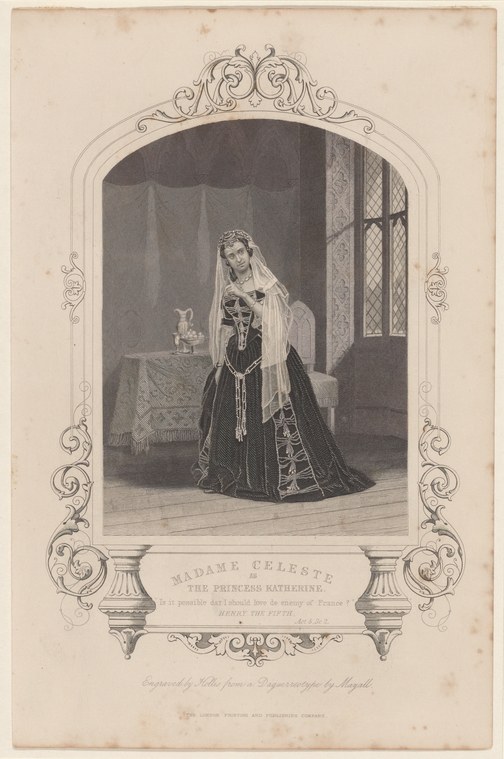
Madame Celeste as the Princess Katherine
Unknown artist
- Collection:
- Prints depicting dance
- Source:
- New York Public Library
- Rights:
- Public domain — free to use, share and adapt.
- Recorded as:
- Public Domain
For dance historians, this image is valuable as a record of 19th-century theatrical costume, training, and the celebrity culture surrounding the stage. It shows how performers were marketed and immortalized through engraved portraiture, a practice that shaped public memory of dance and theatre. The work also documents the moment when theatrical dance was becoming professionalized and systematized, even when the specific image shown is of dramatic rather than choreographic performance.
What you are looking at
A woman in elaborate theatrical dress stands alone in a richly furnished interior, positioned slightly left of center. She wears a dark velvet or brocaded gown with gold embroidery and a long train, layered beneath a heavily patterned outer robe or cloak. A fine white veil falls from her hair, which is adorned with what appears to be a jeweled ornament or crown. The interior behind her is rendered in shadow: a window with latticed panes admits pale light from the upper right, and the suggestion of draped fabric and a small table with objects (possibly a mirror or cosmetics) indicate a private chamber. The woman's posture is upright and frontal, with her arms at her sides; she gazes outward with a composed, dignified expression. The composition is formal and symmetrical, framed by an ornamental border in the neoclassical taste, with scrollwork at top and supporting pedestals at the base. The overall effect is of a portrait-like theatrical image, a record of a performer in costume rather than a scene of action.
The dancing
A single figure dominates the composition, standing in an erect, formal posture with minimal gesture or movement. Her arms rest at her sides, her weight appears centered and still. The body language conveys authority and nobility—there is no indication of active dancing or even the preparedness to dance. The elaborate costume and static pose suggest this is a moment of presentation or display rather than movement.
The dance depicted
This is not a representation of dance in action, but rather a theatrical portrait of a performer in costume, likely from a play or dramatic work. The title identifies the figure as Madame Celeste in the role of Princess Katherine, indicating this is a record of a specific performer in a specific role, probably from a mid-19th-century London theatrical production. The costume is consistent with Romantic-era stage dress for royal or aristocratic female roles in dramatic theatre. While the work documents theatrical performance, it does not depict a recognizable dance style or movement vocabulary.
How it was made
This is an engraving or steel engraving, a common reproductive technique for theatrical portraiture in the 19th century. The fine detail, the careful modeling of the fabric textures, the ornamental border, and the inscription visible below the image are all consistent with the methods of commercial theatrical print-making. Such engravings were produced in editions and distributed widely, serving as souvenirs of celebrated performances, advertisements for forthcoming productions, or illustrations for theatrical journals and playbills. The technique allowed precise rendering of costume detail and the ornamental framing enhanced the work's prestige and display value.
About this work
This is a theatrical portrait engraving documenting Madame Celeste in the role of Princess Katherine, likely dating to the 1830s or 1840s, during her period as a celebrated performer on the London stage. The work belongs to the tradition of theatrical portraiture that recorded the costumes and personae of celebrated actors and actresses, serving both as a record of a performance and as a souvenir for theatre-goers. Although it depicts a theatrical performer and derives its cultural significance from the theatre, the image itself does not represent dance or choreographed movement; it is a formal portrait of a costumed figure. It is included in the Gallery of Dance in Art as a document of the theatrical culture from which many dance forms and theatrical dance traditions emerged, and as evidence of how performers were publicized and remembered in the 19th century.
How to look at it
Attend to the costume: the layered fabrics, the gold embroidery, the fine veil, and the jeweled ornament convey luxury and theatrical artifice. Notice how the artist uses shadow and light to model the figure against the interior setting, creating a sense of a performer in a dressing room or on stage. The formal symmetry and ornamental border elevate the portrait to a status akin to a royal portrait, suggesting the cultural prestige attached to celebrated performers. The stillness of the pose and the directness of the gaze are characteristic of theatrical portraiture of the period, presenting the performer as an object to be admired rather than as a moving, dancing body.
The artist
The engraver is not recorded in the catalogue. The inscription at the bottom of the print would typically carry the engraver's name and the artist's name (if the composition was based on a painting or drawing by another hand). Mid-19th-century theatrical engravings were produced by specialized printmaking shops, often as commercial ventures; they were distributed through print sellers, theatres, and theatrical journals. The quality of the engraving and the ornamental framing suggest a professional, established workshop.
The period
This image dates to the era of Romantic theatre and the international celebrity of European performers on the London stage. Madame Celeste was a French dancer and actress who performed in London from the 1830s onward, becoming famous for both dramatic roles and for pantomime and ballet. The period saw the rise of the star system, in which individual performers became objects of devotion and their images were mass-produced as souvenirs. Theatrical costume in this era was elaborate and historically referential, designed to signal status and period; the costumes worn by celebrated performers were eagerly copied by audiences. The engraved theatrical portrait became a major form of popular visual culture, and collections of such prints were a common pursuit among theatregoers.
Where it lives
This engraving is held by the New York Public Library as part of its collection of prints depicting dance. The work is catalogued without an identified engraver, artist, or precise date, though stylistic and costume evidence suggests the 1830s–1840s. Such prints were produced as commercial objects in substantial editions and widely distributed; the presence of the work in an American institutional collection reflects both its original circulation and the subsequent historical interest in preserving theatrical imagery.
Questions about this work
Is Madame Celeste a dancer?
Madame Celeste was a performer celebrated for both dramatic acting and pantomime, and she did perform in ballets and dance-inflected dramatic works, but this particular image shows her in a theatrical dramatic costume rather than in a dance role. She was a versatile stage performer working in the era when the boundaries between acting, pantomime, and dance were fluid.
What is Princess Katherine from?
The catalogue does not specify the source play or production. Given Celeste's prominence in London theatre in the 1830s–1840s, this is likely a role from a contemporary dramatic work or historical play performed at a major London theatre, but the exact production requires further research.
Why is this in a dance gallery if there is no dancing?
Theatrical portraiture documents the culture and visual world of the stage from which theatrical dance emerged. This image is valuable for understanding 19th-century costume, celebrity, and how performers were publicized and remembered—all part of the history of theatrical dance.
More dance artwork





