49 works in this view — arrow keys or swipe to move between them.
Dance in Art
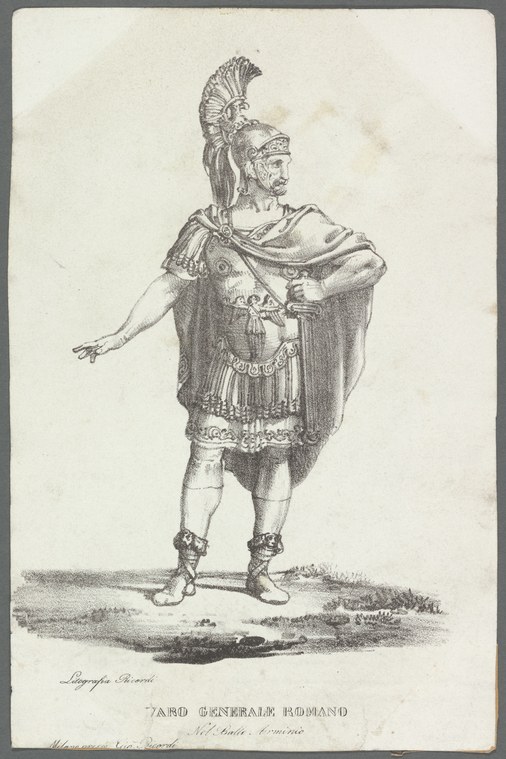
Arminio
Unknown artist
- Collection:
- Prints depicting dance
- Source:
- New York Public Library
- Rights:
- Public domain — free to use, share and adapt.
- Recorded as:
- Public Domain
For dancers and dance historians, this work illuminates the formal, sculptural quality of eighteenth-century theatrical training and the neoclassical aesthetic that governed both dramatic and dance performance. The engraving documents the precise vocabulary of theatrical gesture and carriage that dancers would have learned and understood.
What you are looking at
A single male figure in classical Roman military dress stands in a contrapposto pose against a plain background. He wears a crested helmet with an elaborate plume, a short pleated skirt (pteruges), and a draped cloak fastened at the shoulder. His right arm extends outward in a gesture of address or declamation. His left leg bears ornate greaves or leg armor. The figure is rendered in fine black ink on cream paper, using cross-hatching to model the form and create depth in the drapery. The engraving captures a moment of theatrical address or command, with the body weight shifted onto the back leg, creating a dynamic but controlled stance.
The dancing
The single figure demonstrates a formal, upright carriage typical of neoclassical representation. The extended right arm and open palm suggest oratory or dramatic gesture rather than movement through space. The weight distribution and rigid posture indicate a moment of stillness and dignified presentation rather than active dance. The contrapposto stance—weight on one leg with the other slightly relaxed—suggests theatrical convention rather than the flowing movement of social dance.
The dance depicted
This appears to be a theatrical or dramatic pose rather than a representation of dance proper. The figure exemplifies the declamatory stance of classical Roman theater or neoclassical stage performance. While not depicting social or ceremonial dance, the work captures the formal body language and gestural vocabulary of theatrical performance, which in the eighteenth century shared training and aesthetic conventions with dance. The military costume and formal address suggest this may represent a scene from an opera seria or tragedy with a Roman theme.
How it was made
This is a fine engraving executed in black ink on paper, likely created in the eighteenth century. The technique employs delicate cross-hatching and parallel lines to build tone and suggest three-dimensional form, particularly in the rendering of fabric and armor. The precision and finish indicate professional production, probably for publication or circulation as a single print or as part of a larger series illustrating theatrical costume and performance.
About this work
This engraving depicts a classical Roman warrior or orator in a formal theatrical pose, rendered with the precision and elegance characteristic of eighteenth-century theatrical costume prints. The work belongs to a tradition of neoclassical illustration that documented the visual language of stage performance, including the formal poses, gestures, and sartorial choices that governed theatrical presentation. While not a dance scene per se, it represents the codified body language of theatrical culture, which was intimately connected to dance training and convention in the period.
How to look at it
Observe the precise balance and alignment of the figure—the way the plume of the helmet extends vertically, anchoring the composition, and how the extended arm creates a diagonal line of force. Notice the careful articulation of the drapery, which falls in classical folds and reveals the sculptor's eye at work. The moment chosen is one of pause and formal address: the figure is caught not in motion but in the stasis of theatrical declamation.
The artist
The artist is not recorded in the catalogue, but the signature or inscription visible at the lower left ("Bourgois Pinxit" or similar) may identify the designer. The print itself was likely engraved by a specialist craftsman. The style is consistent with mid-to-late eighteenth-century theatrical costume illustration, a popular genre across Europe.
The period
This work was created during the height of neoclassicism, when European theater and visual culture were preoccupied with reviving classical forms and aesthetics. In this period, dance and drama were closely linked; dancers trained in the same academies, and the formal deportment and gestural vocabulary were shared. Theatrical costume prints were widely collected and circulated, serving as documents of stage fashion and as models for aspiring performers.
Where it lives
The work is part of the New York Public Library's Prints collection, which documents theatrical and dance imagery from the sixteenth through nineteenth centuries. This engraving belongs to a larger body of costume and character documentation associated with opera and dramatic performance.
Questions about this work
Is this a dance?
Not in the strict sense of social or recreational dance, but rather a theatrical pose. In the eighteenth century, however, dancers and actors trained together, and the formal body language and gestural vocabulary seen here would have been familiar to both. This print documents the neoclassical aesthetic that governed both dance and dramatic performance.
What is the figure's costume?
Classical Roman military dress, including a crested helmet with a tall plume, a short pleated military skirt (pteruges), greaves or leg armor, and a draped cloak or mantle. This costume identifies the figure as a warrior or general, likely from an operatic or dramatic work with a classical theme.
Why would a dance gallery include this?
Because it documents the formal training, gestural language, and aesthetic ideals that shaped eighteenth-century dance. The neoclassical style and the codified body language visible here reflect the same cultural moment and visual principles that governed ballet and theatrical dance.
More dance artwork





