49 works in this view — arrow keys or swipe to move between them.
Dance in Art
Arminio
Unknown artist
- Collection:
- Prints depicting dance
- Source:
- New York Public Library
- Rights:
- Public domain — free to use, share and adapt.
- Recorded as:
- Public Domain
This work is instructive primarily as a negative case: it shows how Renaissance artists rendered classical dress and formal gesture, and why such images cannot be assumed to depict dance even when they dress figures in theatrical garments. For historians studying how classical knowledge was visualized and circulated, it is valuable; for dance history, it is a reminder that not every classical or theatrical image is a dance image.
What you are looking at
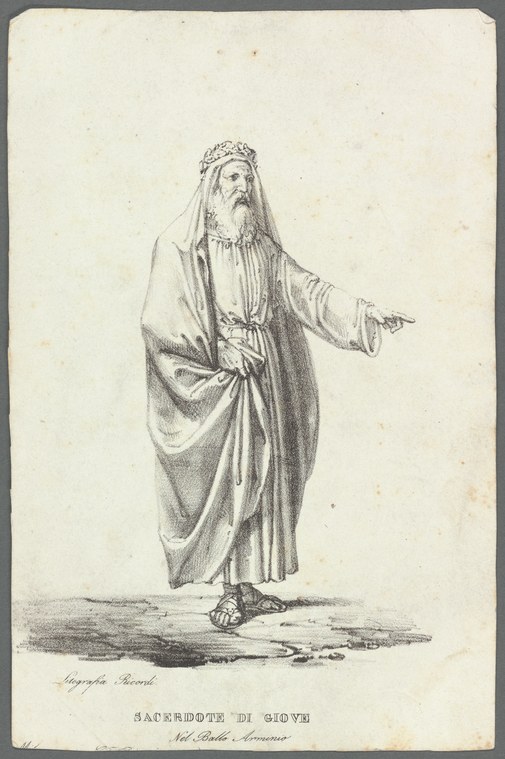
A single figure in classical drapery stands against an empty background, rendered in fine line engraving. The man wears a long pleated tunic gathered at the waist with a broad sash, over which falls a voluminous cloak or himation. His hair is long and bound with a wreath or crown; his beard is full and elaborately rendered. His left arm extends outward in an oratorical or declamatory gesture, the palm open, while his right hangs at his side. He stands in a contrapposto stance on a minimal ground line. The technique is precise and classical, with careful attention to the fall of fabric and the modeling of form through parallel lines. The inscription at the base reads "Sarcerdote di Giove / Nel Balbi Amminiani," identifying him as a priest of Jupiter from a classical source.
The dancing
A single standing male figure whose posture is fundamentally static rather than dynamic. The weight rests evenly on both feet, and while the extended left arm suggests speech or address, there is no weight shift, no transfer of balance, and no indication of rhythmic movement. The body is frontal and formal. This is a pose of authority and proclamation rather than the embodied, weight-committed posture of dance.
The dance depicted
This image does not depict dance. Although the classical dress and the formal theatrical pose might superficially suggest a classical theatrical scene, the figure's stance, the absence of any partner or group, and the oratorical rather than kinetic gesture all point to a representation of classical statuary or a figure from history or mythology rather than a dancer. The extended arm is an attribute of speech or command, not movement. The catalogue record's identification as "Arminio" (Arminius, the Germanic chieftain) or as a priest of Jupiter suggests the image is documenting a historical or legendary figure, likely from a Renaissance or early modern source text.
How it was made
This is a fine engraving on paper, executed with the characteristic precision of line-work that defines the form through parallel hatching and careful modeling. The technique allows for clear reproduction and wide circulation; the inscription in Italian suggests this is from an Italian source, likely a published set of prints documenting classical figures or theatrical characters. Engravings such as this were common in the 16th and 17th centuries as illustrations for humanist texts, theatrical treatises, or antiquarian studies.
About this work
This is a classical figure study in engraving—a representation of a historical or mythological personage (identified variously as the priest Jupiter or possibly derived from a theatrical or literary source) rather than a dance document. It belongs in a dance archive only because it was catalogued there; the image itself shows no dancing, no dancers, and no kinetic principle. It is a study of classical dress and bearing, executed in the formal vocabulary of Renaissance engraving, and represents the scholarly interest in reconstructing classical forms that animated humanist art of the period. The pose and drapery follow the conventions of classical statuary and theatrical costume, not the movement vocabulary of any dance tradition.
How to look at it
Observe the careful attention to the fall and fold of the drapery—the pleats of the tunic, the weight and volume of the cloak. Note the formal frontality of the pose and the static balance. The extended left arm should be read as a gesture of speech or authority (in the classical rhetorical tradition), not as a movement gesture. Compare this to images of actual dancers from the same period: the difference in body weight, in dynamism, and in the relationship between figure and ground will be immediately apparent. This is a figure at rest, performing an attribute or office, not an action.
The artist
The artist is not recorded. The style and technique suggest a 16th- or 17th-century Italian engraver working in the tradition of classical figure studies. The inscription credits a source ("Nel Balbi Amminiani"—possibly a printed text or collection), suggesting this is a reproductive engraving rather than an original composition.
The period
This image belongs to the Renaissance humanist tradition of studying and reconstructing classical antiquity. In the 15th and 16th centuries, scholars and artists were intensely engaged in recovering classical texts, costume, and gesture. Engravings like this one were often published as illustrations to theatrical treatises, classical histories, or antiquarian studies. They documented how classical figures were imagined to have dressed and carried themselves, and they circulated these images widely among educated readers. This was the age of learned pageantry and classical revival in theatrical spectacle, but this particular image is scholarly reconstruction rather than a document of actual performance.
Where it lives
Held in the New York Public Library's collection of prints depicting dance. The work is catalogued there but no artist, date, or publication details are recorded. It appears to be from a published series of classical figure studies, likely Italian, from the 16th or 17th century.
Questions about this work
Why is this in a collection of dance prints if there is no dance?
The theatrical costume and classical subject matter likely led to its cataloguing as a dance-related image, but the image itself shows no kinetic activity and no dancing. It is a historical or mythological figure study rendered in the formal vocabulary of classical dress and Renaissance engraving. This is a reminder that costume and theatrical context do not automatically indicate dance.
What does the inscription mean?
It reads "Sarcerdote di Giove / Nel Balbi Amminiani," identifying the figure as a priest of Jupiter and crediting a source text or collection (possibly the Balbi or Amminiani collections). This suggests the print is documenting a classical or legendary figure from a printed scholarly or theatrical source rather than from direct observation.
Is this a ballet or theatrical pose?
No. While the figure wears theatrical or classical dress, the posture is static and formal—a pose of authority and address rather than movement. The extended arm follows the classical convention of oratorical gesture. This is a representation of a figure at rest, not a dancer in action.
More dance artwork





