49 works in this view — arrow keys or swipe to move between them.
Dance in Art
Arminio
Unknown artist
- Collection:
- Prints depicting dance
- Source:
- New York Public Library
- Rights:
- Public domain — free to use, share and adapt.
- Recorded as:
- Public Domain
For dance historians, this work illustrates how operatic and dramatic subjects were disseminated through engravings to audiences who might never see a live performance. The image reveals the iconography and emotional register associated with a classical hero—the costume, the attributes, the posture of dignity in suffering—that would have framed choreographic treatment of the same character on stage.
What you are looking at
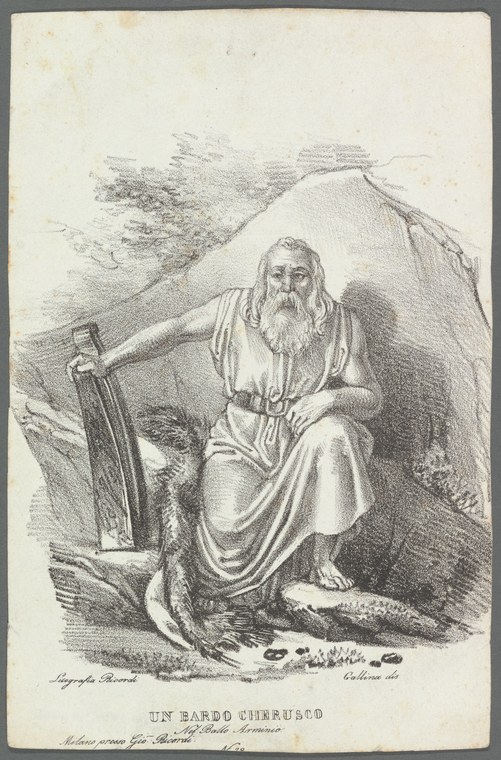
An old man with a long flowing beard sits alone on rocky ground, dressed in classical drapery that falls loosely around his seated form. He holds a double-headed axe or labrys across his lap, the tool of a woodcutter or laborer. Behind him rises a dramatic rocky outcrop or mountainside, with wind-bent trees leaning away from the peak, their branches swept by invisible force. The composition is intimate and melancholic: the figure is turned slightly, gazing downward or into middle distance, his posture one of rest or weariness. At his feet lie scattered stones and what may be tools. The scene is rendered in fine black and white line work characteristic of 19th-century engraving, with careful cross-hatching to model form and suggest the texture of cloth, flesh, and stone.
The dancing
A single seated male figure dominates the composition. His weight rests fully on the ground, one leg extended, the posture slack and heavy—this is not an active or dynamic pose. The axe rests passively across his lap rather than being wielded. His bearded face is turned away from the viewer in a pose of contemplation or sorrow. The drapery hangs without tension, pooling around his hips and legs. There is no suggestion of movement, balance, or the controlled musculature that dance requires. The body is at rest.
The dance depicted
This image does not depict dance. The figure is stationary and contemplative, the pose one of repose rather than movement. The costume and setting invoke classical or operatic tradition—the title 'Arminio' refers to the historical Germanic warrior Arminius, subject of numerous Renaissance and Baroque operas and dramatic works—but the moment chosen is one of stillness, not performance or choreography. Any dance associated with the operatic character would occur in a different scene; this engraving captures a moment outside the dancefloor or stage.
How it was made
This is a line engraving, identifiable by the fine parallel lines (hatching and cross-hatching) used to create tone and model three-dimensional form. The technique was well-established for reproductive and original prints by the 19th century and allowed wide circulation among educated audiences. The delicate gradations of light and shadow—particularly in the rendering of the drapery and the face—demonstrate skilled burin work. The engraving process was labor-intensive and therefore reserved for subjects deemed worthy of investment; the presence of a classical or historical subject here suggests the print was intended for a cultured audience familiar with operatic and literary tradition.
About this work
This engraving depicts Arminio, the historical figure known in Renaissance and Baroque opera and drama, in a moment of solitary repose. The figure sits apart from the world, contemplative and weary, holding the tools of labor. Although 'Arminio' is the title of several operas and dramatic works that would have included dance and spectacle, this particular image isolates a moment of stillness—a character study rather than a scene of action. It belongs in a dance archive not because it shows dance, but because it documents how a danced or dramatically performed character was imagined and circulated in print culture.
How to look at it
Attend to the deliberate stillness of the pose and the artist's choice to show the character in a moment of contemplation rather than action. The weathered face, the heavy drapery, and the tool in hand establish 'Arminio' as a man of labor and struggle. The rocky landscape and wind-bent trees heighten the sense of solitude and classical dignity. The engraving technique itself—the visible labor of the burin—asks the viewer to spend time with the image, tracing the lines that build form, much as one might study a written character portrait.
The artist
The artist is not recorded in the catalogue. The engraving is signed or inscribed at the lower left and right margins, but these details are not fully legible in the image. The style and subject matter are consistent with 19th-century European reproductive or original printmaking, likely Italian or French in origin given the operatic subject and the inscription language.
The period
Arminio was a popular subject in European opera and drama from the 16th century onward, particularly during the Baroque and Classical periods when historical and classical subjects dominated the repertory. Engravings of operatic characters, scenes, and celebrated performers were a major form of cultural circulation, allowing those without access to theaters to imagine and discuss celebrated productions. By the 19th century, when this print was likely made, such engravings served both as commemoration of past performances and as illustrations of character types and dramatic moments.
Where it lives
The work is held in the Prints collection of the New York Public Library, catalogued under 'Prints depicting dance' despite the absence of active choreography. This placement reflects the collection's interest in operatic and dramatic imagery and the characters whose stories shaped European performance tradition.
Questions about this work
Is this image actually about dance?
No. It depicts a character at rest, not in performance. It is included in a dance archive because the figure is drawn from operatic and dramatic tradition, and understanding how such characters were imagined and printed helps contextualize the choreography created for them on stage.
Who was Arminio?
Arminio (Arminius in Latin) was a Germanic warrior who led a confederation of tribes against Roman occupation in 9 CE. He became a symbol of nationalist resistance and heroic dignity, and was celebrated in Renaissance and Baroque opera, drama, and visual art. The figure's popularity in European culture made him a natural subject for operatic treatment and dramatic illustration.
Why is an old man holding an axe?
The axe is a laborer's tool, establishing Arminio as a man of action and strength rather than courtly refinement. The classical drapery and the solitary, dignified pose transform the tool into a symbol of noble suffering and endurance, fitting for the tragic or historical drama the image represents.
More dance artwork





