49 works in this view — arrow keys or swipe to move between them.
Dance in Art
Arminio
Unknown artist
- Collection:
- Prints depicting dance
- Source:
- New York Public Library
- Rights:
- Public domain — free to use, share and adapt.
- Recorded as:
- Public Domain
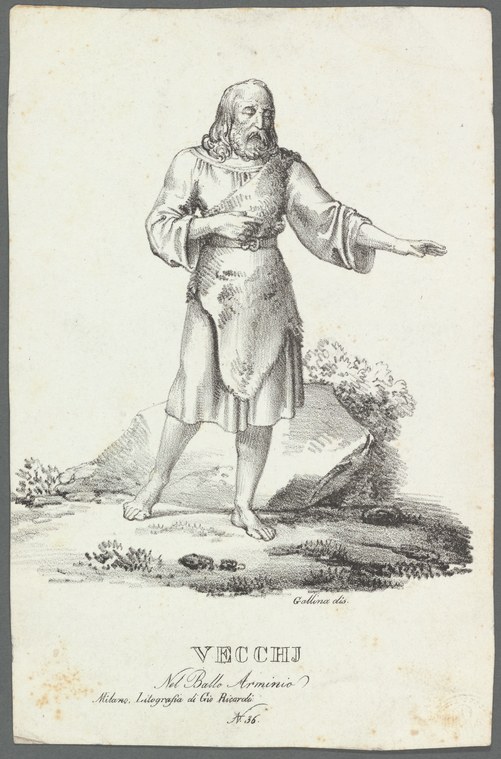
The print documents how classical subjects and costume were imagined and performed in theater during the 18th or 19th century, and how theatrical movement—including gesture and pantomime—could be understood as cognate with dance. It shows the material culture of costumed theatrical performance and the visual conventions used to convey classical character.
What you are looking at
A solitary male figure stands barefoot on rocky ground scattered with small plants and shrubs, posed in a gesture of address or declamation. He wears simple draped clothing—a short tunic or kilt with full sleeves—of the kind associated with classical antiquity or its imaginative reconstruction. His stance is frontal and open, weight evenly distributed, with one arm raised to chest height and the other extended outward in a gesture of speech or appeal. The figure's bearing is dignified and theatrical rather than relaxed; the sparse landscape and solitary placement give the image an allegorical or representational quality, as though the figure is meant to embody a concept or character rather than depict a moment from lived experience. The engraving technique renders the form with fine hatching and clear contours, creating strong graphic definition.
The dancing
The single figure occupies the center of the composition with classical contrapposto suggested but not fully realized—the weight is not clearly shifted to one leg, giving the pose a more frontal formality. The raised arm position and open torso suggest an orator or actor in classical dress rather than a dancer in motion. There is no partner, no closed hold, and no clear indication of rhythmic or coordinated movement. The gesture reads as pantomime or dramatic address rather than dance vocabulary.
The dance depicted
The figure's pose and costume evoke classical or neoclassical theatrical convention rather than any identifiable dance form. The inscription—partially visible as 'Odalisque' or similar—and the title 'Arminio' (Arminius) suggest this is a character from classical drama or operatic narrative. The pose may represent a moment from a dramatic scene that incorporates gestural movement or pantomime, but there is no clear evidence of balletic, courtly, or folk dance technique. The work appears to document theatrical costuming and classical pose rather than active dancing.
How it was made
This is an engraving, likely 18th or 19th century, executed with fine lines and cross-hatching characteristic of hand-engraved reproductive prints. The technique allowed precise definition of form and drapery and made the image reproducible and widely distributable. The print's inclusion in a collection titled 'Prints depicting dance' suggests it was catalogued as dance-related, but the engraving's primary function may have been theatrical or antiquarian documentation rather than dance promotion.
About this work
This engraved print depicts a male figure in classicizing theatrical dress in a pose of oratorical or dramatic gesture, with the title identifying the subject as Arminio (Arminius). The work sits at the intersection of neoclassical costume study, theatrical documentation, and antiquarian interest in classical subjects. Its inclusion in a dance collection likely reflects the fluid boundary between theatrical gesture, pantomime, and dance in period understanding, or a broader cataloguing of costumed figure studies.
How to look at it
Pay attention to the precise positioning of the limbs and the symmetry of the pose—this is a formal presentation of a classical character type rather than a captured moment of movement. The engraving's fineness and clarity suggest this was meant to be studied as a model for costume, bearing, and classical style. The spare background and frontal placement emphasize the figure as a type or archetype rather than a naturalistic scene.
The artist
The artist is not recorded. The style and technique suggest a professional reproductive engraver working in the 18th or 19th century, creating prints after drawings or paintings for circulation among a educated or theater-interested public.
The period
The work reflects the widespread European fascination with classical antiquity that shaped both neoclassical art and theatrical practice in the 18th and 19th centuries. Classical dramatic subjects, including historical figures like Arminius, were regularly staged in opera, spoken drama, and pantomime, with considerable attention paid to historical costume. The theatrical vocabulary of the period freely blended dance, pantomime, gesture, and spoken word, and costume prints like this one circulated as reference material and popular imagery.
Where it lives
The work is held in the New York Public Library's collection of prints depicting dance. The cataloguing reflects the library's broad interpretation of dance-related imagery to include theatrical costuming, gesture, and classical subject matter.
Questions about this work
Is this actually a dance?
It depicts a figure in a posed gesture rather than active dancing. The work likely belongs in a dance collection because it documents how classical theatrical characters—who might perform choreographed movement, pantomime, or gesture—were costumed and presented. The boundary between theatrical gesture and dance was less fixed in the 18th and 19th centuries than it is now.
Who was Arminio?
Arminius (Arminio in Italian opera and theater) was a Germanic chieftain who defeated Roman legions. The figure became a subject for neoclassical opera, drama, and pantomime across Europe, representing themes of heroic resistance and classical virtue.
Why is a figure in classical dress in a collection of dance prints?
The collection documents the visual culture of dance and theatrical movement more broadly. Costume prints, studies of classical character types, and images of pantomime and gesture were understood as part of the same cultural world as dance performance.
More dance artwork





