49 works in this view — arrow keys or swipe to move between them.
Dance in Art
Night dances in Hapaee
Unknown artist
- Collection:
- Prints depicting dance
- Source:
- New York Public Library
- Rights:
- Public domain — free to use, share and adapt.
- Recorded as:
- Public Domain
This engraving is a primary record of how Pacific dance was seen and represented in the era of European exploration, and what visual conventions shaped that representation. For scholars of dance history and Pacific cultures, it offers evidence of both the dance itself and the attitudes and visual literacy that colonial-era observers brought to it. The image's circulation in print meant it shaped European understanding of the Pacific for generations, making it a key document in the history of how dance is mediated, interpreted, and translated across cultural and geographic distance.
What you are looking at
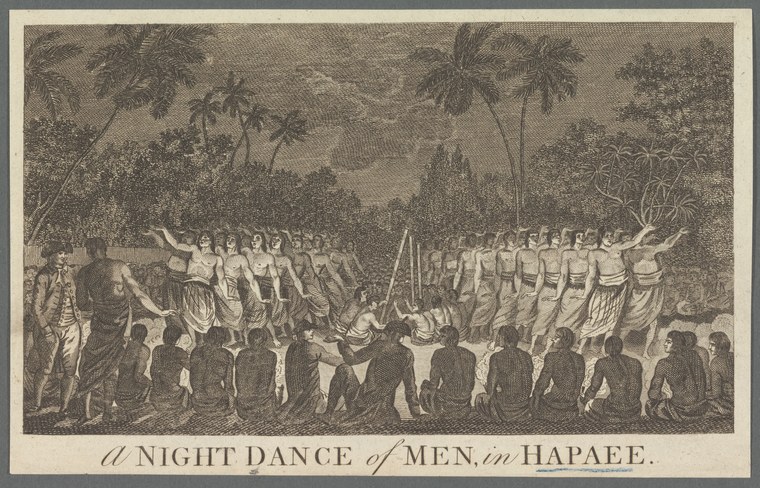
This engraving depicts a nocturnal gathering in Hapaee (Tahiti) arranged in a clearing ringed by palms and tropical vegetation. Two parallel lines of figures face each other across an open space: one line consists of lightly-clad male dancers in motion, the other of seated or reclining spectators, their bodies rendered in darker tones. The dancers gesture with raised arms and inclined torsos. A single standing figure in European dress—presumably a European observer—stands at the left margin, watching. The tropical setting is rendered through dense foliage at top and sides, and the nocturnal atmosphere is suggested by the engraving's overall tone and the title's specification of night. The composition emphasizes the contrast between the active dancers and the watching crowd, framing this as a spectacle observed by an outsider.
The dancing
The male dancers stand or move with arms raised and bodies angled, suggesting rhythmic motion across the open ground. The seated or supine figures form an audience arranged in ranks, their stillness contrasting with the dancers' activity. No pair-work or closed holds are evident; the movement appears to be individual or coordinated group gesture rather than partnered dance. The European figure's stillness and separated position mark him as an observer from outside the community. The pose and framing suggest a display or ceremony rather than social recreational dancing.
The dance depicted
This depicts night dances of men in Hapaee (likely Hanaei or another Tahitian location), documenting a Pacific Indigenous dance practice as witnessed or understood by European observers in the eighteenth or early nineteenth century. The image shows what was likely a ceremonial or display dance rather than everyday social dance. The gender-separated arrangement—active male dancers with a watching crowd—and the nocturnal timing suggest a ritual or prestigious performance context. Without identifying ethnographic documentation alongside the image, the specific dance cannot be named with confidence, but the composition records a moment of performance and observation that shaped early European understanding of Tahitian movement practices.
How it was made
This is an engraving, a relief-printing technique that allowed wide circulation in the eighteenth or early nineteenth century. The uniform tonal values, use of parallel line-work for shading, and compositional clarity are characteristic of copper-plate engraving. The technique's capacity for fine detail and reproducibility made it the standard medium for circulating images of exploration and ethnographic observation. This work likely appeared in a travel narrative or natural history publication, reaching educated European audiences interested in the Pacific.
About this work
This engraving documents a night dance in Hapaee as it was observed and recorded by European travellers. It belongs to a significant body of printed ethnographic imagery from the era of Pacific exploration, most likely the late eighteenth century. The work captures not the dance itself in its lived context, but rather a European visual encounter with it—a moment of spectatorship arranged and frozen for circulation in print. It is historically valuable as evidence of what early modern European observers chose to represent about Pacific dance and how they framed it: as a spectacle, a display, a rite of the colonial moment. For a gallery of dance in art, it represents the intersection of actual Pacific dance practice and European visual culture, and the power of engraved images to shape how unfamiliar movement practices were understood across continents.
How to look at it
Notice the deliberate separation of active dancers from watching bodies, and the positioning of the European observer at the margin—these compositional choices frame the dance as a spectacle for viewing rather than as a participatory event. Observe the gesture of the dancers: the raised arms and angled torsos suggest rhythmic motion but do not convey the specific footwork or connection to music that would make the dance style legible. The nocturnal setting is indicated more by title and context than by visual means; the engraving's technique does not readily convey darkness. The work is best read not as an accurate record of the dance itself, but as an image of the moment of European observation and the visual language available to represent Pacific movement to a European public.
The period
This work was produced during the era of Pacific exploration, most likely the 1770s–1820s, when European travel narratives and natural history publications generated an enormous appetite for engravings of exotic lands and peoples. Tahiti and the broader Pacific held particular fascination following the voyages of Cook and others, and printed images of Pacific life reached a wide middle-class audience. The engraving format was standard for such publications, allowing detailed but highly mediated representations of Indigenous cultures to circulate widely and shape European imagination. Dance, along with dress and bodily ornament, was a key marker of cultural difference in these narratives and was frequently depicted as exotic spectacle rather than as skilled practice or lived ritual.
Where it lives
This engraving is held in the New York Public Library's collection of prints depicting dance. Such prints were typically produced in series as part of travel narratives or natural history compilations and were intended for a broad educated audience.
Dance in this work
Questions about this work
Is this a reliable record of how Tahitian people actually danced?
The engraving documents what a European observer saw and chose to represent, filtered through European visual conventions and the limitations of the engraving medium. It shows posture, gender roles, and group arrangement, but the specific footwork, music, and cultural meaning are invisible or lost. It is more valuable as a record of colonial-era visual culture than as ethnographic documentation.
What is 'Hapaee'?
The geographic reference in the title is uncertain; it may refer to Hanaei or another Tahitian location, or the name may be a European corruption of a local place-name. Without additional documentation from the source publication, precise identification is difficult.
Why are the dancers separated from the audience?
The arrangement may reflect an actual ceremonial or ritual structure in which dancers performed for spectators, or it may be an imposed European interpretation of the event. The presence of the European observer at the margin of the composition suggests this is a scene of contact and observation rather than documentation of an unmediated practice.
More dance artwork





