49 works in this view — arrow keys or swipe to move between them.
Dance in Art
Dancing couple, with poem beginning "Um a Drei"; Jugend
Unknown artist
- Collection:
- Prints depicting dance
- Source:
- New York Public Library
- Rights:
- Public domain — free to use, share and adapt.
- Recorded as:
- Public Domain
This work shows that by 1900, ballroom dancing had become so codified and laden with social anxiety that it could serve as the primary vehicle for social satire. For dance historians, it documents the gulf between the formal requirements of ballroom dance and the psychological experience of those who performed it—a tension that would define much early twentieth-century dance reform and the rise of modern dance as a reaction against such constraint.
What you are looking at
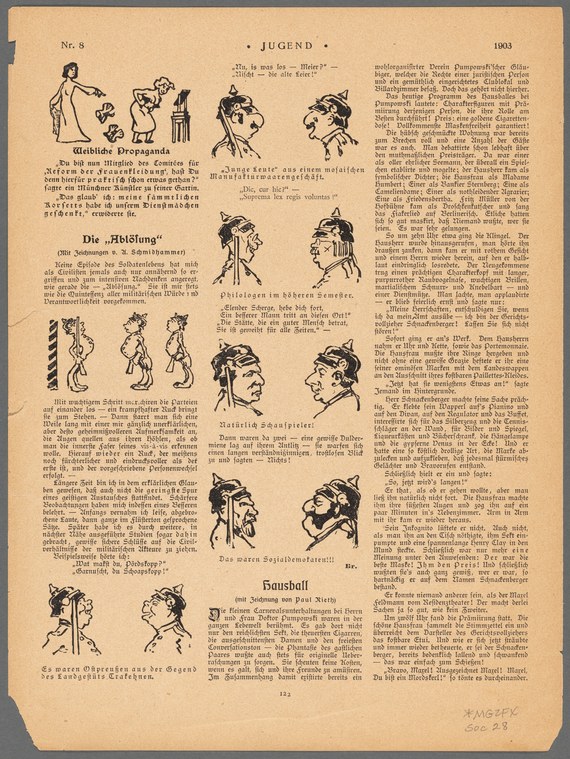
This is a page from the German arts journal *Jugend* (Youth), dated 1903, filled with satirical line drawings of social dancing and courtship. The page presents multiple vignettes, each a small sketch capturing different moments and attitudes. At the top is a section titled "Gätzliche Propaganda" showing simplified figures in various poses of flirtation and approach. Below that, a larger section called "Die 'Haltung'" (The Posture or Bearing) occupies the center, with a series of comic head studies and full-length figures of dancers and courting couples in exaggerated attitudes—stiff spines, pursed lips, self-conscious gestures. The figures wear period dress: men in suits and hats, women in high-collared blouses and long skirts typical of the 1900s. At the bottom, a section titled "Hätzlich Gesellspiele" (Courtship Games) returns to full-figure couples, some in dance positions. The entire composition uses ink line drawing with high contrast against the aged paper, typical of journal illustration. The tone is mockingly observational: the artist captures the awkwardness and self-consciousness of ballroom manners and the rituals of heterosexual encounter, finding comedy in stiffness and affected posture.
The dancing
The bodies throughout are rendered with exaggerated angularity and tension, emphasizing psychological discomfort over physical fluidity. Dancers appear rigidly postured, with stiff spines, bent elbows held at sharp angles, and heads tilted in studied nonchalance. Couples stand in what appears to be closed ballroom position—one pair shows a man's hand at a woman's waist and her arm raised—but the artist has caricatured the formality into something tense and uncomfortable. Feet are barely indicated; the focus is on the upper body and facial expression. Individual studies show men with pursed lips and sideways glances, women with tilted chins and raised eyebrows, all conveying self-consciousness rather than pleasure in movement.
The dance depicted
These are social ballroom dances of the belle époque, most likely the waltz or foxtrot—dances requiring a closed hold and upright posture. The *Jugend* journal was a vehicle for satirizing contemporary life and manners, and this page uses dance as a lens for observing courtship ritual and gender performance in the modern city. The artist is not documenting how the dance was *done* technically, but rather how it *felt*—as a anxious, regulated performance of propriety. The exaggeration suggests the artist saw ballroom dancing as a social necessity rather than a natural pleasure, a view consistent with fin-de-siècle critique of bourgeois artifice.
How it was made
This is a line-drawn illustration printed in an art journal, likely lithography or photomechanical reproduction of pen and ink drawings. The technique produces sharp, crisp line work with no shading—all expression comes from contour and composition. This medium was ideal for satirical and comic illustration and reached a broad educated readership through *Jugend*, which circulated across the German-speaking world. The speed and directness of pen line suggests an artist working quickly to capture psychological nuance rather than anatomical accuracy, which is precisely what the satirical project required.
About this work
This page from *Jugend* magazine (1903) uses ballroom dancing as a vehicle for satirizing bourgeois courtship rituals and social anxiety in Edwardian Germany. The anonymous artist captures dancers in closed ballroom position—likely waltzing or performing a similar social dance—but renders them with exaggerated stiffness and self-consciousness to mock the artificiality of middle-class manners. The work sits at the intersection of social observation and visual humor, using dance not as a subject for celebration but as a mirror held up to contemporary pretension. It belongs in a dance art gallery as evidence of how dance functioned as social performance and as a canvas for satirical critique of the society that produced it.
How to look at it
Look first at the postures: almost no figure is at ease. Spines are locked, chins are lifted in studied indifference, arms and hands are positioned with visible tension. The artist has frozen the moment not at the peak of movement but in the pause—the held position—where the regulation of the body is most visible and most ridiculous. Notice too the faces: the men study the women, the women look away; everyone is aware of being watched. This is satirical observation of social dance as performance of status and propriety, not as physical pleasure. The small scale and repetition of the figures—multiple couples in slightly different attitudes on a single page—is itself a satirical device, as if to say: this is all the same anxious ritual, endlessly repeated.
The period
In 1903, ballroom dancing was the primary social dance of the European bourgeoisie and a strictly regulated arena of courtship and class performance. The waltz had dominated since the nineteenth century; the foxtrot and one-step were just arriving from America and generating moral anxiety. *Jugend*, founded in 1896, was a leading journal of modernism and social commentary, publishing work by major illustrators and designers and offering sharp visual critique of contemporary life—urban, sexual, commercial, and political. This page reflects the journal's irreverent stance toward bourgeois manners and its use of humor and caricature as a tool of cultural analysis. The fin-de-siècle saw growing critique of ballroom dancing as artificial, repressive, and life-denying—a critique that fed directly into the early modern dance movement and the work of choreographers like Isadora Duncan.
Where it lives
This page is held as part of a collection of prints depicting dance in the New York Public Library. It is a printed page from *Jugend*, a Munich-based weekly arts journal that circulated widely in German-speaking Europe from 1896 onward.
Dance in this work
Questions about this work
What dance is being shown?
The figures appear to be dancing a social ballroom dance, most likely the waltz or foxtrot, based on the closed hold and upright posture. However, the artist's primary interest is in the social and psychological dimensions of ballroom dancing rather than in technical accuracy about the specific style.
Why are the dancers drawn so stiffly?
The stiffness is intentional and satirical. The artist is exaggerating the formal posture required by ballroom dance etiquette to mock the artificiality and emotional repression built into bourgeois social ritual. The bodies are meant to look uncomfortable because that is the point.
Who was *Jugend* and why did it publish dance imagery?
*Jugend* was a leading modernist arts journal published in Munich from 1896 onward. It used visual satire and social commentary to critique contemporary life, including courtship, gender relations, and urban manners. Dance was a perfect subject because it made social performance and regulation visible in the body.
What does this tell us about dance in 1903?
It shows that ballroom dancing was so heavily codified and laden with rules about posture, distance, and propriety that it had become a target for critique and satire. This rigidity would feed directly into the modern dance movement's rejection of ballroom convention in favor of natural movement and emotional authenticity.
More dance artwork





