49 works in this view — arrow keys or swipe to move between them.
Dance in Art
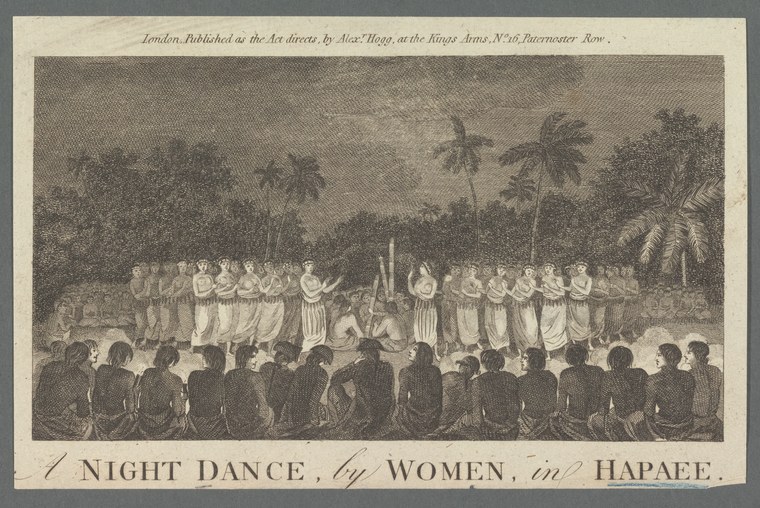
Night dances in Hapaee
Unknown artist
- Collection:
- Prints depicting dance
- Source:
- New York Public Library
- Rights:
- Public domain — free to use, share and adapt.
- Recorded as:
- Public Domain
This print is one of the earliest European engravings of Polynesian dance, capturing a performance tradition at a moment of first sustained European contact. For dance historians, it provides crucial visual evidence of line-based, non-partnered dance structures in the Pacific and shows how these dances were formally organized and socially valued. For art historians, it exemplifies the aesthetic strategies 18th-century engravers used to render unfamiliar bodies and landscapes for European audiences, revealing assumptions about what was visually and culturally significant.
What you are looking at
A night gathering in Ha'apai, Tonga, depicted in this 18th-century engraving, shows two facing lines of figures arranged around a central space under a canopy of palm trees. The background line consists of approximately 12–14 figures in light dress, standing or moving in formation; the foreground shows a similar number of darker silhouettes seated on the ground, facing inward. The setting is tropical and open-air, lit as if by moonlight or firelight, creating strong contrasts between the illuminated dancers and deep shadows. The composition suggests a formal, ceremonial arrangement rather than free movement, with the two groups oriented toward a shared performance space. Palm fronds and dense foliage frame the scene, establishing the Pacific island setting.
The dancing
The figures are arranged in two parallel lines facing each other across an open space, a formation typical of many Pacific dances. Those standing in the rear line appear to be in upright postures, some with arms extended or raised; those seated in the foreground maintain an attentive, watching position. The bodies are not pressed together in a close hold but are distinct and individually visible, suggesting a line formation rather than partnered dance. There is no visible footwork detail in the engraving, but the overall posture and arrangement indicate coordinated, disciplined movement rather than free improvisation.
The dance depicted
This is most likely a depiction of traditional Hawaiian or broader Polynesian circle or line dance, possibly a hula or a related form of social gathering dance. The title 'Night Dance' and the tropical setting point toward Pacific island practices; the formal two-line arrangement is consistent with documented hula formations or similar Oceanic dances performed in ceremonial or social contexts. The separation of standing and seated figures may reflect different roles within the dance—performers and observers, or successive verses of a multi-part piece. Without additional documentation, the specific dance form cannot be definitively identified, but the image demonstrates a non-European dance tradition performed in a formal, structured manner.
How it was made
This is an engraving, a medium that allows fine linear detail and was widely used in the 18th century for the dissemination of travel narratives and ethnographic imagery. The technique's reliance on line and crosshatching creates the strong tonal contrasts visible here—the brilliance of the light clothing and foliage against the solid blacks of the foreground figures and shadows. Engravings of this type were produced for circulation among educated audiences in Europe and were typically bound into travel accounts or natural history collections, making them a primary means by which Europeans encountered images of Pacific island cultures. The skill required to render tropical vegetation and complex figure groupings suggests a print made for publication rather than a preliminary study.
About this work
This engraving documents a formal nocturnal gathering dance in Ha'apai, Tonga, and is one of the earliest European visual records of Pacific island dance practices. It dates from the era of intensive European exploration and documentation of the Pacific (late 18th century), when such images were in high demand among collectors and readers of travel narratives. The work is significant both as ethnographic testimony—showing the structured, line-based nature of the dance—and as an example of how European printmakers represented non-European movement cultures. It belongs in a dance history collection because it is evidence of how a living, complex dance tradition was understood and translated into European visual form, and what elements of that tradition were deemed significant enough to document and circulate.
How to look at it
Attend first to the overall composition and formation: the print's central achievement is the rendering of two coordinated lines of human figures in organized space. Notice how the artist has used light and shadow to distinguish the standing rear line from the seated foreground; the contrast suggests the simultaneity of the two groups and their relationship to each other. Look at the frame created by the palm trees and foliage—this is a 'framing' device that marks the scene as exotic and bounded, a 'moment' captured from European perspective. The seated figures in the foreground, though darkly rendered, anchor the viewer's eye and create a sense of proximity; we are invited to see the dance as if from their vantage point.
The artist
The engraving is credited to published authorship rather than an artist's signature. It was produced by a commercial print shop (Nick Hogg, at the King's Arms, Fenchurch Row, London) as part of a larger publication documenting Pacific exploration. The engraver remains unrecorded, which was common practice for commercial reproductive prints. Such prints were created by teams of engravers working from sketches or descriptions brought back by travelers; the degree of artistic license or fidelity to eyewitness observation cannot be determined from the print alone.
The period
This print belongs to the age of Pacific exploration and the growth of the illustrated travel narrative as a dominant literary and visual form. In the 1770s–1790s, voyages by James Cook and others generated intense European curiosity about Pacific island cultures, and engravings like this were among the primary means by which those cultures were represented and circulated. In the history of dance, this period saw the rise of ethnographic interest in non-European movement; at the same time, European theatrical dance (ballet and social dance) was becoming more professionalized and codified. This image sits at the intersection: a 'factual' record of distant dance, presented to a European audience through the conventions of 18th-century printmaking, yet inevitably shaped by the medium, the engraver's hand, and European aesthetic expectations.
Where it lives
This engraving is held in the New York Public Library's collection of prints depicting dance. It was published in London by Nick Hogg as part of a travel or natural history publication, indicating it was produced for commercial circulation among educated European readers. The print's presence in a specialized dance collection suggests it has been recognized in modern times as a significant document of dance history, even though it likely originated as a general-audience travel illustration.
Dance in this work
Questions about this work
Is this a real record of what actually happened in Ha'apai?
This print is likely based on a traveler's sketch or description, but it has been translated through multiple stages: observation, drawing, engraving, and commercial production. The broad structures—two facing lines, tropical setting, formal arrangement—may well be accurate, but details of costume, movement, and individual posture should be read as the engraver's interpretation, not as documentary photography. The print is evidence of what Europeans *thought* they saw and what they chose to depict, rather than an unmediated record.
What dance is this, exactly?
The specific dance form cannot be identified with certainty from the image alone. It could be an ancestor of the modern hula, or a form of 'ōta'a (line dance) or similar Pacific tradition. The formal, two-line structure and the mix of standing and seated participants suggest a structured social or ceremonial dance, but without documentary text or additional sources, the precise name and function remain unclear. The title 'Night Dance' may reflect the engraver's interpretation rather than a native name for the form.
Why are some figures seated and some standing?
The most likely explanation is that the two groups have different roles within the performance: one group may be the primary dancers while the other maintains a supporting or observational role, or the dance may have unfolded in verses with alternating participation. Alternatively, the artist may have arranged the figures this way for compositional reasons—to create depth and visual interest. Without additional documentation, the functional meaning of the distinction cannot be established.
Who made this print?
The print was published by Nick Hogg in London, but the engraver who actually cut the image into the copper plate remains unnamed in the catalogue record. This was typical of 18th-century commercial printmaking, where engravers often worked anonymously for a publishing house. The identity of the original artist who sketched the scene (possibly a travel artist aboard an exploration voyage) is also unrecorded.
More dance artwork





