49 works in this view — arrow keys or swipe to move between them.
Dance in Art
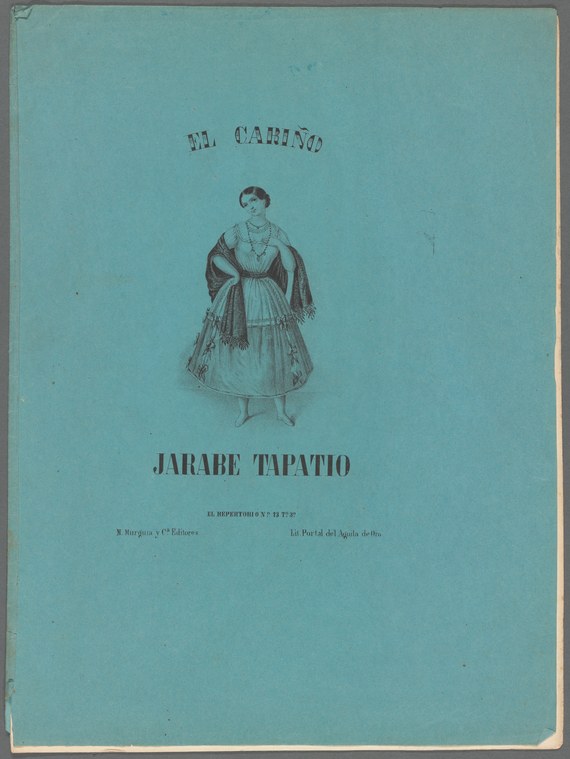
El cariño: jarabe tapatio
Unknown artist
- Collection:
- Prints depicting dance
- Source:
- New York Public Library
- Rights:
- Public domain — free to use, share and adapt.
- Recorded as:
- Public Domain
It documents the nineteenth-century theatrical circulation of Mexican folk dance through European-dominated print networks, showing how the jarabe tapatío entered international culture not as a living practice but as a costume type and stage attraction. The image reveals the gap between dance as embodied practice and dance as costume, spectacle, and subject for foreign consumption.
What you are looking at
A single female figure stands centered against a pale turquoise ground, wearing a voluminous mid-nineteenth-century dress with a fitted bodice and full skirt that extends to mid-calf. The dress appears to be a day or indoor garment in a light fabric, with a white or cream-colored chemise visible at the neckline. Over her shoulders she wears a large dark shawl or rebozo, draped generously and caught at the sides, which falls almost to the hem of the skirt. Her dark hair is styled in the fashion of the 1830s–1850s, pulled back from her face. The figure stands in a relaxed, frontal pose with arms at her sides or lightly holding the shawl, facing the viewer directly. Her posture is upright but informal, suggesting a moment of everyday dress rather than theatrical performance. The simplicity of the composition and the pale background emphasize the figure and her costume.
The dancing
A single standing figure, likely female, shown full-length and frontal. The body is relaxed and still, without the turned-out positioning or lifted carriage typical of ballet. The arms hang naturally or are engaged with the shawl. There is no indication of mid-movement, turned positions, or the flexed engagement of trained dancers; the pose is that of a model displaying costume rather than executing choreography.
The dance depicted
The title identifies this as the jarabe tapatío—the Mexican Hat Dance or Cariño (Affection)—yet the image shows a static, posed figure in street or domestic dress rather than a scene of dancing. The jarabe tapatío is a Mexican folk dance, traditionally performed by a couple or pairs, marked by rapid footwork, rhythmic heel-and-toe work, and playful courtship movement. It is typically accompanied by guitars and violin. This print appears to document costume or character type rather than movement, suggesting it may be a theatrical or promotional image relating to the dance or a play featuring it, rather than a direct representation of the dance in action.
How it was made
A hand-colored lithograph or engraving, likely mid-nineteenth century, to judge from the printing technique and tonal qualities. The figure is rendered in restrained greens and browns over a carefully prepared pale ground, with fine line work defining the shawl and dress details. The inscription at the top and bottom are printed in the same pass. This is a commercial print—likely for theatrical promotion or costume reference—designed for wide circulation in Mexico and Spanish-speaking regions, and to reach audiences interested in folk costume and character types.
About this work
This is a costume study or theatrical character print titled after the jarabe tapatío, the famous Mexican folk dance. Rather than depicting the dance itself, it presents a single standing figure in the street costume and shawl of mid-nineteenth-century Mexico, posed for examination of garment construction and social dress. The print was likely made for theatrical use—as a reference for costume makers, a playbill, or promotional material—rather than as documentary evidence of the dance in performance. It belongs in a dance collection as a historical record of how the jarabe tapatío and Mexican folk culture were mediated through print culture and theater during the nineteenth century, when European and North American audiences were developing appetite for 'national' dance spectacles and exotic costume imagery.
How to look at it
Observe the construction of the costume—the proportion and cut of the full skirt, the drape of the heavy shawl, the fitted bodice—which tells us about the garment's function in daily life and in theatrical representation. Notice that the figure is not dancing: there is no suggestion of weight on one foot, no turned-out position, no lifted frame or engaged arms. The print documents what the dancer wore, not how she moved, and that distinction is important to understanding how dance traveled through visual culture.
The period
The jarabe tapatío emerged in Mexico in the late eighteenth century and became widespread in popular celebration and social dance by the early nineteenth century. During the 1830s–1850s, when this print was likely made, Mexican folk traditions were becoming fashionable in European salons and theaters, often filtered through Romantic-era interest in 'exotic' and 'national' culture. The dance was performed both in Mexico and abroad, and prints like this served multiple functions: documentation of costume, theatrical reference material, and souvenirs of Mexico for foreign audiences. The stylistic and sartorial conventions suggest a date in the second quarter of the nineteenth century.
Where it lives
This is part of the New York Public Library's collection of prints depicting dance. It belongs to the category of popular lithographs and engravings produced for theatrical, entertainment, and costume reference purposes during the nineteenth century.
Dance in this work
Questions about this work
Is this actually a picture of the jarabe tapatío being danced?
No. The title identifies the dance and character type, but the image is a static costume study—a single figure posed for inspection of her dress. This is typical of theatrical prints of the period, which often served as costume reference or promotional material rather than as representations of movement in action.
What is the garment she is wearing?
A day dress or indoor costume of the 1830s–1850s, consisting of a fitted bodice, full skirt, and white chemise at the neckline. Over her shoulders is a dark rebozo or shawl, a versatile garment worn across Spanish-speaking cultures for warmth, modesty, and as a marker of regional identity.
Where would this print have been used?
Likely in theater—as a reference for costume makers, part of a playbill or program, or as promotional material. Prints like this were also sold as souvenirs and images of 'national' costume types to foreign audiences interested in Mexico and Mexican culture.
What is the jarabe tapatío?
A Mexican folk dance originating in Guadalajara, traditionally performed by couples or groups with rapid footwork, heel-and-toe rhythms, and playful courtship interaction. It is typically accompanied by guitars and violin, and by the nineteenth century it had become widely known and performed in theaters across Mexico and internationally.
More dance artwork





