49 works in this view — arrow keys or swipe to move between them.
Dance in Art
Foyer de la danse
Unknown artist
- Collection:
- Prints depicting dance
- Source:
- New York Public Library
- Rights:
- Public domain — free to use, share and adapt.
- Recorded as:
- Public Domain
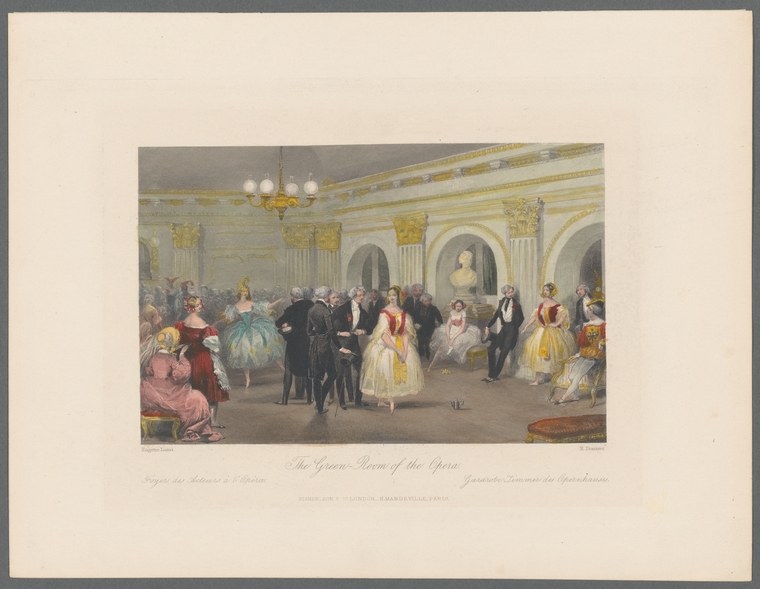
The foyer was where ballet dancers and society women met; it blurred the line between art and social performance. This image captures the intersection: a space that was simultaneously a rehearsal room for the Opéra, a place of courtship and marriage-making, and a public theater of elite identity. For historians of both dance and society, it documents how bodies were trained, displayed, and hierarchized in the 19th century.
What you are looking at
A grand ballroom scene set in a neoclassical interior with soaring columns, ornate capitals, and a coffered ceiling lit by a hanging chandelier. The floor is polished and spacious. Dozens of figures in formal 19th-century dress populate the room—women in voluminous ball gowns in pale colors (white, cream, pale blue, pale yellow) with low necklines and off-shoulder sleeves, men in dark tailcoats and white shirts. The composition centers on a few couples dancing or about to dance, with groups of seated and standing observers arranged around the periphery. At the far end of the room, a marble bust or statue sits in an arched niche. The lighting is cool and even, with the scene rendered in muted tones—grays, creams, golds, and soft pastels—creating an atmosphere of formal, composed elegance. The print shows the characteristic color palette and romantic sensibility of mid-19th-century salon imagery.
The dancing
The central dancers are arranged in closed ballroom hold or approaching it—upright posture, the woman's right hand on the man's left shoulder, his right arm at her waist. Their bodies are parallel and aligned in the formal frame of social dance. Dancers are distributed across the floor in a loose promenade pattern, some moving, others pausing. The standing figures maintain the stiff, ceremonial deportment expected of ballroom society; there is no exuberance or loose movement. The weight is carried upright and controlled.
The dance depicted
This is almost certainly a waltz or quadrille in an elite Parisian ballroom setting, most likely the foyer (rehearsal and social space) of the Opéra during the Second Empire or early Third Republic. The formal dress, the architectural grandeur, the all-white and pale-colored gown convention, and the coupled or group formations all confirm this is a haute société dance event. The waltz was the dominant partner dance in such settings from the 1830s onward, though the quadrille remained equally popular in formal ballroom contexts. The image captures not the energy of the dance itself but the social choreography of the ballroom—the minute of arrival, greeting, and pairing.
How it was made
This is a hand-colored engraving or steel engraving, identifiable by the fine linear hatching visible in the shadows, the crisp outlines, and the restrained application of watercolor or gouache over the printed line work. The technique allowed for mass production and wide circulation to a middle-class audience eager for images of elite social life. The color has been applied selectively—the women's gowns are tinted distinctly, while the men's dark clothing remains largely uncolored—a common practice to reduce cost while maintaining visual focus. The print's refinement and scale suggest it was issued as a single folio sheet or bound into a contemporary album or journal.
About this work
This is a printed record of Parisian ballroom culture at the height of its theatrical formality. The 'Foyer de la danse' of the Opéra was as much a place of social performance as a space for actual dancing—a stage within a stage where the elite practiced the codes of courtship, rank, and propriety. The print documents not a specific performance but a genre: the evening reception in a ballroom that epitomized 19th-century bourgeois aspiration and refinement. It belongs in a dance collection because the ballroom itself was a primary theater of 19th-century social choreography, and because the engraving serves as visual evidence of how that choreography was understood and represented to a public that both participated in and consumed images of such spaces.
How to look at it
Notice the stillness: despite the title's reference to dance, most figures are static, observing, or in transition. The artist has chosen the moment before or between dances—the social choreography of arrival and assembly. Look at the dress code's uniformity: the pale gowns of the women, the invariant dark tailcoats of the men. These constraints were not aesthetic but social law. The architectural setting is as much a subject as the figures; the neoclassical grandeur frames and legitimates the scene, making the ballroom itself an institution. The small scale and refinement of the print invites close viewing—this was a work for the drawing room table, an object of aspiration and gossip.
The period
The foyer de la danse of the Palais Garnier (or the earlier Opéra Le Peletier, which burned in 1873) became an iconic symbol of Second Empire Paris and remained so through the Belle Époque. Mid-to-late 19th-century visual culture was saturated with images of ballroom scenes, both as fine art and as popular prints—evidence of the ballroom's grip on the imagination of the rising bourgeoisie. The waltz and quadrille were at the apex of acceptable social dance; these were not vernacular forms but codified, taught, and morally regulated. Simultaneously, the foyer of the Opéra gained a reputation for courtesan culture and the meeting of dancers and their patrons, making it a site of both aspiration and illicit intrigue in the popular imagination.
Where it lives
Held by the New York Public Library as part of its collection of prints depicting dance. The work is catalogued without medium, date, or artist attribution in the record consulted, suggesting it may be one of many unmarked commercial prints or lithographs produced in Paris during the mid-to-late 19th century.
Dance in this work
Questions about this work
Was the 'foyer de la danse' a real place?
Yes. The foyer was an actual room in the Palais Garnier (built 1875) and its predecessor, the Opéra Le Peletier. It served as a rehearsal space for ballet dancers and as a public reception room where members of the Jockey Club (wealthy male subscribers) could socialize, view dancers, and arrange liaisons. It became iconic in 19th-century culture as a symbol of both artistic refinement and sexual commerce.
What dance are they doing?
Most likely a waltz or quadrille, the two dominant ballroom dances of this period among the elite. The upright posture, closed hold, and formal dress all indicate one of these two styles. The composition suggests a moment of assembly rather than active dancing, so the specific steps are not visible.
Who made this print?
The artist is not recorded in the catalogue. It may be a commercial print or lithograph produced by a Paris-based publisher, or a work from a larger suite of ballroom and opera scenes popular in the 19th century. The absence of a signature in the visible margins suggests it was either a mass-produced work or one where attribution was lost in circulation.
Why are the men all in dark suits?
This was the strict code of masculine ballroom dress in the 19th century. Men were required to wear dark tailcoats, white shirts, and light trousers or breeches; any deviation marked them as lower class, foreign, or eccentric. Women's dress was equally regulated—pale colors, low necklines, full skirts—but allowed for more variety in shade and decoration. The uniformity was not accidental but a sign of social order.
More dance artwork





