49 works in this view — arrow keys or swipe to move between them.
Dance in Art
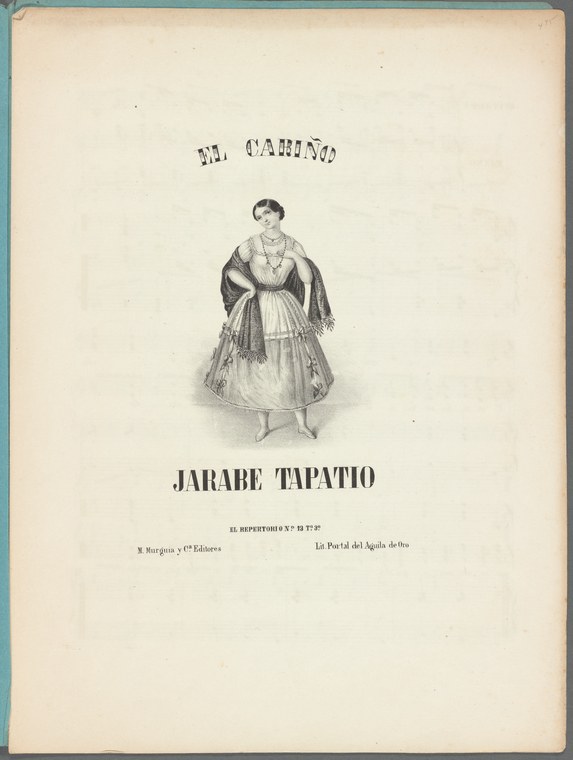
El cariño: jarabe tapatio
Unknown artist
- Collection:
- Prints depicting dance
- Source:
- New York Public Library
- Rights:
- Public domain — free to use, share and adapt.
- Recorded as:
- Public Domain
This is one of the earliest visual records of a dance that would become emblematic of Mexico itself, captured at a moment before the *Jarabe Tapatío* was fully assimilated into theatrical spectacle and international folklore. For historians of Mexican dance, the image documents how the dance was understood and presented in the mid-nineteenth century—as a solo display of elegance and control rather than primarily as a partnered courtship ritual. The engraving also illustrates the role of commercial print in circulating and standardizing images of national and folk dances across borders.
What you are looking at
A single female figure stands in three-quarter view against a plain background, wearing a full-skirted dress of the mid-nineteenth century. The skirt is voluminous, gathered at the waist, and reaches to the ankles; it appears to be rendered in light tones suggesting silk or cotton. Over this she wears a dark shawl or rebozo draped across her shoulders and arms, adding both volume and a sense of movement to the composition. Her posture is upright and dignified, with her weight settled on one leg in a stance suggesting either a moment of repose or the beginning of a step. The figure's dark hair is styled in the fashion of the 1840s–1850s, and her expression is composed and direct. The engraving employs fine parallel lines to create form and texture, particularly in the rendering of the fabric folds, which fall naturally but with a suggestion of the swinging motion characteristic of Mexican folk dress in motion.
The dancing
The dancer stands in a stable, frontal position with her body aligned vertically. Her right leg appears to carry her weight while the left is slightly advanced, suggesting the possibility of a step or sway. Her arms hang naturally at her sides, with the rebozo draped and held loosely—a pose that allows the fabric to billow and move. This stance is neither a closed ballroom frame nor a seated position, but rather the upright bearing of someone prepared to dance or captured mid-gesture. The absence of a partner and the solitary nature of the figure suggest this is a solo dance or a portrait of the dancer herself rather than a partnered interaction.
The dance depicted
This is a portrait of the *Jarabe Tapatío* (Mexican Hat Dance), one of the most recognizable dances of Mexico and the Americas. The title inscribed on the print confirms this identification. The *Jarabe Tapatío* originated in Guadalajara and became famous as a virtuosic solo or partnered dance performed at social gatherings and, later, in theatrical contexts. The engraving shows the dancer in street or formal dress rather than performing costume, suggesting this may be a portrait of a known performer or a representation of the dance as it was danced in social settings rather than in theatrical spectacle. The dress, posture, and period of the engraving (mid-nineteenth century based on style) align with the era when the *Jarabe* was becoming widely known beyond Mexico.
How it was made
This is an engraving, likely a commercial print, executed with fine parallel hatching lines to create tonal gradation and form. The technique allows for crisp definition of the figure and intricate rendering of textile details—the gathered skirt, the folds of the rebozo, and the surface texture of the dress. The print carries a publication line crediting "N. Rougon y Cª Editores" (N. Rougon and Company Publishers) and "La Paz del Aguila de Oro" (The Peace of the Golden Eagle), suggesting this was a commercially produced, likely distributed print intended for a broad audience. Engravings of this type were the primary medium for circulating images of performers and dances in the nineteenth century, before photographic reproduction became standard.
About this work
This engraving documents the *Jarabe Tapatío*, a central dance in Mexican cultural identity, at the moment when it was becoming known internationally. The print shows the dancer in dignified street dress, captured in a moment of poised stillness that suggests the controlled bearing required of the performer. The image sits at the intersection of folk tradition and commercial theatrical culture: it is neither a documentary of village practice nor a record of an elaborate stage production, but rather a portrait of a dance as it existed in the consciousness of urban, print-consuming audiences in Mexico and possibly Spanish-speaking cities across the Atlantic. The print's distribution through a Madrid publisher indicates that Mexican dances held interest for European audiences by this period.
How to look at it
Observe the posture of the figure: she is neither in motion nor at rest, but in a state of readiness. The slight advance of the left leg and the placement of weight suggest the moment before a step or the hold of a sustained pose—a convention of dance portraiture in which the artist freezes a characteristic attitude rather than a specific moment in a sequence. Notice the rendering of the skirt and rebozo: the engraver has used light and shadow to suggest the volume and potential movement of the fabrics, even though the figure herself is still. This technique allows the viewer to imagine the swinging, swirling motion of the dance even in a static image. The dignified, frontal presentation of the figure, without narrative context or male partner, emphasizes the dance as a display of the performer's individual skill and elegance.
The period
The *Jarabe Tapatío* emerged in Guadalajara in the early nineteenth century and gradually became associated with Mexican identity during a period of significant social and political change. By the 1840s–1850s, when this print was made, Mexico had recently lost territory to the United States and was consolidating internal political identity. The publication of this engraving in Madrid suggests that Mexican dances were gaining curiosity value in European cultural circles, part of a broader nineteenth-century appetite for exotic and picturesque dances from the Americas and colonial territories. In the context of printmaking, this work belongs to the tradition of theatrical and cultural portraiture that flourished in the nineteenth century, before photography displaced engraving as the primary medium for such documentation.
Where it lives
The print is held in the New York Public Library's collection of prints depicting dance. It was issued by N. Rougon y Compañía Editores of Madrid and La Paz del Aguila de Oro, indicating nineteenth-century Spanish publication and distribution.
Dance in this work
Questions about this work
What is the Jarabe Tapatío?
The *Jarabe Tapatío*, or Mexican Hat Dance, is a traditional Mexican dance that originated in Guadalajara. It became emblematic of Mexican national identity and is typically performed solo or with a partner, featuring elaborate footwork and the dramatic manipulation of a sombrero. By the nineteenth century, it had begun circulating in theatrical and international contexts, as this engraving attests.
Is this dancer a famous performer?
The engraving does not identify the individual pictured. It appears to be a generic portrait of the dance as performed by a recognizable female dancer of the period, produced for commercial sale rather than as a record of a specific performance or celebrated artist.
Why is she wearing a rebozo rather than a costume?
The rebozo (shawl) and street dress suggest this portrays the dance as it was performed in social settings rather than in theatrical costume. This indicates that by the mid-nineteenth century, the *Jarabe* was danced both as a folk practice in everyday settings and as a staged spectacle.
More dance artwork





