49 works in this view — arrow keys or swipe to move between them.
Dance in Art
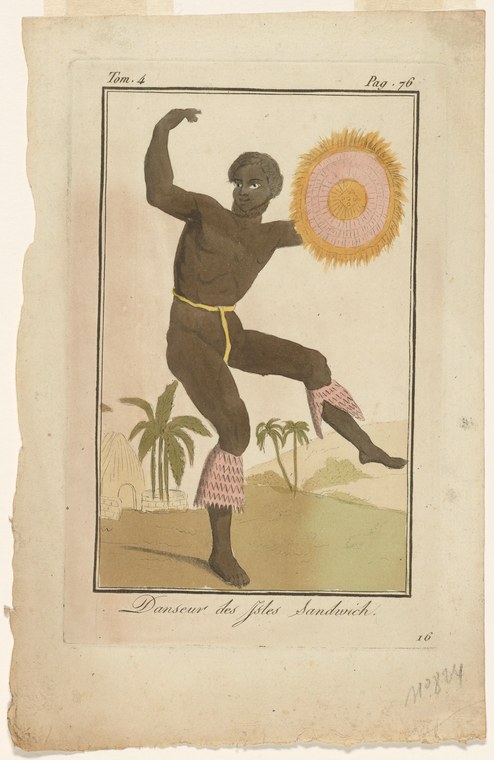
Danseur des Isles Sandwich
Unknown artist
- Collection:
- Prints depicting dance
- Source:
- New York Public Library
- Rights:
- Public domain — free to use, share and adapt.
- Recorded as:
- Public Domain
This image sits at the intersection of ethnography, exoticism, and early modern print culture. It provides rare visual evidence of how European artists depicted Pacific Islander bodies in motion during the Age of Contact—and reveals the distortions that European aesthetic conventions imposed on non-Western movement traditions. For dance historians, it raises essential questions about authenticity, representation, and the colonial gaze.
What you are looking at
A male figure strikes a dynamic, acrobatic pose against a pale background, captured in a hand-colored engraving. He stands on one leg with the other extended upward in a high extension, his torso twisted and one arm raised overhead while the other is bent. His body is rendered in dark brown tones, and he wears what appears to be a minimal garment—a short wrapped skirt or loincloth in patterned fabric around his hips, with leg wrappings visible. The artist has positioned him centrally, and to the right floats a large stylized sun with radiating rays in gold and red. Small palm trees appear at the base, anchoring the figure in a tropical setting. The title beneath reads "Danseur des Isles Sandwich" (Dancer of the Sandwich Islands), and the image is labeled "Planche 76" with a volume notation.
The dancing
The single figure demonstrates extreme flexibility and strength: his standing leg is locked and fully supporting his weight, while his free leg rises nearly vertical in a controlled extension. His raised arm extends the line upward, creating an elongated silhouette. His head is turned to gaze toward his raised arm. The posture suggests both performative display and physical mastery—the body is arranged for effect rather than appearing natural or transitional. There is no partner or interaction; the figure is presented as a solo virtuoso.
The dance depicted
This is most likely a documentation of Hawaiian (Sandwich Islands) hula or a warrior's display dance, depicted as a static acrobatic pose. The image presents a moment of extreme extension that may represent either a stylized moment within Hawaiian sacred dance traditions or, more probably, an exoticized European interpretation of Pacific Island warrior athleticism. The tropical setting (sun, palms) is explicitly coded. However, the highly artificial, contorted quality of the pose—particularly the awkward arm placement and extreme turnout—suggests this may reflect European fascination with Pacific bodies as physically exotic rather than an accurate record of indigenous dance. The costume is minimal and ethnographic rather than theatrical.
How it was made
This is a hand-colored engraving, as evidenced by the fine line work forming the figure and the carefully applied watercolor or gouache washes in brown, gold, red, and flesh tones. The technique allowed for distribution of multiple copies across Europe—this was a reproductive print, likely part of a collected series ("Planche 76" indicates a numbered sequence). The hand-coloring suggests a higher-value circulation, aimed at educated collectors or natural history enthusiasts. The precision of the engraved line contrasts with the gestural freedom of the applied color.
About this work
This engraving documents a moment of acrobatic virtuosity attributed to Hawaiian dance culture in the late 18th or early 19th century, when European contact with the Pacific was intense and such imagery circulated widely among collectors. The work belongs to a tradition of ethnographic prints that both recorded and reimagined non-European bodies for European audiences. The figure's extreme flexibility and isolated presentation make it a rare visual record of how European artists understood or performed Pacific Island physicality during this period, though the accuracy of the representation is uncertain.
The work is housed within the New York Public Library's collection of prints depicting dance, where it serves as evidence of how early modern Europe visualized and circulated images of other cultures' movement practices. Its specific moment—a frozen acrobatic apotheosis—tells us as much about European artistic convention and curiosity as it does about Hawaiian dance itself.
How to look at it
Notice the impossibility of the pose itself: the extreme turnout and extension would be difficult to sustain naturally, suggesting the artist prioritized aesthetic display over documentary accuracy. The sun and palms frame this as exotic spectacle rather than lived practice. Observe how the figure's musculature and dark skin tone are rendered with care, yet the pose itself—contorted and artificial—may reflect European fantasies about Pacific Islander flexibility and primitiveness rather than actual performance. The centrality and isolation of the figure emphasize viewing it as an anatomical specimen as much as a dancer.
The period
This engraving dates to the era of intensive European contact with the Pacific (late 18th or early 19th century), when prints of indigenous peoples and practices circulated as both scientific documentation and exotica for European collectors. The Sandwich Islands (Hawaiian Islands) had entered European consciousness following Cook's voyages (1776–1779). Such ethnographic prints were typically produced in series and sold to natural historians, collectors, and the educated public curious about distant lands. The style and hand-coloring technique place it within the tradition of European naturalistic illustration adapted to represent human subjects and movement.
Where it lives
This work is held within the New York Public Library's collection of prints depicting dance. It is part of a numbered series ("Planche 76"), suggesting it was one of a larger published suite of ethnographic or natural history prints, likely distributed through commercial circulation in Europe during the late 18th or early 19th century.
Dance in this work
Questions about this work
Is this an accurate depiction of Hawaiian dance?
Probably not entirely. While Hawaiian hula and warrior dances do demand strength and flexibility, the extreme artificiality of this pose—the impossible arm angle and turnout—suggests European artistic convention overrode documentary fidelity. The figure appears designed to showcase exotic physicality for a European audience rather than to record an actual movement. Hawaiian hula was (and is) a complex cultural practice with spiritual significance; this image flattens it into acrobatic spectacle.
What are the Sandwich Islands?
The Sandwich Islands was the European name for the Hawaiian Islands, given by Captain James Cook after the Earl of Sandwich. The name was used throughout the 18th and 19th centuries in European documents and prints. It now carries colonial baggage and is no longer in use.
Why is the sun so large and stylized?
The massive sun functions as both geographical marker (the tropical Pacific) and visual frame, emphasizing the exotic locale. Its flat, geometric style contrasts with the naturalistic rendering of the figure, suggesting symbolic rather than literal intent—the sun codes this as a distant, otherworldly place.
What does the numbering 'Planche 76' mean?
This indicates the print is plate 76 of a numbered series, likely a natural history or ethnographic reference work published in Europe. Such multi-plate series allowed collectors to acquire prints in installments or as a complete set, making them accessible to a wider audience than expensive paintings.
More dance artwork





