49 works in this view — arrow keys or swipe to move between them.
Dance in Art
Newest fashions for 1830
Unknown artist
- Collection:
- Prints depicting dance
- Source:
- New York Public Library
- Rights:
- Public domain — free to use, share and adapt.
- Recorded as:
- Public Domain
Fashion plates are the most direct surviving evidence of what dancers actually wore in the 1830s—not the formal dress codes of court, but the everyday theatrical and social garments that shaped movement possibilities. Without them, historians rely on paintings and written descriptions; fashion plates show construction, fabric, weight, and the exact silhouette that determined posture and step. This image also documents the gendered division of fashion documentation: women's dress was recorded in obsessive detail in fashion plates, while men's was often shown schematically, reflecting both the economics of dress-making and the visibility assigned to women's bodies.
What you are looking at
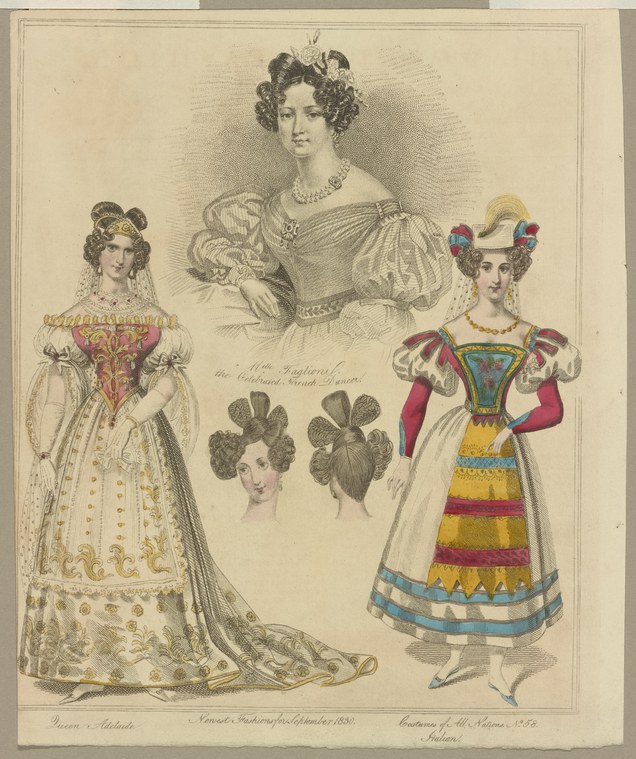
This is a hand-colored fashion plate from approximately 1830 showing three female figures arranged to display the latest styles in dress and hair ornamentation. The central figure, slightly larger and positioned higher, wears an off-shoulder gown of pale fabric with puffed sleeves and a pearl necklace, her curled hair adorned with feathers or plumes. To the left stands a younger woman in an elaborate white dress with a deep pink or red brocaded bodice, the skirt densely embroidered with gold foliate patterns and a long trained hem; her hair is dressed in the high loops typical of the period. On the right, another figure wears a striking dress of yellow and multicolored silk with striped bands of deep red, purple, and blue, white puffed sleeves, and gold ornamental trim at the waist and hem; her hair is similarly looped and crowned. Two small sketches of women's heads between the figures show alternate hairstyles in the same high-looped arrangement. The composition is a formal three-figure display against a plain background, typical of fashion-plate production, with no narrative or social setting suggested.
The dancing
The three figures stand upright in presentation poses with minimal physical engagement with each other. Their arms are positioned to display the sleeves and bodice construction—relaxed at sides or gently extended. There is no dance frame or partnering; instead, each figure presents herself frontally or in slight three-quarter view, with weight equally distributed and posture formal and stationary. The tall, narrow silhouettes, sloped shoulders, and cinched waists are characteristic of early 1830s women's fashion. None of the bodies show any evidence of movement, weight shift, or the engaged musculature of active dance.
The dance depicted
This image does not depict dance in action. It is a fashion plate—a commercial illustration designed to display current dress styles and trends, not to document a specific dance style or performance. While the elaborate gowns shown here would have been worn at social events including balls and dances of the Regency and early Victorian period, the figures are posed statically for costume display rather than performing any recognizable dance movement or hold. The absence of any male partners, closed holds, or compositional framing of a dance scene distinguishes this from theatrical or social dance imagery.
How it was made
This appears to be a hand-colored engraving or lithograph typical of early 19th-century fashion publishing. The fine linear work defining fabric texture, embroidery details, and facial features is consistent with steel engraving; the subtle shading and colored washes applied afterward suggest hand coloring over a black-and-white print base. The technique allowed for the precise rendering of textile patterns and construction details essential to fashion documentation, and the hand-coloring process made each print slightly unique. Works of this type were mass-produced for fashion periodicals and bound collections aimed at a middle- to upper-class female audience and dressmakers.
About this work
This is a fashion plate from the 1830s—a commercial illustration showing three women's dresses and hairstyles of the moment. It belongs in a dance archive not because it depicts dance, but because it documents the material culture in which early 19th-century social and theatrical dance took place. The silhouettes, construction, and ornamentation of these gowns constrained and defined the movement possible in ballrooms and on stages; understanding what dancers wore, and how those clothes were made and promoted, is essential to understanding what their bodies could do and how observers understood their movement. Fashion plates are primary sources for the embodied history of dance.
How to look at it
Attend to the detail of construction: the gathered seams at the shoulder, the fullness of the sleeves, the placement of embroidery, the layering of fabrics. These details tell you how much movement was possible and in what directions. The exaggerated height and fineness of the hairstyles—requiring hours of dressing and prone to damage—indicate that the wearers of these dresses were not expected to move vigorously. Look also at how the eye is directed: the composition treats each figure as a flat display surface, much like a dress form or mannequin. This is not portraiture or narrative art; it is commercial instruction in how to dress.
The artist
The artist is not recorded, which is typical for commercial fashion plates of this era. They were produced by publishing houses—in this case apparently a British or European concern active in the 1830s—and often executed by staff illustrators whose names were not considered commercially valuable. The inscriptions at the base of the print (partially legible) likely indicate the publisher or periodical title and the date of the plate.
The period
The 1830s were the height of Romanticism in fashion and the arts. Women's dress of this period is characterized by exaggerated puffed sleeves (the "leg of mutton" silhouette), narrow waists achieved through tight corseting, and an emphasis on the vertical line and graceful drape. In dance, this was the era of Romantic ballet—the period of Marie Taglioni and the birth of pointe work and ethereal aesthetics. The same cultural values that produced the sylph in ballet produced the elongated, narrowly corseted silhouettes shown here. Fashion plates were at their height as a form of commercial communication and as a window into women's social life and aspirations.
Where it lives
This print is held in the New York Public Library's collection of prints depicting dance, suggesting it was acquired as evidence of dancewear or the material context of dance history. Fashion plates of this period were typically published in periodicals (such as *La Belle Assemblée*, *The Gentleman's Magazine*, or *Ackermann's Repository*) or collected and bound into volumes for reference by wealthy households and professional dressmakers.
Questions about this work
Is this actually a dance image?
No—it is a fashion plate, a commercial illustration of current dress styles. It is included in dance archives because understanding what dancers wore is essential to understanding what their bodies could do. The elaborate gowns, tight corseting, and heavy embroidery constrained movement in ways that shaped both social and theatrical dance of the 1830s.
Who wore these dresses?
Wealthy women of the middle to upper classes. The left and right figures wear the most elaborate gowns—likely for formal evening or theatrical occasions. The central figure's dress is simpler and might represent day wear or a more modest social event. All three represent aspirational fashion aimed at women with access to skilled dressmakers and expensive fabrics.
How were fashion plates made?
These were typically hand-colored engravings or lithographs. A trained engraver would cut the design into a steel plate or draw it on a lithographic stone, creating fine lines that could hold ink for printing. After printing in black, the images were colored by hand using watercolors or hand-applied inks—a labor-intensive process that made each print unique despite being mass-produced.
What does the hairstyle tell us?
The high loops and elaborate ornamentation (feathers, combs, ribbons) show that hair was a major focus of fashion and took considerable time and skill to arrange. Women did not wear their hair this way for practical reasons; it was purely decorative and aspirational, indicating leisure and wealth. It would have been fragile in vigorous movement, confirming that women of this class were not expected to dance strenuously.
More dance artwork





