49 works in this view — arrow keys or swipe to move between them.
Dance in Art
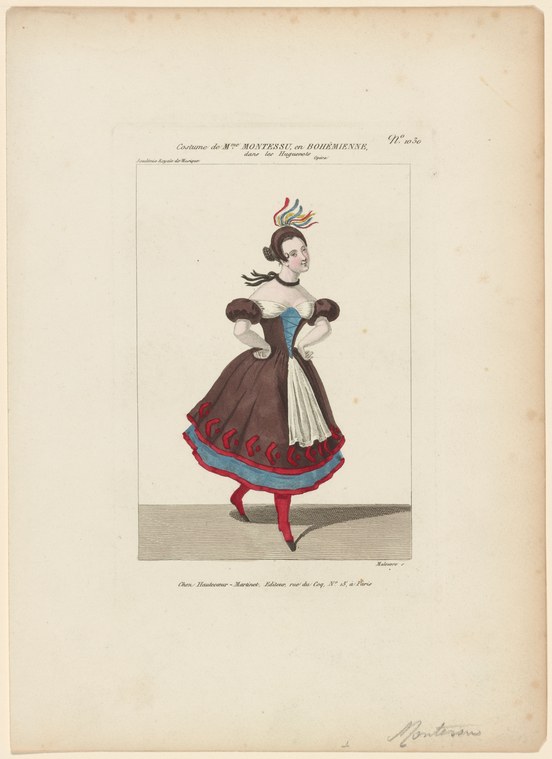
Costume de Mme. Montessu, en Bohémienne, dans Les Huguenots, opéra, Académie royale de musique
Unknown artist
- Collection:
- Prints depicting dance
- Source:
- New York Public Library
- Rights:
- Public domain — free to use, share and adapt.
- Recorded as:
- Public Domain
This print documents the material culture of nineteenth-century grand opera and the visual language through which racial and ethnic otherness was constructed on the European stage. For dance historians, it evidences the close relationship between costume, character type, and operatic narrative—the dress signals the character's role in the drama and the conventions of spectacle that governed ballet interludes and ensemble movement within the opera.
What you are looking at
A single female figure stands against a plain ground in a three-quarter view, facing left. She wears a dark burgundy dress with a fitted bodice and full skirt; the skirt is trimmed with a scalloped red band at the hem and underlaid with a turquoise panel that shows beneath. Her shoulders are bare, with white puffed sleeves or shoulder pieces framing her arms, which are held out to the sides with elbows slightly bent—a gesture of display or presentation. A feathered headdress in red and gold sits atop her dark hair, styled close to her head. Her feet are visible in red heeled slippers. The figure stands with weight evenly distributed, in a formal presentation pose typical of theatrical costume studies. The plain background and careful frontal-to-profile positioning suggest this is a costume plate or theater documentation rather than a narrative scene.
The dancing
The dancer stands in an upright, balanced posture with arms held mid-height and away from the body, palms facing forward or slightly outward—a pose of display and presentation rather than active motion. The legs are straight and the weight appears centered. The carriage is formal and static, without the dynamic bend or weight shift typical of active dance. This is a posed figure study rather than a captured moment of movement.
The dance depicted
This is a costume design or costume documentation for a theatrical performer, specifically labeled as the costume worn by Mme. Montessu in the role of a Bohemian woman (bohémienne) in Giacomo Meyerbeer's opera *Les Huguenots* (1836). The work documents historical stage dress rather than depicting a particular dance, though *Les Huguenots* featured ballet and dancing. The exotic costume—with its jewel-toned silk, feathered headdress, and orientalizing details—represents the nineteen-century operatic convention of othering non-European characters through dress. No specific dance technique is evident; the pose is one of costume presentation.
How it was made
This is a hand-colored engraving or lithograph, a reproductive print technique that allowed wide circulation of theatrical costume documentation to the educated public and fellow practitioners. The fine line work delineates the silhouette and construction of the dress, while watercolor or hand coloring defines the rich jewel tones of the fabrics and the feather work. The technique was standard for theater documentation in the nineteenth century and implies an audience of opera-goers, artists, and costumiers who would recognize the work and use such prints as reference.
About this work
This is a theatrical costume plate documenting the stage dress of a minor character in Meyerbeer's most celebrated opera. It represents the mid-nineteenth-century practice of disseminating designs and key costumes through colored prints—a form of marketing, documentation, and professional reference combined. The work sits at the intersection of theater history, fashion history, and operatic practice, recording both the visual culture of the Opéra and the conventions through which European audiences encountered imagined Bohemian or Eastern European characters on stage. The static, frontal pose is not a dance image, but it records the costume in which stage movement and dance would have occurred.
How to look at it
Look first at the construction of the dress: the fitted bodice, the full skirt with its decorative trim, the layered color that suggests depth and richness of fabric. Notice how the pose communicates formality and display—the arms are neither at rest nor in motion, but arranged for the viewer's examination. The feathered headdress and the turned-out posture are cues to the character's role as exotic spectacle within the opera's narrative. This is documentation meant to be studied, not a moment of performance frozen.
The artist
The artist is not recorded on the print. However, costume plates of this quality and format were produced by specialist theatrical printers and engravers, often working from sketches by costume designers or theater artists. These prints were typically published and sold through the Opéra or through music and theater publishers in Paris; they functioned as both souvenirs and professional tools.
The period
This print dates to the 1830s, the height of French grand opera under the direction of Eugène Scribe and composers like Meyerbeer. *Les Huguenots* (1836) was one of the most successful and frequently performed operas of the era, and its success drove demand for costume documentation and theatrical imagery. The Romantic era's fascination with exotic and historical settings generated a market for prints showing the spectacular costumes that gave visual form to fantasy worlds on stage. At the same time, the realistic study of historical dress—even imagined historical dress—was becoming an academic discipline, and costume plates served as reference for both artists and costumiers.
Where it lives
This is a colored engraving or lithograph from the New York Public Library's collection of prints depicting dance. It is part of a larger archive of theatrical imagery and costume documentation from European opera houses, assembled as a visual record of stage practice.
Questions about this work
What opera is this from?
*Les Huguenots* (The Huguenots) is a five-act grand opera by Giacomo Meyerbeer with a libretto by Eugène Scribe. It premiered in 1836 at the Paris Opéra and became one of the most performed operas of the nineteenth century. The plot involves religious conflict during the French Wars of Religion, with numerous historical and invented episodes featuring spectacle, pageantry, and ballet.
Who was Mme. Montessu?
Montessu was a singer and performer in the chorus or secondary roles at the Paris Opéra during the 1830s–1840s. Her name appears on costume plates and in cast lists for major productions, but detailed biographical information is scarce. She was typical of the many skilled performers who made grand opera productions possible.
Why is this character described as 'Bohemian'?
The term 'bohémienne' was used loosely in nineteenth-century opera to denote exotic, marginalized, or Romani women characters—figures understood as outside respectable European society. The costume—jewel-toned silks, feathered headdress, jeweled ornaments—encodes this exoticism for the audience. It reflects Romantic-era orientalism and the operatic convention of spectacle in the depiction of 'other' characters.
Is this a dance print?
Technically, this is a costume plate, not a scene of dancing. However, it documents the dress in which stage movement and ballet would have occurred, and it belongs in a dance archive because it records the visual and material conditions of operatic performance when dance was integral to grand opera.
More dance artwork





