49 works in this view — arrow keys or swipe to move between them.
Dance in Art
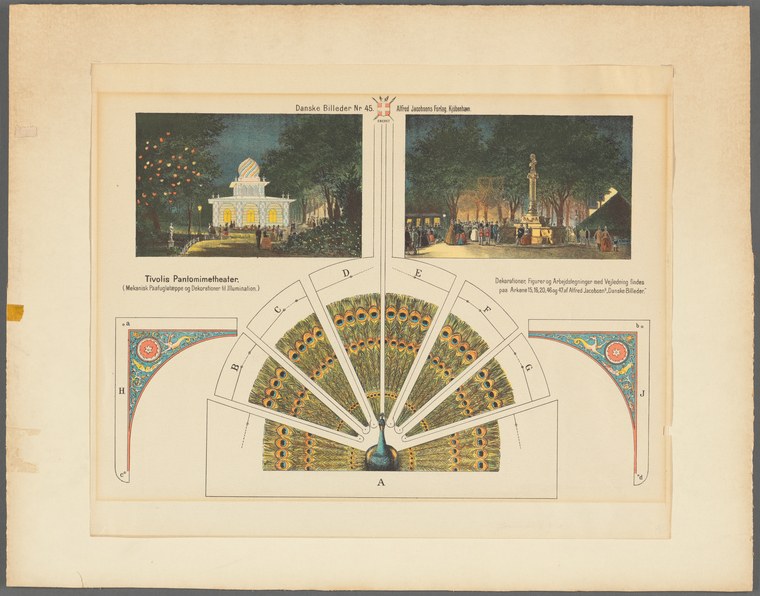
Tivolis Pantomimetheater. Danske Billeder Nr. 45
Unknown artist
- Collection:
- Prints depicting dance
- Source:
- New York Public Library
- Rights:
- Public domain — free to use, share and adapt.
- Recorded as:
- Public Domain
The image preserves visual evidence of Tivoli's role as a center for theatrical entertainment in the late 19th or early 20th century, including pantomime performance. It shows how theaters marketed themselves through integrated architectural and atmospheric imagery. The work also illustrates the relationship between theater design and audience experience during a period when pantomime was a major form of popular entertainment.
What you are looking at
This is a design for Tivoli's Pantomime Theater, presented as an architectural floor plan with two illuminated theatrical vignettes. The upper left shows a nighttime exterior scene with a domed or rotund structure—likely the theater building itself—brightly lit against a dark sky scattered with stars or fireworks. A crowd of figures gathers before it. The upper right depicts an interior scene under moonlight: an avenue of trees leads toward an illuminated obelisk or monument, with silhouetted figures standing and promenading in small groups. The central and lower portion is an overhead view of the theater's auditorium, rendered in ornate decorative style with radiating wedge-shaped sections in gold and jewel tones, marked with letters A through F to indicate seating or functional areas. Ornate corner medallions frame the composition.
The dancing
The figures in both theatrical scenes are small and silhouetted, rendered as solid forms rather than anatomically detailed dancers. In the exterior view (upper left), they cluster and stand upright, apparently stationary or moving slowly in a crowd. In the interior garden scene (upper right), they appear as individual or paired figures in relaxed stance, some suggesting a leisurely walk or promenade posture. The scale and treatment make it impossible to discern specific dance technique, hold, or footwork. These are architectural renderings emphasizing spatial layout rather than kinetic study.
The dance depicted
This is not a representation of a dance performance but rather an architectural or design document for a theater venue. Tivoli Gardens, the historic amusement park in Copenhagen, was known for pantomime performances and theatrical entertainment, but this image documents the building and its ground plan rather than depicting dance itself. The small figures are occupants and audience members, not dancers executing a choreography. The work belongs to the category of theatrical or entertainment architecture rather than dance documentation.
How it was made
This is a chromolithograph (color lithograph), a mass-production printing technique that allowed detailed color work and fine ornamental detail. The technique is characteristic of late 19th or early 20th-century commercial and architectural illustration in Scandinavia. Lithography's ability to render fine gradations of tone and bright color made it ideal for theatrical promotion and architectural presentation intended for a broad audience. The hand-colored or multi-plate approach is evident in the distinct color zones—the golden and jeweled tones of the floor plan, the atmospheric blue of the night sky, the greens of the garden vegetation.
About this work
This is an architectural promotional document for Tivoli's Pantomime Theater in Copenhagen, part of a series titled *Danske Billeder* (Danish Pictures). It combines floor plan with theatrical vignettes to showcase both the building's grandeur and the entertainment experience it offered. The work sits at the intersection of theater history, architectural documentation, and commercial graphic design. It records not a dance performance itself but the designed space in which performances—including pantomime and dance—would have taken place. For dance historians, it documents the venue and audience experience of a major Scandinavian entertainment center.
How to look at it
Approach this as an architectural narrative rather than a performance image. Observe how the designer has used two contrasting scenes—the crowded exterior and the intimate garden promenade—to convey atmosphere and draw the viewer into the fantasy of the space. The jeweled floor plan below anchors the composition, suggesting opulence and ordered luxury. The figures, though small, are positioned to suggest leisure, gathering, and social pleasure. This is promotional architecture—designed to sell not a dance but an experience.
The artist
Unknown. The print is part of the *Danske Billeder* (Danish Pictures) series, a commercial illustration enterprise, but no individual artist is recorded. Such architectural and promotional prints were typically produced by commercial lithography workshops rather than individually credited artists.
The period
Tivoli Gardens opened in 1843 and became one of Europe's first major amusement parks. Pantomime was a major attraction through the 19th and into the 20th century, drawing on commedia dell'arte traditions and combining dialogue, music, and stylized movement. The park's aesthetic emphasized fantasy, spectacle, and the theatrical transformation of urban space—visible here in the contrast between the nocturnal garden setting and the jeweled interior. The chromolithographic technique and decorative style place this in the period of Tivoli's greatest cultural influence, roughly 1880–1920.
Where it lives
The print is part of the New York Public Library's collection of prints depicting dance. It is one plate in the *Danske Billeder Nr. 45* series (Danish Pictures No. 45), a commercial series documenting Danish landmarks and public attractions.
Questions about this work
Is this a depiction of an actual dance performance?
No. This is an architectural and promotional design for a theater building. The small figures represent audience members, crowds, and occupants of the space rather than performers executing a choreography. It documents the venue rather than the performance.
What is Tivoli's Pantomime Theater?
Tivoli Gardens in Copenhagen, founded 1843, was a major European amusement park featuring various entertainments including pantomime performances. Pantomime—combining commedia dell'arte, music, and stylized movement—was one of its signature attractions through the 19th and early 20th centuries.
How was this print made?
This is a chromolithograph, a color lithography process that allowed fine detail and bright color in commercial printing. It was an efficient way to produce multiple copies for promotion and public circulation, typical of late 19th and early 20th-century architectural and commercial illustration.
What is the floor plan showing?
The radial seating or sectional arrangement of the theater auditorium, marked with letters. The ornate decorative treatment—in gold and jewel tones—presents the interior as a jeweled space, reinforcing the theater's appeal as a site of luxury and spectacle.
More dance artwork





