49 works in this view — arrow keys or swipe to move between them.
Dance in Art
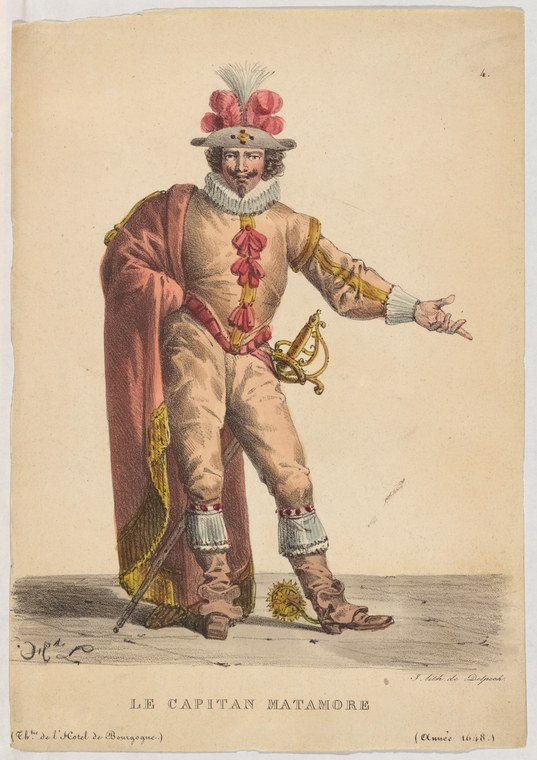
Le capitan Matamore
Unknown artist
- Collection:
- Prints depicting dance
- Source:
- New York Public Library
- Rights:
- Public domain — free to use, share and adapt.
- Recorded as:
- Public Domain
Commedia dell'arte characters were not merely theatrical types but repositories of movement technique, comic timing, and physical convention that shaped European performance across dance, comedy, and theater. This image captures the visual and postural language of a character whose stock movements and gestures were taught, imitated, and transformed into balletic and dance forms throughout the 17th and 18th centuries. Understanding how performers of the period understood and embodied theatrical physicality is essential to interpreting both the dance and theater of the era.
What you are looking at
A single male figure stands in a three-quarter pose against a plain background, his weight shifted onto his right leg in a theatrical stance. He wears an elaborate costume of the commedia dell'arte tradition: a cream-colored doublet with red ornamental buttons running down the center, a voluminous red cloak lined in gold that sweeps behind him, and white stockings that extend to mid-calf. His legs are encased in brown boots with decorative cuffs. Around his neck sits a stiffened white ruff collar in the Elizabethan style. Most striking is his headdress: a tall construction of red fabric adorned with white feathers or plumes that crown his head. His face, rendered with sharp features and a slight smile, is framed by shoulder-length hair. He holds a small object (possibly a scroll or token) in his right hand, which gestures outward in a declamatory manner, and his left hand rests near his hip where a gold-hilted sword hangs at his side. The entire figure is rendered in hand-colored engraving or etching, with careful attention to the texture and shading of the fabrics.
The dancing
The single figure displays the exaggerated, presentational posture of commedia dell'arte theater rather than ballroom or concert dance. His stance is fundamentally static—weight held upright, chest forward, limbs extended in demonstration rather than in motion through space. The arm raised in gesture suggests declamation or comic display rather than the coordinated partnered movement of social dance. There is no indication of momentum, traveling, or the partnered framing that would characterize ballroom or theatrical dance forms; this is a character portrait presented for recognition and admiration.
The dance depicted
This does not depict dance in the technical sense. The figure is *Capitano Matamore*, a stock character from the commedia dell'arte tradition—a boastful, braggart soldier. Commedia dell'arte did involve physical comedy, movement, and stylized gesture, but this image captures a static costume portrait rather than a moment of choreographed dance. The pose is theatrical and deliberately expressive, but the body is held in character presentation rather than executing steps or patterns. The image documents the visual spectacle and costume convention of a theatrical character type rather than a specific dance form.
How it was made
This is a hand-colored engraving or etching, likely from a printed source documenting commedia dell'arte characters. The technique allowed for precise rendering of costume detail—the buttons, feather work, fabric draping, and decorative elements are carefully delineated—and the hand coloring (red, gold, cream, and brown) has been applied with attention to naturalistic shading and texture. The inscription at the foot identifies the character in French ("LE CAPITAN MATAMORE"), and the notation suggests this is a collected plate from a theatrical documentation series, probably 17th-century French or Italian. The medium's precision and circulation in prints made character types widely recognizable across Europe.
About this work
This is a character portrait from the commedia dell'arte tradition, rendered as a hand-colored engraving and documenting the costume and presentation of the braggart-soldier type *Capitano Matamore*. The work belongs in a gallery of dance in art not because it depicts choreographed dance, but because commedia dell'arte was a fundamental training ground for physical theater and movement vocabulary in early modern Europe, and because the theatrical gesture, exaggerated posture, and costume spectacle shown here are inseparable from the kinetic tradition it represents. The figure's deliberate physical presentation—the lifted chest, the gesturing arm, the weighted stance—embodies a codified performance vocabulary that influenced dance, theater, and physical comedy for centuries.
How to look at it
Attend to the pose: the deliberate lift of the chest, the outward gesture of the hand, the forward weight on one leg. These are not the signs of a person in motion but of a character *presenting* himself to an audience—showing off his costume, his rank, his confidence. The exaggerated verticality, the bold color contrasts (red against cream and gold), and the heraldic swagger of the outfit are all designed to read from a distance and to lodge in the viewer's memory. This is how commedia characters taught their audiences to *see* performance: as a legible, repeatable, recognizable sign system in which gesture, costume, and posture conveyed character and intent.
The artist
The artist is not recorded. This appears to be a plate from a published series documenting commedia dell'arte character types, likely produced in France or Italy in the 17th century. Such prints were widely circulated as reference materials for actors, performers, and audiences, allowing character types and their costumes to be recognized and understood across different performances and cities. The careful attention to costume and feature suggests a professional engraver working from theatrical performance or costume description.
The period
Commedia dell'arte flourished from the 16th through 18th centuries, and by the 17th century, when this print was likely made, it had become a dominant performance tradition across Italy and France. Characters like Capitano Matamore—the boastful foreign soldier—were stock types with recognized costume, movement vocabulary, and comic routines. This period also saw the codification of ballet de cour in France and the early development of theatrical dance forms that would borrow heavily from commedia's physical vocabulary. The theatrical spectacle visible in this costume—the exaggerated silhouette, the heraldic color and pluming—reflects the visual excess and physical comedy that characterized 17th-century European performance.
Where it lives
The work is held in the New York Public Library's Prints collection, catalogued within a series of prints depicting dance. The notation at the foot suggests it was part of a published series documenting commedia dell'arte character types, likely issued in multiple impressions and circulated as theatrical reference or entertainment.
Questions about this work
Is this actually a dance?
Not in the choreographic sense. This is a character portrait from commedia dell'arte, a theatrical tradition that involved highly stylized movement, gesture, and physical comedy but was not organized into steps or patterns like ballroom or concert dance. The pose is theatrical and expressive, designed to present the character to an audience, but it captures a moment of static display rather than movement through space.
What is commedia dell'arte and why does it matter to dance history?
Commedia dell'arte was an improvisational performance tradition originating in Italy in the 16th century, featuring stock characters, masks, and codified movement vocabularies. It was hugely influential on European theater and dance; characters and their physical vocabularies were absorbed into ballet, pantomime, and theatrical dance throughout the 17th and 18th centuries. Understanding the physicality of commedia is essential to understanding how early modern performers understood and executed theatrical movement.
Who was Capitano Matamore?
Capitano Matamore (the name translates to 'captain kill-a-Moor') was a stock character in commedia dell'arte—the braggart foreign soldier, usually depicted in outlandish costume, boasting of military exploits and romantic conquests while remaining fundamentally ridiculous and cowardly. His costume, as shown here, was designed to be visually impressive but absurd, and his movement vocabulary involved exaggerated swagger, overblown gesture, and physical comedy.
More dance artwork





