49 works in this view — arrow keys or swipe to move between them.
Dance in Art
The hunt ball
Unknown artist
- Collection:
- Prints depicting dance
- Source:
- New York Public Library
- Rights:
- Public domain — free to use, share and adapt.
- Recorded as:
- Public Domain
This image preserves the visual and social context of 19th-century country-house ballroom culture, showing how dance functioned as a frame for courtship, social observation, and the performance of class status. For historians of ballroom dance and Romantic-era social dancing, it provides evidence of costume, spatial arrangement, partnering conventions, and the dense, crowded informality that characterized actual ballroom practice—often quite different from the idealized illustrations found in dancing masters' manuals.
What you are looking at
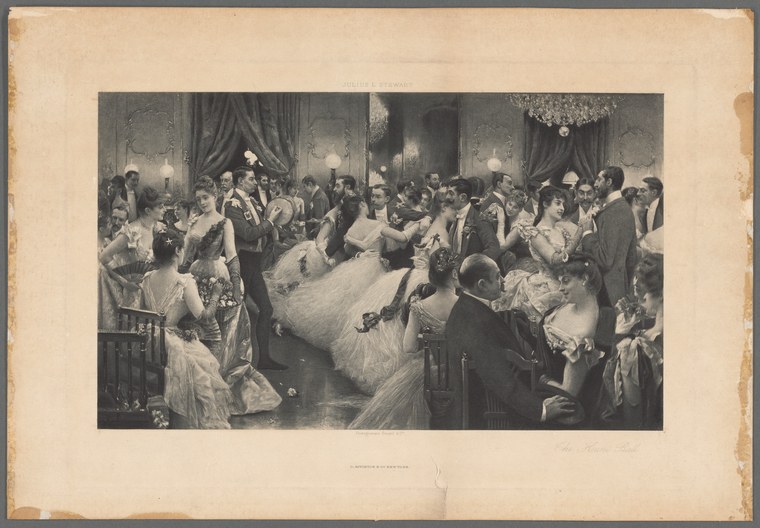
A crowded formal ball set in an ornate interior, rendered as a monochromatic engraving. The space is defined by heavy draped curtains and a decorative ceiling fixture; gaslight or candlelight casts deep shadows across the assembled crowd. The composition is densely packed, with figures in evening dress—men in tailcoats, women in elaborate ball gowns with full skirts—arranged throughout the depth of the room. Several couples occupy the center and foreground in dancing posture, while others stand conversing or observing at the periphery. The women's skirts dominate the visual field; one figure in the right foreground displays a dramatic swirl of fabric, suggesting active movement. The scene captures the social choreography of the hunt ball—a formal country gathering—rather than a structured dance performance, with the ballroom itself as protagonist.
The dancing
Dancers occupy closed ballroom holds: men's frames are upright and formal, women positioned at a slight angle to their partners. The visible couples show the posture typical of 19th-century waltz or quadrille—upper bodies held at reserve, arms extended in the prescribed frame. One woman's skirt catches mid-motion, billowing outward in the characteristic sweep of a turn. The crowd density—dozens of figures layered from foreground to background—means that most are static or barely articulated, their bodies merely suggested by silhouettes and dress. The overall impression is of restrained, mannered movement within a highly structured social context.
The dance depicted
This is a waltz or quadrille scene set within the social calendar of the English hunt season, likely mid-to-late 19th century. The hunt ball was a staple of country-house life, where the local gentry gathered for formal dancing. The image does not document a specific named dance in technical detail, but rather captures the ballroom ritual itself—the formal closed hold, the measured carriage, the elaborate dress that signified participation in this elite social world. The artist has chosen to show the ball as spectacle and social event rather than as a display of virtuosity.
How it was made
This is an engraving, likely a steel or wood engraving given the fine cross-hatching and tonal range visible throughout. Engravings of this type were used for book and periodical illustration in the 19th century, making them relatively accessible to a broad audience—this work would have reached readers through exhibition catalogs, annuals, or illustrated periodicals of the period. The medium's exacting linewerk allowed the artist to capture elaborate architectural detail, costume texture (silk, brocade, lace), and the subtle modulation of light across a complex composition. The technique required significant planning and multiple states; this particular print shows mastery of tonal gradation through varying densities of line.
About this work
"The Hunt Ball" documents the formal social dancing of the English country house, a central institution of 19th-century upper-class life. Rather than depicting professional dancers or a theatrical performance, it records the participatory ballroom dancing of the gentry—the waltz and quadrille as lived social practice. The engraving format suggests this was a widely circulated image, possibly appearing in illustrated periodicals or gift books aimed at audiences familiar with or aspiring to this world. It belongs in a dance archive because it captures not virtuosity but the cultural function of ballroom dance as a marker of social position, propriety, and participation in elite ritual.
How to look at it
Observe how the artist has handled the problem of rendering crowded motion: the eye is drawn to the couple in the foreground whose skirt swirls outward, reading as the moment of a turn. Notice how the engraver has used varying densities of line to suggest depth—figures in the middle distance are hazier, their forms less distinct—and how the heavy drapery frames and contains the dancing space. The formal, restrained bearing of the visible couples, their upright posture and measured distance from one another, reflects the conventions of Victorian ballroom propriety: passion was not to be displayed, only social order through dance. The crowd itself is almost as much the subject as the dancers; this is a gallery of observation as much as an image of movement.
The period
The hunt ball was a fixture of the English social calendar from the 18th century onward, but reached peak prominence and elaborate formality during the Victorian era (1837–1901). This engraving likely dates to that period, when illustrated periodicals such as *The Illustrated London News* (founded 1842) made scenes of fashionable life widely available to middle-class readers aspiring to knowledge of upper-class customs. The waltz had become the dominant ballroom dance by the 1850s, though the quadrille remained common at formal events. The costume—particularly the women's full skirts, which suggest the crinolined silhouettes of the 1850s–1870s—supports a Victorian date. Engravings of social scenes were a major genre of Victorian book and periodical illustration, often documenting the rituals of courtship and marriage.
Where it lives
This work is held in the New York Public Library's collection of prints depicting dance. It is catalogued as "The Hunt Ball," with no artist attribution recorded. The engraving format and archival category suggest it was selected for the collection as evidence of dance practice and social custom in the 19th century.
Dance in this work
Questions about this work
What is a hunt ball?
A hunt ball was a formal ball held during the hunting season (autumn and winter) at country estates, primarily in England. It was a social and economic event for the local gentry—a gathering where the hunting community danced, dined, and conducted courtship and social business. The ball was a key marker of social calendar and class participation.
What dances would have been performed at a hunt ball?
By the mid-19th century, the waltz was the dominant dance at formal balls, though the quadrille (a figure dance for four couples) remained standard for opening sets. The polka, lancers, and Scottish reels also appeared. Dances were typically led by the highest-ranking couples present, setting the tone for the evening.
Why are the women's skirts so large?
This reflects mid-to-late Victorian fashion. Women wore crinolined petticoats—structured skirts supported by a framework of steel hoops or whalebone—which created the voluminous silhouette visible here. The crinolined skirt was both a marker of respectability and a practical garment for ballroom dancing, as it moved dramatically with turning and swaying motion.
Is this a historically accurate record of how these dances looked?
Broadly yes, though like all illustrations it is stylized for legibility and impact. The closed holds, upright posture, and restrained gesture align with contemporary dancing manuals and photographs. The scene captures the social tenor—formality, propriety, and orderly movement—more reliably than it documents precise footwork, which is invisible in the finished image.
More dance artwork





