49 works in this view — arrow keys or swipe to move between them.
Dance in Art
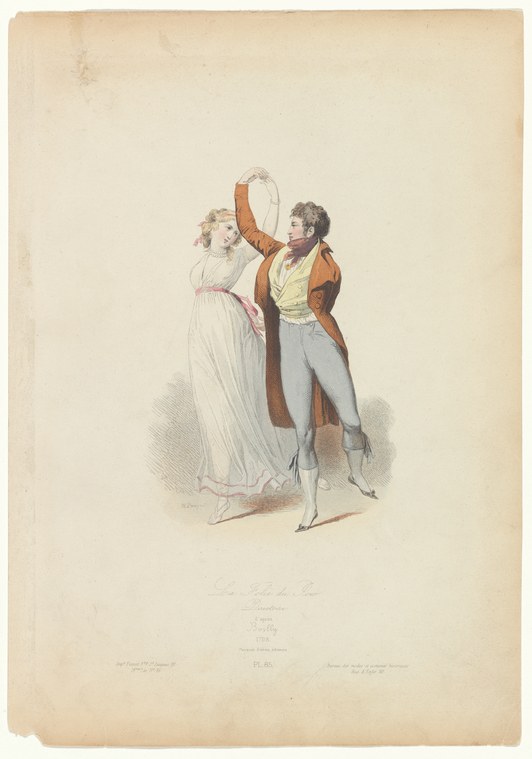
La folie du jour, Directoire: d'après Boilly, 1798
Unknown artist
- Collection:
- Prints depicting dance
- Source:
- New York Public Library
- Rights:
- Public domain — free to use, share and adapt.
- Recorded as:
- Public Domain
The work shows the visual and gestural conventions of pre-waltz courtship at a historical moment when European ballroom practice was transforming. For historians of dance, fashion, and gender, it documents how bodies were positioned, how proximity was managed, and how flirtation was choreographed in elite society before and during the early waltz era.
What you are looking at
A young couple occupies the center of this hand-colored engraving in an intimate moment of social interaction. The woman, dressed in a high-waisted white neoclassical gown with her hair arranged in the Directoire fashion, stands facing slightly left while gazing at a small hand mirror she holds aloft. The man, dressed in the military-influenced coat and tight breeches of the Directoire period, stands close beside and slightly behind her, gesturing upward toward the mirror with his right arm extended. His posture suggests he is directing her attention or making a compliment. The composition is set against a plain background typical of fashion and social scene prints of the period, with subtle shading that suggests an interior space. The title, *La folie du jour* (The Folly of the Day), suggests this depicts a fashionable vanity or moment of courtship flirtation common to the social life of the French Directory era (1795–1799).
The dancing
The woman's weight is evenly distributed; her body is upright and formal, constrained by the high waistline and narrow silhouette of Directoire dress. The man leans slightly toward her, his right arm raised in an elegant gesture that frames the mirror. Neither figure is in active motion or a dancing position—they stand in what might be called a promenade or conversation posture rather than a dance hold. His gesture is rhetorical rather than proprioceptive: this is a moment of social theater rather than kinetic dance.
The dance depicted
This is not a depiction of dance proper, but of fashionable social conduct—the flirtation and courtship rituals that were the choreography of Directoire salon life. The gesture and proximity suggest a waltz might follow, as the waltz was gaining ground in this period, but no actual dance position or footwork is shown. The work documents the social rituals and body language of courtship rather than the technique or movement of any specific dance form.
How it was made
This is a hand-colored engraving, likely produced as a fashion or social satirical print for circulation in Paris during or shortly after the Directoire period. The soft coloring—pastels and flesh tones—and the fine line work are characteristic of commercial reproductive prints of the 1790s–early 1800s. The notation 'd'après Boilly' indicates it was made after a design by Louis-Léopold Boilly, a prolific painter of fashionable Parisian life and social satire. Such prints were inexpensive and widely distributed, making them primary documents of period taste and conduct.
About this work
This is a fashion and social satire print documenting the courtship rituals of the French Directoire period. The work captures not a dance itself but the theatrical, gestural language of fashionable society—the flirtation, vanity, and body language that surrounded social interaction among the young and well-dressed. It belongs in a dance archive because dance history is inseparable from the social rituals and courtship practices from which formal dances emerged, and because the Directoire era was a moment of rapid change in how men and women touched, moved near one another, and performed sociability.
The print's satire ('folly of the day') suggests contemporary observers recognized these rituals as performative and worth mocking—making it a document of how dance and deportment were understood as fashionable codes rather than natural behavior.
How to look at it
Attend to the woman's gaze away from her companion and toward the mirror—vanity and self-regard are the satirical subject. The man's gesture is not a dance move but a social performance: he is paying homage to her beauty or her absorption in her appearance. The extreme formality and constraint of both figures—despite their proximity—shows how bounded by etiquette and costume these social interactions still were. Compare this to actual waltz depictions from a decade or two later to see how radical the change to close-hold, moving partnership would appear.
The artist
The print is attributed to the school or workshop of Louis-Léopold Boilly (1761–1845), a prolific painter of Parisian life, fashion, and social satire during the Revolutionary and Napoleonic periods. Boilly was known for his detailed, often witty depictions of contemporary manners, dress, and social interaction. His works were frequently engraved and hand-colored for popular distribution, making him a key documenter of how the French bourgeoisie and salon society saw themselves.
The period
The Directoire period (1795–1799) was marked by rapid social and sartorial change. Women's dress moved toward the high-waisted, lightweight neoclassical silhouette shown here—a stark departure from the structured court fashion of the ancien régime. This simplified, almost Greco-Roman aesthetic was not merely fashion; it signaled political allegiance to Revolutionary ideals and reflected changing ideas about women's bodies and movement. In dance, this was the moment when the waltz was beginning to infiltrate elite ballrooms from Vienna and provincial German courts, challenging the formal, set-pattern dances (cotillion, quadrille, contredanse) that had ruled the 18th-century salon. The print captures a social moment suspended between these old and new worlds—the formal courtship rituals of the past meeting the more intimate, close-proximity interaction that would characterize the waltz era.
Where it lives
This print is held in the New York Public Library's collection of prints depicting dance. Such collections typically include fashion plates, social satires, theatrical depictions, and ballroom scenes as primary sources for understanding embodied social history.
Questions about this work
Is this a waltz?
No. While the couple's proximity and the date suggest the waltz was emerging in fashionable circles, no actual dance position or footwork is shown. This depicts the social flirtation and courtship ritual that preceded or framed formal dancing, not the dance itself.
Why is the title 'The Folly of the Day'?
The title suggests satire. The woman's absorption in her mirror image, and the man's gesture of admiration toward it, mock the fashion-obsession and vanity of Directoire society. Boilly frequently lampooned the follies of contemporary taste and behavior.
What does 'd'après Boilly' mean?
It means the print was made after (à partir de) a painting or drawing by Boilly. He did not engrave it himself; a specialist engraver translated his design into the print medium for wider circulation.
How was this print colored?
By hand, after the engraving was printed. Professional colorists or semi-skilled workers applied watercolor or gouache to each print, which is why slight variations exist between surviving impressions. This made the print more expensive than black-and-white versions but still affordable for middle-class consumers.
More dance artwork





