49 works in this view — arrow keys or swipe to move between them.
Dance in Art
Drawn after nature
Unknown artist
- Collection:
- Prints depicting dance
- Source:
- New York Public Library
- Rights:
- Public domain — free to use, share and adapt.
- Recorded as:
- Public Domain
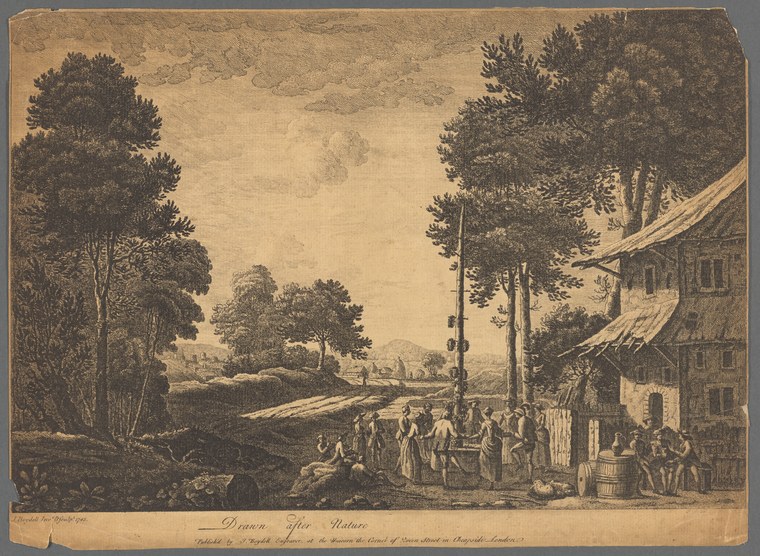
For dance historians, this image is rare evidence of the actual context and social texture of folk celebration in the period—not how it was idealized in pastoral poetry, but how it was practiced in village spaces. The emphasis on gathering and assembly rather than spectacular movement shows that folk dance functioned as communal ritual and social binding, not primarily as entertainment or display. For art historians, it exemplifies the shift toward documentary social imagery and the growing middle-class interest in picturesque views of rural life.
What you are looking at
A rural village gathering, rendered as an engraving in sepia tones. The composition shows a central pole—a maypole or dance standard—around which figures are assembled in an open space before a substantial house with a pitched roof. Tall trees frame both sides of the scene, creating a theatrical proscenium. To the right, figures cluster near the building; to the left and center, others stand or move in the open ground. The light is even and comes from above, typical of eighteenth-century engraving practice. A figure in light dress stands prominently near the pole, with others in darker clothing arrayed around it. The scene has the quality of a documented social occasion rather than a formal spectacle—the gathering appears casual, almost documentary in its attention to costume and posture.
The dancing
The bodies are upright and alert rather than in vigorous motion. Most figures stand or walk in relaxed postures; none display the extended, balletic frame of theatrical dance. Several figures in the foreground and middle ground wear long skirts and coats typical of late eighteenth-century dress. The central figure near the pole wears lighter clothing and appears to be either dancing or standing as a focal point for the assembly. No obvious paired holds or formations suggest formal ballroom dance; instead, the arrangement is loose and social, with individuals distributed across the space as if arriving, watching, or preparing rather than mid-performance.
The dance depicted
This appears to depict a maypole or seasonal village celebration rather than a ballroom dance or theatrical performance. The maypole was a traditional folk gathering in British and northern European communities, particularly at May festivals or summer celebrations. The title "Drawn after nature" suggests the artist witnessed or documented an actual event. The loose assembly, the prominence of the pole as a focal point, and the rural setting with substantial house and framing trees are all consistent with late eighteenth-century English rural celebrations. Whether active dancing around the pole is occurring or is about to occur is unclear; the image captures a moment of social assembly rather than captured movement.
How it was made
This is an engraving, likely a hand-colored or tinted example given its sepia tone and the note of publication visible at the base. The fine parallel lines and cross-hatching typical of copper-plate engraving are visible in the foliage, sky, and distant landscape. The technique allowed for relatively wide distribution as a print; engravings were cheaper to reproduce than paintings and were a primary vehicle for documentary imagery of social life in the eighteenth century. The precision of line and the careful gradation of tone suggest a skilled practitioner. The publication line at the base (partially legible) indicates this was issued as a commercial print, likely for middle-class consumption.
About this work
This engraving documents a rural gathering, possibly a maypole celebration or seasonal folk assembly, drawn from observation in late eighteenth-century England or a similar northern European context. The scene captures a moment before, during, or after communal dancing, showing the social and spatial organization of folk celebration rather than the formal theatricality of ballroom or theatrical dance. The work is valuable as visual evidence of how village dance was practiced and witnessed in this period—as a gathering organized around a symbolic center (the pole) rather than around virtuosity or formal steps. It belongs to the tradition of "drawn from nature" social documentation that emerged in the mid-eighteenth century, when artists began recording vernacular life with ethnographic attention.
How to look at it
Look first at the maypole as the organizational center—it is the anchor of the composition and presumably the anchor of the dance event itself. Notice how the figures are distributed in space rather than grouped in tight geometric formation; this distribution tells you this is a folk gathering, not a formal ballroom event. Attend to the costumes: the long skirts, coats, and hats are accurate to the period and suggest the artist is concerned with documentary detail. The framing trees and the substantial farmhouse create a sense of specific place rather than generic landscape—this is somewhere particular, witnessed and recorded.
The period
This engraving dates to the era of increasing interest in rural life and folk custom among urban and educated audiences—roughly 1750–1800. The late eighteenth century saw a boom in printed views of British scenery, rural occupations, and seasonal celebrations, driven by romantic nationalism and nostalgia for preindustrial life. Contemporary artists like Thomas Rowlandson and William Blake were similarly documenting scenes of social gathering and folk practice. At the same time, formal dance was increasingly professionalized and moved indoors to ballrooms and theaters; scenes of outdoor folk assembly became subjects of antiquarian or picturesque interest rather than living dance practice among the educated classes.
Where it lives
This print is held in the Prints collection at the New York Public Library, part of a broader archive of dance imagery. It is a commercial engraving, likely issued as a separate sheet or as part of a series of rural scenes or seasonal celebrations. The inscription at the base is the primary source for title and publication information; the artist remains unattributed in the catalogue record.
Dance in this work
Questions about this work
What is a maypole and how did people dance around it?
A maypole is a tall decorated pole, typically erected in a village green for seasonal festivals (particularly May Day). Dancers would typically hold ribbons or form circles around it, though the specific movements varied by region and time period. This image shows the pole and assembly but does not make the choreography clear; the loose distribution of figures suggests a casual gathering rather than organized stepping.
Is this a real event or an invented scene?
The title "Drawn after nature" and the publication details suggest the artist witnessed or documented an actual gathering. However, as an engraving issued for public sale, it may have been edited or idealized to suit middle-class taste for the picturesque. The specificity of the architecture and landscape suggests it depicts a real place.
What was the difference between folk dance and ballroom dance at this time?
Folk dance like maypole celebrations was outdoor, seasonal, communal, and organized around traditional spaces and times (like May Day). Ballroom dance was indoor, formalized with specific steps and patterns, and primarily practiced by educated and aristocratic audiences. By the late eighteenth century, these had become quite separate social worlds.
More dance artwork





