49 works in this view — arrow keys or swipe to move between them.
Dance in Art
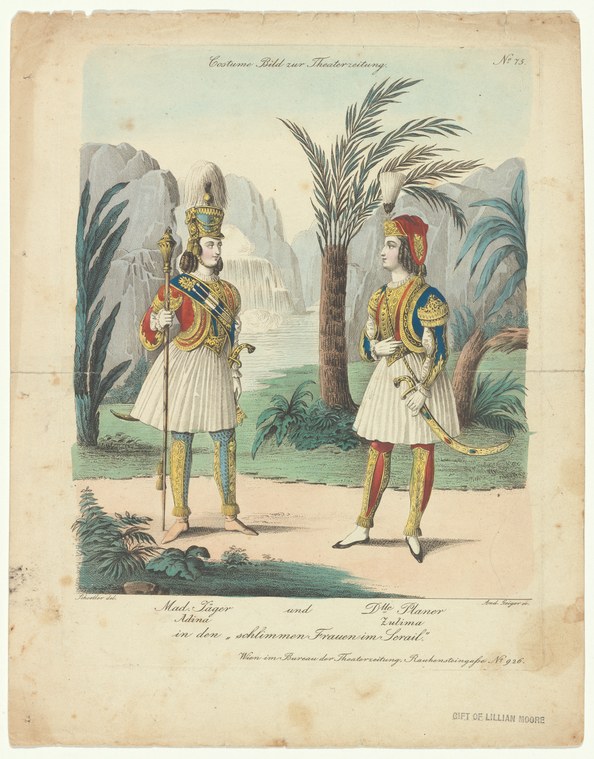
Mad. Täger (Adina) und Dlle. Planer (Zulima) in den "Schlimmen Frauen im Serail"
Unknown artist
- Collection:
- Prints depicting dance
- Source:
- New York Public Library
- Rights:
- Public domain — free to use, share and adapt.
- Recorded as:
- Public Domain
This image records the performance personas and costume design of two named female dancers in a significant theatrical tradition, making it valuable for historians of 19th-century theater, performance identity, and the material culture of opera. It shows how dance and theater practitioners of the period were documented and circulated to audiences, and demonstrates the conventions of Orientalism in European performance before photography made such documentation routine.
What you are looking at
Two figures in early 19th-century military dress stand in a lush tropical setting with tall palm trees and distant water. The figure on the left wears a white tunic with gold-trimmed epaulettes and a tall plumed headdress, holding a curved sabre; the figure on the right wears similar military dress with red-brown sleeves and a feathered bonnet. Both stand in relaxed, conversational postures suggesting an encounter or dialogue rather than active combat. The landscape behind them—rocky outcrops, cascading vegetation, and what appears to be a waterfall or river—places this in an exotic, colonial setting. The hand-colored engraving technique gives the scene the appearance of a theatrical or operatic illustration, with careful attention to the rich blues, greens, and golds of the costumes against the naturalistic background.
The dancing
Neither figure is engaged in active dance movement. Both stand upright with neutral weight distribution and relaxed arm positions—the left figure holds a sabre at their side, the right figure's arms hang naturally. The figures are separated by the central palm tree, positioned to face or acknowledge each other. This is a scene of courtship, negotiation, or dramatic encounter frozen at a moment of conversation rather than motion. The formal military dress and heraldic posture suggest theatrical rather than social or recreational dance.
The dance depicted
This appears to be a costume illustration from a 19th-century opera or theatrical spectacle rather than a depiction of an actual dance form. The title references *Die schlimmen Frauen im Serail* (The Wicked Women in the Seraglio), a work in the tradition of Oriental fantasies that were popular in European theaters. While no active dancing is shown, the image documents the visual conventions of such productions: exotic colonial setting, military-exotic costume hybrids, and the staging of female performers (Adina and Zulima are the named dancers) in Orientalist drag or cross-gender roles. The theatrical tradition here is one of spectacle and costume rather than a specific documented dance technique.
How it was made
This is a hand-colored engraving, likely from a theater or opera journal of the early 19th century. The technique—fine line engraving with hand watercolor application—was standard for theatrical costume and scene documentation in this period. The precision of the military insignia and the careful modeling of fabric suggest this was a commissioned record of an actual production, distributed to audiences or collectors interested in theatrical design. The hand-coloring, uneven but deliberate, indicates individual production rather than mass printing, typical of expensive specialty theater publications.
About this work
This is a theatrical costume illustration documenting two named performers—Mademoiselle Täger (as Adina) and Mademoiselle Planer (as Zulima)—in a production of an Oriental-themed opera or spectacle. The work belongs to the tradition of 19th-century European Orientalism, where exotic settings and cross-dressed military roles were standard stage devices. It is not a record of dance in motion but of theatrical costuming and staging convention. The engraving documents both the performers and the visual fantasy of colonial-era European theater, preserved in an archive that recognized such images as worthy of collection.
How to look at it
Look at the still, conversational posture: this is not a moment of dance but of theatrical encounter, chosen to display costume and setting rather than movement. The precision of the military dress—the epaulettes, the sabre, the feathered headdress—reveals what the designer considered central to the fantasy. The tropical setting, drawn with picturesque rather than naturalistic detail, frames these figures as exotic specimens. The image is a theater program made permanent: it tells you what the audience came to see, and how the performers were publicly identified.
The artist
The engraving is not attributed in the catalogue record. The notation 'Lith. Woelffinger' at lower right suggests involvement by a lithographic workshop or publisher of that name, common practice for theater prints of the period. Such images were often produced collaboratively by theater workshops, costume designers, and engravers, with authorship distributed across the production.
The period
The early 19th century saw explosive growth in European opera and spectacular theater, with Oriental settings and exoticized female roles becoming dominant fashion. The Napoleonic Wars and expanding colonialism fueled appetite for such fantasies. This period precedes the development of ballet as a codified international form; performance was primarily tied to specific opera houses, named performers, and ephemeral productions. The hand-colored engraving was the primary means by which theater audiences could own and circulate images of celebrated performances and performers.
Where it lives
The work is held in the New York Public Library's prints collection documenting dance imagery. The inscription 'Gift of Lillian Moore' indicates it was collected by the pioneering dance historian Lillian Moore, whose archive formed the basis of NYPL's dance holdings. The notation 'No 115' suggests it is one of a numbered series, typical of bound theater print collections or individual dance-history compilations.
Questions about this work
Are these dancers actually dancing?
No. This is a theatrical costume and scene illustration showing two performers in conversation or confrontation. It documents what they wore and how they were presented to audiences, not what they did in motion on stage. Such images were common in 19th-century theater documentation, preserving the visual spectacle rather than the choreography.
What is the Opera about?
*Die schlimmen Frauen im Serail* (The Wicked Women in the Seraglio) belongs to a tradition of Oriental fantasies popular in 19th-century European theater. Little is known about this specific production from the surviving record, but such works typically featured exotic settings, military intrigue, and female performers in cross-dressed or exoticized roles, designed to appeal to audiences' appetite for colonial spectacle.
Who were Täger and Planer?
Both are named on the print as performers in this production. Beyond that identification, the catalogue record provides no further biographical information. Such prints were the primary way individual theater performers became known to audiences beyond their home city, and collecting them was a way fans documented their favorites.
More dance artwork





