49 works in this view — arrow keys or swipe to move between them.
Dance in Art
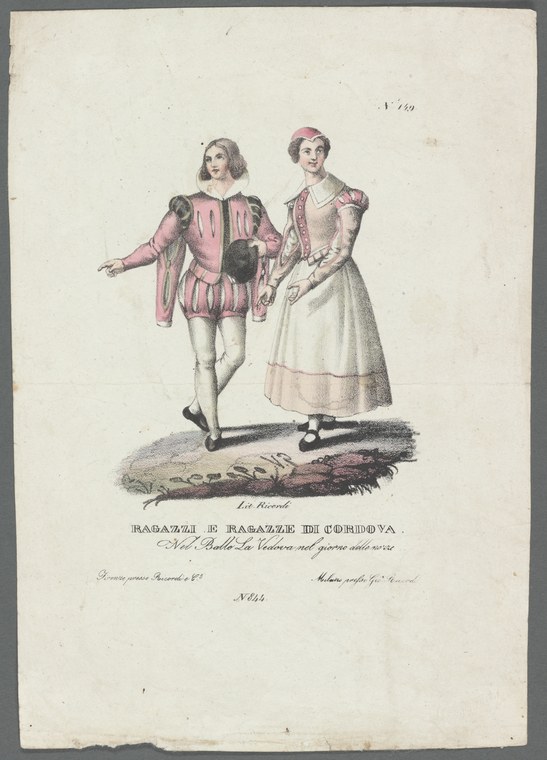
Ragazzi e ragazze di Cordova nel ballo La vedova nel giorno delle nozze
Unknown artist
- Collection:
- Prints depicting dance
- Source:
- New York Public Library
- Rights:
- Public domain — free to use, share and adapt.
- Recorded as:
- Public Domain
This work is rare documentary evidence of early 19th-century popular theatrical dance outside the ballet tradition—a visual record of how young performers embodied character and narrative through gesture and costume. The titled reference to a specific dramatic dance allows researchers to trace the work across European performance contexts and to recover details of choreography and meaning that are otherwise absent from historical records.
What you are looking at
A hand-colored engraving showing two young dancers in Cordoban dress, posed against a plain background with minimal setting detail. On the left, a boy wears a pink doublet with slashed sleeves and puffed sections, fitted at the waist with a short skirt; dark hose; and black shoes. His left arm extends gesturally outward. On the right stands a girl in a pink bodice with puffed sleeves and a full skirt reaching to her ankles, pale in tone. Both figures have pale complexions and styled hair typical of early-to-mid 19th-century European representation. The composition is a simple paired portrait, with the dancers shown at approximately three-quarter length and facing slightly toward each other, as if pausing mid-performance or about to begin.
The dancing
The two figures stand in loose proximity rather than in direct physical contact. The boy's posture is more animated—his left arm lifted and extended as if gesturing or leading—while his weight appears forward on one leg. The girl stands more formally upright, her arms at her sides or held neutrally. Neither figure demonstrates the turned-out positions or lifted ports de bras characteristic of ballet training; instead, both embody a more naturalistic, folk-derived stance. The spatial separation and the boy's leading gesture suggest a courtship dance or a dance in which partners briefly connect and separate.
The dance depicted
The title specifies this depicts Spanish (Cordoban) youth performing 'La vedova nel giorno delle nozze' (The Widow on Her Wedding Day), which suggests a dramatic or narrative pantomime dance likely from the Italian theatrical or commedia dell'arte tradition, adapted for Spanish performance contexts. The costume—particularly the boy's Renaissance-derived doublet and the girl's full skirt—evokes historical or rustic dress rather than contemporary fashion, a convention used in European dance prints to signal folk authenticity or theatrical archaism. The absence of pointe shoes, the relaxed frame, and the narrative title all point to a social or theatrical dance rooted in European folk practice rather than academic ballet, though the date and precise choreographic content cannot be established from the image alone.
How it was made
This is a hand-colored engraving, identifiable by its fine line work, cross-hatching for shading (particularly visible in the ground beneath the figures), and the characteristic precision of the medium. The hand coloring—applied in flat, soft washes of pink, flesh tone, and pale hues—is period-appropriate and uneven in places, consistent with commercial hand coloring of the early 19th century. As a colored engraving, this work was produced for circulation among a broad, non-specialist audience: dancers, theater enthusiasts, music teachers, and domestic collectors. The medium allowed for rapid reproduction and affordable dissemination across Europe, and the inclusion of Italian and Spanish titles suggests a deliberately international market.
About this work
This hand-colored engraving documents a performance tradition now largely lost: European theatrical dance rooted in folk narrative and commedia dell'arte, performed by and for Spanish and Italian audiences in the early 19th century. The work captures the moment of a specific dance—'The Widow on Her Wedding Day'—with careful attention to costume and the gestural language that distinguished it. It belongs in a dance archive not as a record of an elite form like ballet, but as evidence of a popular, narrative-driven theatrical practice in which young dancers performed historical or rustic characters. The engraving's circulation and style suggest it was created to teach, advertise, or commemorate a performance tradition that engaged ordinary European audiences and persists now chiefly in printed images.
How to look at it
Notice the boy's gestural reach and the spatial separation between the two figures: the artist has chosen to freeze a moment of approach or invitation rather than a supported balletic lift or synchronized pair movement. This choice conveys a folk or commedia aesthetic in which dance emerges from storytelling and character rather than from abstract movement vocabulary. The detailed rendering of the Cordoban costume—the pink doublet's slashing, the girl's gathered skirt—anchors the dance to place and narrative: these are not timeless dancers but performers enacting a widow's wedding day.
The artist
The artist is not recorded. The engraving's style—the refined line work, the accurate rendering of textile detail, and the careful hand coloring—suggests professional production, likely by an established engraving workshop serving the theatrical market. The inclusion of Italian and Spanish titles implies a commercially-minded engraver working in a cosmopolitan European publishing center, possibly Rome, Milan, or Madrid, during the early-to-mid 19th century.
The period
In the early 19th century, European theatrical dance existed in a complex ecology: ballet was professionalized and increasingly codified under the Romantic aesthetic, but popular theater, commedia dell'arte, and folk-narrative dance remained vital forms, especially in Italy and Spain. Hand-colored engravings of dancers and dance scenes were a major medium for documenting performance and circulating images of famous dancers, character roles, and theatrical moments among paying audiences and amateur dancers. This print belongs to that widespread market of theatrical ephemera that recorded and promoted theatrical dance culture beyond the opera house.
Where it lives
The work is held in the New York Public Library's collection of prints depicting dance, a collection built primarily from 19th and early 20th-century theatrical ephemera and documentary prints.
Dance in this work
Questions about this work
What is 'La vedova nel giorno delle nozze'?
The title translates as 'The Widow on Her Wedding Day.' It refers to a specific theatrical dance or pantomime dance, likely drawn from Italian commedia dell'arte or Spanish folk-theater traditions. The narrative—a widow remarrying—would have been performed through gesture, costume, and music. The dance appears to have circulated across European theatrical venues in the early 19th century, but detailed records of the choreography or music are scarce.
How do I know this is an engraving?
The image shows characteristic engraving technique: fine parallel lines (hatching) used to create shadow and depth, particularly beneath the figures' feet. The line quality is consistent and precise, typical of hand engraving rather than lithography or etching. The hand coloring—applied in soft, flat washes—was a common commercial practice that allowed engravings to be colored quickly and sold at affordable prices.
Is this ballet?
No. The posture, costume, and title all indicate a narrative theatrical dance rooted in European folk and commedia traditions, not academic ballet. The figures lack the turned-out positions, lifted ports de bras, and formal training visible in ballet prints of the same period. This is a social or theatrical dance, performed by young dancers in character.
Who were the dancers?
The print is titled 'Ragazzi e ragazze di Cordova'—boys and girls from Cordoba—but does not name individual performers. This phrasing suggests either that the dancers were local to Cordoba and known by place, or that the print was advertising a traveling company or theatrical troupe. No documented performance history survives.
More dance artwork





