49 works in this view — arrow keys or swipe to move between them.
Dance in Art
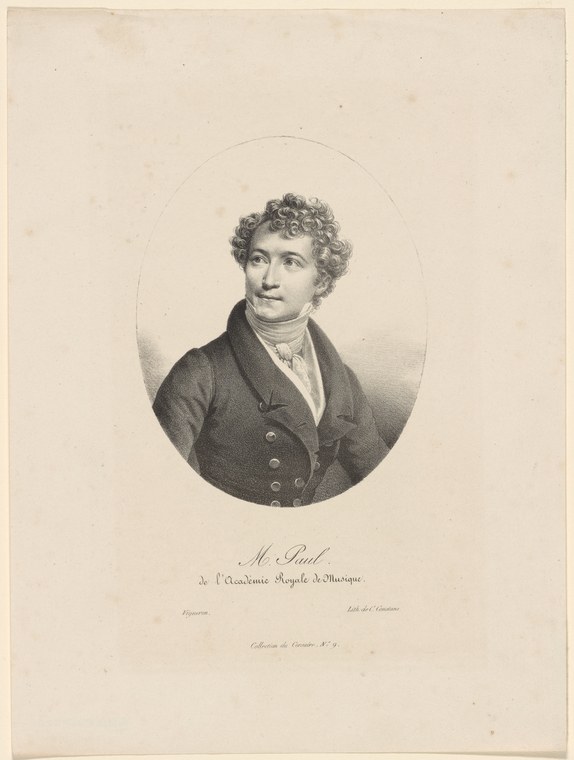
M. Paul de l'Académie royale de musique
Unknown artist
- Collection:
- Prints depicting dance
- Source:
- New York Public Library
- Rights:
- Public domain — free to use, share and adapt.
- Recorded as:
- Public Domain
The inscription identifies the subject by title and institution but not by full name, suggesting he was known to the print's intended audience but is now lost to recovery. The work documents the visual culture of the Paris Opera and the practice of commemorating its personnel through portraiture.
What you are looking at
A bust-length portrait of a young man with curled hair, rendered as an engraving in oval format. He wears a dark double-breasted coat with visible buttons over a white cravat or collar, and his gaze is directed upward and to the left in a pose typical of Romantic-era portraiture. The figure is set against a plain background within a simple oval frame, with minimal setting detail. Below the portrait, text identifies him as 'M. Paul / de l'Académie royale de musique'—indicating he was associated with the Paris Opera.
The dancing
The subject is a single figure shown from shoulders up. His posture is upright and composed, with head tilted slightly upward in a contemplative or elevated pose characteristic of portraiture of theatrical personalities. There is no active gesture or bodily engagement with space; this is a formal commemorative likeness rather than a figure in motion.
The dance depicted
This is not a dance scene. The inscription identifies the subject as a performer or official connected to the Académie royale de musique (the Paris Opera), but the portrait format provides no evidence of what he danced, taught, or performed. He may have been a dancer, choreographer, ballet master, or administrator, but the image itself shows only his face and formal dress, not his practice or technique.
How it was made
This is an engraving—a print executed in line, likely steel or copper. The technique is evident from the fine parallel hatching used to model the face and create shadow in the coat, and the crisp linear frame around the oval. As a reproductive engraving of the 19th century, it was likely made from a painting or drawing and issued as a commercial print for a modest audience of opera-goers and collectors of theatrical portraiture. The oval format and formal execution follow conventions for portraits of professional entertainers.
About this work
This is a formal portrait engraving of an unidentified man associated with the Paris Opera (Académie royale de musique), likely from the 19th century. The inscription is the only evidence of his connection to dance or performance; the image itself offers only a record of his appearance at a particular moment in his career. Such prints circulated among opera subscribers and were sometimes collected in series to memorialize artists and administrators of the institution.
How to look at it
This is a portrait, not a dance image. Attend to the formal conventions of the medium: the oval frame (a device of intimacy and dignity), the upward gaze (suggesting aspiration or noble bearing), and the fine modeling of the face through hatching. The inscription is the only anchor to dance; without it, there is nothing in the portrait itself to indicate the subject's profession.
The artist
The artist is not recorded. The execution is competent and professional, suggesting a commercial printmaker working for the Paris Opera or a publisher serving its constituency. The oval format and engraving technique place this within a standard 19th-century practice of issuing portrait series of theatrical celebrities.
The period
The Paris Académie royale de musique was the premier venue for ballet and opera in 19th-century France. Dancers and choreographers of the institution were celebrated cultural figures, and prints of their likenesses were sold as mementos and collectibles. The Romantic era saw a high demand for such portraiture as ballet gained prestige and celebrity dancers became public personalities. The curled hair, coat style, and engraving technique suggest a date in the mid-to-late 19th century.
Where it lives
The work is catalogued as part of a collection of prints depicting dance, held by the New York Public Library. It is a commercial engraving, part of what may have been a series of Paris Opera portraits issued for public sale.
Questions about this work
Who was M. Paul?
The full name is not recorded on the print. The inscription identifies him only as 'M. Paul' and notes his connection to the Académie royale de musique (Paris Opera). He may have been a dancer, choreographer, ballet master, or administrator of the institution, but without additional research this cannot be determined from the image alone.
Is this a dancer?
Possibly. The inscription places him at the Paris Opera, which was the home of ballet in 19th-century France, so he may have been a professional dancer, teacher, or choreographer. However, the portrait itself provides no visual evidence of his role or practice.
When and where was this made?
The engraving technique, the style of dress, and the curled hair suggest a mid-to-late 19th-century date, but this is not certain. It was almost certainly issued in Paris, likely as a commercial print sold to opera subscribers and enthusiasts.
More dance artwork





