49 works in this view — arrow keys or swipe to move between them.
Dance in Art
The polka on 19th-century music covers
Unknown artist
- Collection:
- Prints depicting dance
- Source:
- New York Public Library
- Rights:
- Public domain — free to use, share and adapt.
- Recorded as:
- Public Domain
The polka is a crucial transition figure in European dance history—the first dance craze of the industrial age, spreading via print, music, and fashion rather than court transmission. This cover image is a primary visual document of how the dance actually appeared in the ballrooms where it was most danced, and of the commercial infrastructure (print culture, music publishing, domestic performance) that sustained it.
What you are looking at
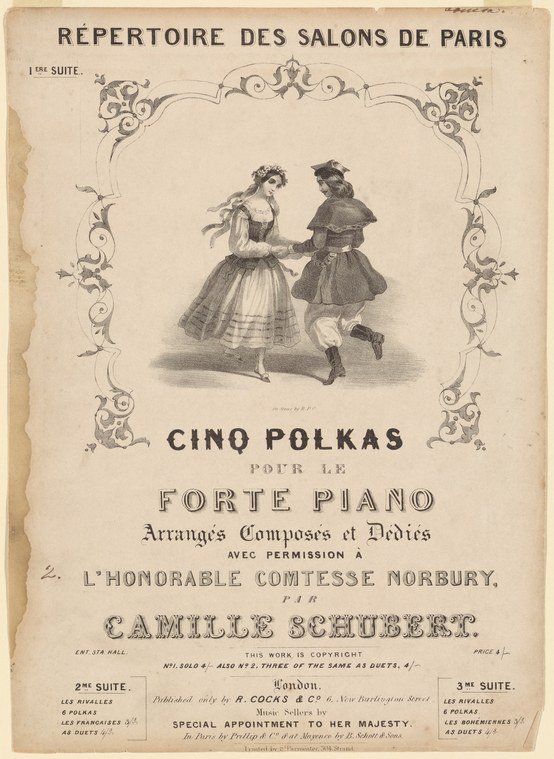
This is the cover page of a printed collection of polka music arranged for forte piano, issued in Paris in the mid-19th century. The title page frames a central vignette showing two dancers in mid-performance: a woman in a pale, full skirt with horizontal striping wears her dark hair up; a man in dark tailcoat and light-coloured breeches faces her with one arm extended. Both are caught in an animated moment—their bodies angled toward each other, their posture suggesting the springing, turning action of the polka. The ornamental border of scrollwork and flourishes that frames this scene is typical of Victorian-era printed music, emphasizing the object's status as a fashionable item for the domestic music room. The typography credits the arrangement to Camille Schubert "with permission to H. Comtesse Norbury", suggesting these pieces were commercial publications intended for amateur musicians.
The dancing
The two dancers occupy the centre of the composition in a semi-closed or open ballroom position, with the man's torso angled slightly backward and his right arm extended toward his partner, suggesting an active turning figure. The woman leans slightly into him, her weight forward and her skirts lifted and swirling, indicating vertical bounce and horizontal rotation. Both figures display the upright carriage and restrained arm styling typical of mid-19th-century ballroom decorum—no dramatic lifts or extensions, but clear evidence of spring in the legs and control in the upper body. The space between them and their relative heights suggest this is not a stylized or exaggerated rendering but a reasonably naturalistic capture of the dance as it would have appeared on a Parisian dance floor.
The dance depicted
This is unequivocally the polka, identified by the title and reinforced visually by the characteristic poses: the upright frame, the woman's full skirt in motion, the springing posture, and the turning action implicit in both bodies' angles. The polka originated in Bohemia in the 1830s and became a craze across Europe by the 1840s–50s, particularly in Paris salon culture. This image documents the dance as it was performed in urban ballrooms—a couple's dance in which partners alternated weight from one foot to the other in a quick, bouncing rhythm while progressing around the room. The presence of a composer's attribution and a dedication to a titled patron indicates this was sheet music for home performance, meaning the dance was not confined to professional dancers or concert halls but was actively danced by amateur musicians and their partners in domestic settings.
How it was made
This is a lithographic print, identifiable by its fine linework, the delicate grey tonal modeling of the figures and border, and the characteristic soft edge of lithographic line. Lithography allowed for rapid, affordable mass production of illustrated sheet-music covers, making fashionable dance images accessible to middle-class households. The ornamental border and framed central image are typical of commercial music publishing in the 1850s–60s, when visual branding and decoration became central to marketing printed music. The survival of multiple copies (this appears to be part of a series, with 1ère, 2ème, and 3ème suites noted) confirms this was a professional trade publication distributed across Europe.
About this work
This is a mid-19th-century Parisian sheet-music cover documenting the polka during the height of its fashionable popularity. The lithograph shows a couple mid-dance, their postures, dress, and frame recording how the polka actually looked when performed by the urban ballroom dancers who were its primary audience. As both a commercial artifact and a visual record, it sits at the intersection of dance history and material culture: it is evidence not only of what the polka was, but of how it was consumed, marketed, and integrated into respectable domestic life. The image is valuable precisely because it is not a high-art representation—it is a commercial document that had to be recognizable and appealing to ordinary dancers and musicians.
How to look at it
Look at the posture of the man's torso and the angle of his extended arm—notice the slight backward lean and the energy implied by his position. Look at the woman's skirt: the artist has rendered it in motion, lifted by the centrifugal force of the turning figure, not hanging static. Look at both dancers' legs and the spring implied in their stance. The artist has chosen a moment of active turning and rising—not a posed or static moment, but a moment that captures the characteristic action of the polka: the hop and turn. Compare this pose to the upright formality of the baroque minuet or the sustained, flowing line of the waltz; the polka's character is restless, bouncy, forward-moving.
The artist
No artist is recorded in the catalogue. The lithograph bears the credit line "Printed by [printer's mark]", which suggests it was produced by a commercial music-printing firm in Paris. Such covers were often unsigned or credited only to the printer, as they were commercial products rather than fine-art prints. The arrangement was composed by Camille Schubert, a pianist and composer active in mid-19th-century Paris, but the identity of the designer of the dance vignette is unrecorded.
The period
The polka arrived in Paris from Prague around 1840 and immediately became a sensation in ballrooms and salons, rivaling the quadrille and waltz in popularity by mid-century. Musically, it was perceived as modern, energetic, and democratic—less rigid than the quadrille, faster and more playful than the waltz. In artistic representation, the polka was frequently depicted in prints, paintings, and satirical caricatures, reflecting both its fashionable status and its controversial reputation among some conservatives who saw it as too vigorous and ungoverned. The lithographic music cover—a hybrid of commercial product design and popular art—was the primary medium through which dance imagery reached the domestic market. This collection's dedication to a titled patron and arrangement by a known composer situates it in the respectable middle and upper-middle class market where the polka was most assiduously promoted and danced.
Where it lives
This is part of a series titled "Répertoire des Salons de Paris" (Repertory of the Paris Salons), housed in the New York Public Library's collection of prints depicting dance. It is a commercial printed artifact—a music-cover lithograph—rather than a unique work, and was mass-produced for sale to amateur musicians.
Dance in this work
Questions about this work
What is a polka and who danced it?
The polka is a couple's ballroom dance that originated in Bohemia in the 1830s and became wildly popular in European ballrooms and salons from the 1840s onward. It was danced by amateur dancers—middle-class men and women in ballrooms, at balls, and at home—rather than by professional performers. The dance is characterized by a quick, bouncing step and turning motion, and is danced in a closed ballroom frame.
Why was the polka so popular?
The polka was perceived as modern, energetic, and egalitarian. It was faster and more animated than the waltz, less rigid than the quadrille, and it allowed greater individual expression and improvisation. It also coincided with the rise of urban ballroom culture and mass print media, which promoted and popularized it rapidly across Europe.
What does the image tell us about how the polka was actually danced?
The lithograph captures the characteristic posture and action of the polka: the upright frame, the springing weight shift, the turning motion, and the full skirt in motion. It shows dancers in a semi-closed or open position, with active engagement and visible energy in the legs and torso. It is a record of how the dance appeared in the ballrooms where it was most commonly performed, not a stylized or theatrical rendering.
What is a lithographic print?
Lithography is a printing technique in which an image is drawn on a stone or metal plate using a greasy substance, then printed onto paper. It allowed for rapid mass production of images and was the primary medium for illustrated sheet-music covers, commercial posters, and popular prints in the 19th century. This technique made visual imagery widely accessible and affordable to middle-class households.
More dance artwork





