49 works in this view — arrow keys or swipe to move between them.
Dance in Art
The polka on 19th-century music covers
Unknown artist
- Collection:
- Prints depicting dance
- Source:
- New York Public Library
- Rights:
- Public domain — free to use, share and adapt.
- Recorded as:
- Public Domain
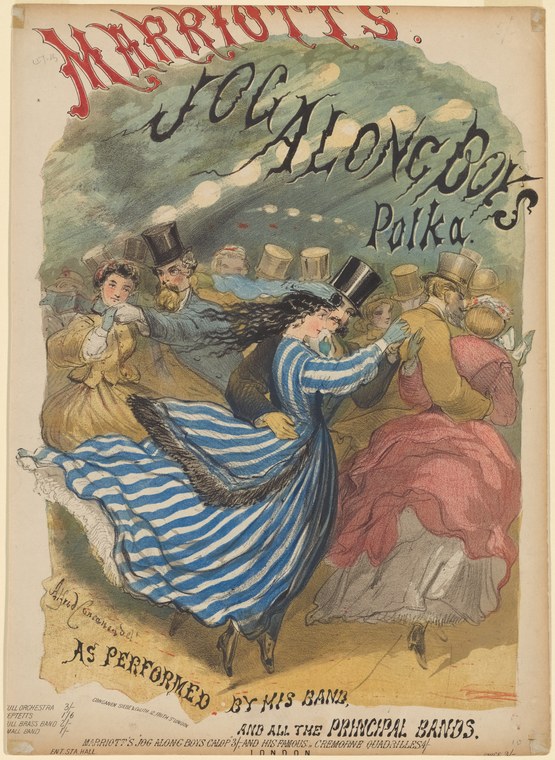
The polka is one of the great global dance phenomena of the 19th century, and this print is a rare visual record of how it looked in motion and how it was promoted as a living social practice rather than a formal technique. For historians of dance, ballroom culture, and the commercialization of entertainment, the image is a primary source showing the polka's visual style, the dress and setting of ballroom dancing, and the business of selling dance to a mass audience.
What you are looking at
A lively ballroom or dance hall scene crowded with figures in 19th-century dress, animated in the midst of the polka. The composition is densely packed with dancers, musicians, and onlookers arranged around the central figures. A couple dominates the foreground: a woman in a striking blue-and-white striped dress with her skirts flying outward, caught mid-spin or leap, her body inclined sharply from vertical; a man in dark coat and top hat partners her, their bodies clearly in a close ballroom hold. Around them, other couples dance in similar formations, their clothing—bright yellows, pinks, reds, and muted tones—creating a sense of festive motion. In the background, figures with instruments (a band) are visible among the crowd. The setting appears to be indoors, lit by what may be candlelight or gaslight. The entire scene vibrates with movement; even the stationary figures lean and gesture, their attention fixed on the dancers.
The dancing
The central couple demonstrates a closed ballroom hold: the man's arm appears to support the woman around her back, their bodies positioned for a turning motion. The woman's weight is visibly committed to the turn—her body angled away from vertical, her arms raised or extended, her skirts billowing with centrifugal force, suggesting rapid rotation. The dancers around them mirror this frame and energy: multiple couples visible in closed holds, bodies tilted inward toward each other, skirts and coat-tails swinging. The footwork cannot be clearly read in this engraved image, but the posture and line suggest the characteristic polka bounce and forward-driving momentum. The crowd of onlookers—men and women standing, some gesturing—reinforces the sense of popular social spectacle rather than formal theatrical display.
The dance depicted
This is unquestionably a polka scene, and likely from a music cover or dance instruction broadside given the title text and inscription visible on the print. The polka was a couple dance in closed ballroom hold that swept through Europe and America in the 1840s–1880s, characterized by a fast 2/4 time, a distinctive syncopated step pattern, and energetic turning. The image captures the dance's defining visual signature: the rapid spinning of partners in a tight closed frame, the woman's skirts lifted and fanned by the momentum, the upright but dynamic posture. The mix of couples at various stages of turning, the band in the background, and the informal social setting (not a formal ball or court) are all consistent with the polka's status as a popular, exuberant dance of the ballroom and music hall, danced by the middle classes and working people alike.
How it was made
This is a hand-colored engraving or lithograph, as evidenced by the fine line work, the color applied in discrete areas, and the characteristic texture of the paper and printing process visible in the image. The work bears the signs of mass production: bright, flat colors in primary and secondary tones; relatively simple shading; and the bold, legible composition needed for a commercial music or dance publication. The presence of the title 'Harris's Polka' prominently lettered at the top and the notation 'AS PERFORMED BY HIS BAND' and 'AND ALL THE PRINCIPAL BANDS' indicates this was a published sheet music or dance hall advertisement, intended for wide circulation and immediate visibility. The technique allowed for rapid color printing suitable for inexpensive commercial distribution.
About this work
This is a mid-19th-century music or dance hall promotional print depicting the polka at the height of its popularity and social reach. The composition is a vivid snapshot of the dance as it was performed and experienced in ballrooms and public dance venues: energetic, social, intimate between partners, and visibly joyful. The print captures not only the mechanics of the dance—the closed hold, the turning, the lifted skirts—but its cultural meaning: a modern, accessible, exuberant social practice open to ordinary people, not confined to court or formal ceremony. The presence of multiple couples, the band, and the crowd of onlookers emphasizes the polka's role as a feature of public entertainment and social gathering.
As a visual document, the print is invaluable evidence of how the polka was actually performed and how it was marketed and consumed. The hand-colored engraving technique and commercial design suggest a work aimed at dancers, musicians, and the dance-curious among the middle and working classes. The title attribution to Harris and 'his band' indicates this was tied to a specific musical or dance performance or performer, giving it a concrete historical foothold.
How to look at it
Look first at the central couple and the angle of the woman's body: the artist has captured the moment of a fast spin, with her weight fully committed to the turn and her skirts fanned by the motion—a decisive visual choice that conveys the polka's energy and pace. Notice how the other couples around them mirror this gesture, creating a rhythm across the composition. The density of the scene and the mix of dancing, watching, and playing emphasizes that the polka was a social and communal practice, not a solo or exhibition form. The bright colors and informal dress mark this as a ballroom dance of the middle classes, not a formal court or theatrical performance.
The period
The polka emerged in Bohemia (present-day Czech Republic) in the 1830s and spread rapidly across Europe and North America in the 1840s–1860s, becoming one of the most danced and most commercially exploited dances of the era. It was danced in ballrooms, public dance halls, theaters, and at social gatherings by people of all classes; it spawned countless published polkas (musical compositions), dance instruction books, and, as this print shows, commercial promotional material. The polka represented modernity, accessibility, and social change—it was faster, more informal, and more egalitarian than the aristocratic dances of the previous generation. By the 1850s–1880s, when this print was likely created, the polka had become a staple of popular music and dance culture, and prints like this one were a standard means of advertising performances, music publications, and dance instruction.
Where it lives
The print is held in the New York Public Library's collection of prints depicting dance. The title, inscription, and commercial design indicate it was a published music cover, dance advertisement, or broadside, intended for circulation in ballrooms, music shops, or dance halls.
Dance in this work
Questions about this work
What is the polka and when was it danced?
The polka is a couple dance in closed ballroom hold, characterized by a fast 2/4 time, a syncopated step pattern, and energetic turning. It originated in Bohemia in the 1830s and became one of the most popular social dances of the 19th century, danced across Europe and America from the 1840s through the 1880s and beyond. It was danced in ballrooms, public dance halls, and at social gatherings by people of all classes.
How can you tell this is a polka from the image?
The title 'Harris's Polka' identifies it directly. Visually, the image shows the polka's signature elements: couples in a closed ballroom hold, rapid spinning with the woman's skirts lifted and fanned by centrifugal force, upright but dynamic posture, and multiple couples dancing in a fast, energetic tempo. The setting—a crowded ballroom with a band—is also typical of polka performance and consumption.
Who danced the polka?
The polka was a democratic dance danced by the middle and working classes in ballrooms and public dance halls. Unlike the formal court dances of the aristocracy, the polka was accessible, informal, and popular among ordinary people. This print's emphasis on a crowded ballroom with many dancers and onlookers reflects the polka's mass appeal.
What does 'Harris's' refer to?
The title attribution to Harris likely refers to a specific musician, bandleader, or performer associated with a well-known polka performance or musical arrangement. The inscription 'AS PERFORMED BY HIS BAND / AND ALL THE PRINCIPAL BANDS' suggests the work was tied to a celebrated performance or performer of the era, and the print was issued as a promotional item or music cover to capitalize on that reputation.
More dance artwork





