49 works in this view — arrow keys or swipe to move between them.
Dance in Art
The polka on 19th-century music covers
Unknown artist
- Collection:
- Prints depicting dance
- Source:
- New York Public Library
- Rights:
- Public domain — free to use, share and adapt.
- Recorded as:
- Public Domain
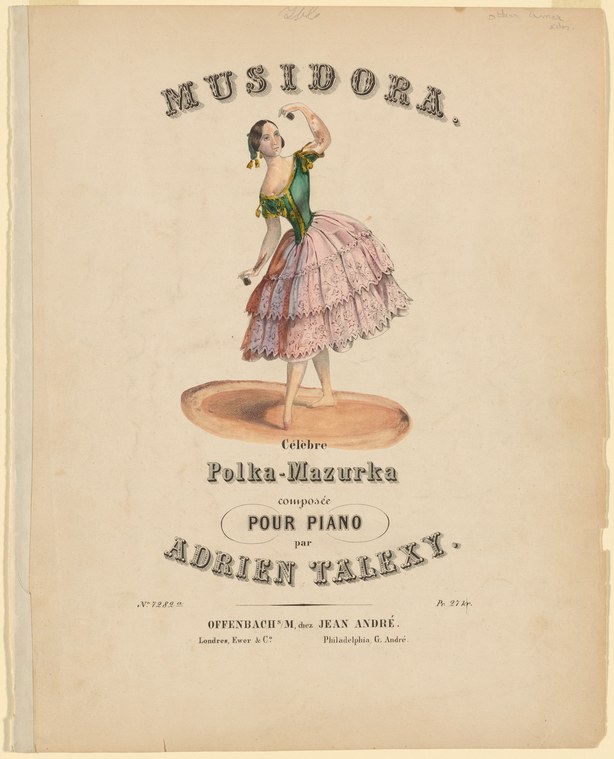
This print is a rare direct visual record of how the polka was actually performed in the mid-19th century—not as a generic couple in a ballroom, but as a celebrated solo performance with specific theatrical presentation. It also documents the close relationship between dance, music publishing, and celebrity in the commercial culture of the era: the polka was not just a parlor dance, but a vehicle for performers and composers to build fame and sell sheet music across the Atlantic.
What you are looking at
A single female dancer stands poised on a shallow oval platform against a pale background, captured in a moment of spirited movement. She wears a vivid green silk bodice or jacket with short sleeves, paired with a voluminous pink skirt of multiple tiers trimmed with lace or gathered ruffles—a fashion of the mid-19th century. Her right arm is raised in a graceful gesture toward her head, while her body twists slightly, suggesting captured mid-turn. Her hair is pulled back in the style of the period. The composition is a formal presentation, as befits a music cover: the dancer is isolated and spotlit, centered on the platform, rendered in hand-colored lithograph with careful attention to the textures of fabric and the play of light across her costume.
The dancing
A single dancer, viewed at three-quarter length. Her posture is upright and elegant, with weight distributed evenly as she appears to turn or pivot. The raised right arm is graceful and controlled, the gesture suggesting either a moment of flourish or the upper-body action of a turning step. Her left arm hangs naturally at her side. The torso twists gently in the direction of her gaze, upward and to the right. There is no partner, no group—this is a solo moment designed to display the dancer herself and her costume.
The dance depicted
This is a polka, as declared explicitly in the title: 'Célèbre Polka-Mazurka.' The polka was one of the dominant social dances of the mid-19th century, spreading rapidly from Eastern Europe to ballrooms across Europe and America after 1830. This image represents the polka as a concert or exhibition piece rather than a social ballroom dance—a solo performance by a named or celebrated dancer (the title suggests fame: 'Célèbre'). The moment chosen shows the characteristic lively, turning action of the polka, with the dancer captured mid-pivot. The composition emphasizes the dancer as a star performer rather than a partner in social exchange.
How it was made
This is a hand-colored lithographic print, a medium perfectly suited to the music-cover market of the 1840s–1860s. Lithography allowed rapid, economical reproduction of images with bold colors and fine detail, making such covers affordable entertainment ephemera. The hand-coloring (visible in the pink and green of the costume, the warm tone of the platform) was applied after printing, a common practice that allowed variation and a more luxurious appearance. The technique permitted both fine line work in the dancer's features and bold areas of flat color in the costume, creating a vivid and eye-catching design for retail display and collection.
About this work
This is a music cover for a polka-mazurka titled 'Musidora,' a hybrid dance form that blended the energetic turning of the polka with elements of the stately mazurka—both immensely popular in the mid-19th century. The print advertises a piano work by Adrien Talexy, published by Offenbach (the famous composer's publisher) in Paris and Philadelphia. It is a document of dance as commercial entertainment and musical fashion: the image serves not to teach the dance but to sell the music by associating it with a glamorous, named performer. The polka and its variants were urban, middle-class dances, and this cover—bright, accessible, and reproducible—is a perfect artifact of that world. The image captures both the visual spectacle of mid-century theatrical dance costume and the commercial machinery that turned dances into sheet music and stars.
How to look at it
Attend to the moment captured: the dancer is neither at rest nor in a full extension, but caught mid-pivot with her upper body already turning and her face lifted. This is the moment of greatest visual interest in a turning step—not the preparation or the landing, but the spiral itself. Notice how the costume is designed to enhance the turning action: the full, tiered skirt reads as a cone of movement, and the bright color makes the figure vivid and legible at the scale of a printed cover. The artist has chosen a theatrical presentation (isolated figure, dramatic platform, formal dress) rather than a ballroom setting, signaling that this is a display of skill and spectacle, not social recreation.
The artist
The artist is not recorded in the catalogue. However, the quality of the lithographic line and the sophistication of the composition suggest a trained commercial artist, likely working in Paris in the mid-19th century during the height of the polka's popularity. Such dance-cover art was a substantial genre, produced by both anonymous staff artists and recognized illustrators. The publisher's imprint—Offenbach à Paris / Brandeis, Bauer & Cie. Philadelphie—indicates transatlantic distribution and commercial significance.
The period
The polka emerged in Bohemia in the 1830s and became a continent-wide craze by the 1840s, rivaling the waltz in popularity and social reach. Unlike the waltz, which retained aristocratic associations, the polka was embraced by the urban middle classes and was danced in ballrooms, music halls, and theaters. Composers and choreographers rapidly created theatrical and hybrid forms—the polka-mazurka being one example—to capitalize on the fashion. This print dates from that peak period, when a new polka or polka variant could become a commercial hit, supporting orchestras, dancers, and music publishers. The mid-19th century also saw the rise of the named female performer as a draw: dancers like Lola Montez became celebrities, and their images were commodified through prints and music covers.
Where it lives
This is a music cover from the collection of dance-related prints held by the New York Public Library. Such covers were printed in quantity and distributed through music shops and to performers; they were ephemeral commercial objects, and survival in a collected set is relatively rare.
Dance in this work
Questions about this work
What is a polka-mazurka?
A hybrid dance form combining the energetic 2/4 triple-step turning action of the polka with slower, more stately movements borrowed from the mazurka. Such fusions were common in the mid-19th century as composers and choreographers experimented with blending popular forms to create new and marketable pieces.
Was the polka danced solo?
Typically, no—the polka was a couple's dance, performed in social ballrooms and dance halls. This image shows it as a theatrical solo performance, a showcase of a celebrated dancer's skill and the designer's costume. This distinction between ballroom and stage versions was important in the era.
Who was Musidora?
The title does not identify the dancer by a clear surname, and no certain record of a performer of this name or period has been located. 'Célèbre' (celebrated) suggests she was known, but she may have been a regional star or the title may be generic. Such dance covers often used flattering or invented names to appeal to audiences.
Why is this a lithograph and not a painting?
Lithography was far cheaper and faster than oil painting, allowing publishers to produce hundreds of copies quickly and sell them affordably alongside sheet music. This made dance imagery accessible to middle-class households and performers, turning it into a form of mass entertainment and advertisement.
More dance artwork





