49 works in this view — arrow keys or swipe to move between them.
Dance in Art
Fairy land schottisch by Van der Weyde
Unknown artist
- Collection:
- Prints depicting dance
- Source:
- New York Public Library
- Rights:
- Public domain — free to use, share and adapt.
- Recorded as:
- Public Domain
This artifact bridges dance history, music history, and visual culture: it shows not only what a schottische was, but how it was marketed to consumers, what fantasies surrounded it, and what visual language was used to make a social dance desirable. The image reveals the gendered, Orientalist, and Romantic aesthetics that shaped 19th-century ballroom culture.
What you are looking at
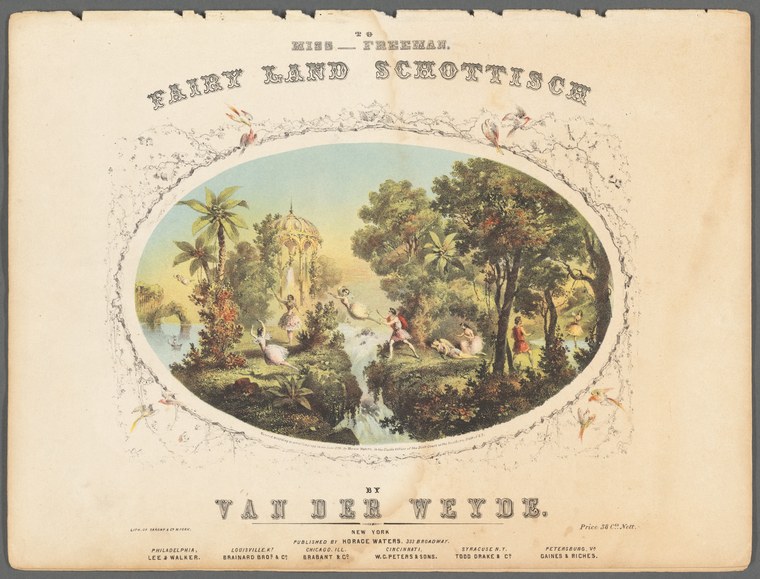
A romantic woodland idyll unfolds within an ornate oval frame. In the foreground, couples and solitary figures move through a lush landscape of towering palms, dense foliage, and classical architecture. The scene is bathed in soft golden light. On the left, a couple dances in the middle distance; other figures recline, gesture, and converse among the trees. A fountain or water feature is visible among the vegetation. The composition draws the eye through layered depth, with the dancing couple positioned as the focal narrative action, while attendant figures populate the scene in attitudes of leisure and courtship. The overall effect is of a fantastical pleasure garden where dance and romance coexist.
The dancing
The central dancing pair—visible in profile in the middle distance—appears to be in a closed ballroom hold, the man's arm at the woman's waist, their bodies oriented in the direction of travel characteristic of couple dancing. The woman's skirt is voluminous and captures the motion of turning. Other figures around them are in conversational poses, reclining on the ground, or gesturing in animated discussion. The postures are relaxed and elegant, belonging to the leisured ballroom world rather than folk or theatrical contexts.
The dance depicted
The title identifies this as a schottische, a popular couple dance of the 19th century that combined elements of the polka with a march-like character. The schottische emerged in the 1840s and became standard in ballroom repertoire throughout the Victorian and Gilded Age. The artistic choice to set the dance in a fantastical, pastoral 'fairy land' rather than a ballroom reflects the Romantic taste of the era, which clothed popular social dances in literary and imaginative contexts. The small scale and peripheral positioning of the dancing couple within the larger pastoral scene suggest this is sheet music cover art, where the dance is the pretext for a broader scene of romantic fantasy.
How it was made
This is a hand-colored lithograph, a reproductive technique that dominated commercial music publishing and popular print culture of the 19th century. Lithography allowed rapid, affordable production of color images and made it economical to commission elaborate covers for individual pieces of sheet music. The delicate hand-coloring—visible in the soft greens of the foliage, the pink of the fabric, and the pale blue of the sky—was applied over a lithographic base. This technique and format indicate wide circulation among amateur musicians and dance enthusiasts of the middle classes.
About this work
This is the cover artwork for a piece of sheet music titled *Fairy Land Schottisch*, composed by Van der Weyde. The schottische was a fashionable ballroom couple dance of the 19th century, and sheet music for individual dances was a major commercial product aimed at home musicians and dancers. The image does not depict a ballroom; instead, it frames the dance within an Orientalist or Romantic fantasy landscape of palms, classical ruins, and languid leisure. This choice was typical of the era—social dances were often marketed through imaginative, literary frames that elevated them beyond mere social recreation. The work belongs to a large body of music publishing ephemera that documents both the dances people actually performed and the fantasies in which they imagined themselves.
How to look at it
Note the careful composition that makes the dance itself almost incidental to the scene: the couples are small and situated among many other figures engaged in romance, conversation, and repose. This was intentional—the artist is not asking you to study the dance technique, but to imagine yourself in this fantasy space where dancing is one pleasure among many. The ornate oval frame that contains the scene is typical of the period and emphasizes the image as a precious, composed object. Look at the clothing: the women wear full skirts with the silhouette of the 1860s–1880s, and the men are in evening dress. This is ballroom fashion, not folk costume or theatrical dress.
The artist
Van der Weyde's full identity and practice remain unclear from the catalogue record. The signature appears on the cover, but no biographical information is recorded. The composition and execution suggest professional commercial art production for the music publishing industry, a substantial sector in 19th-century urban culture that employed many illustrators and designers whose individual identities are now lost.
The period
The schottische rose to peak popularity in the 1850s–1880s, a period when social dancing was central to respectable leisure and courtship in Europe and North America. This overlaps with the height of the Romantic movement in art and literature, which celebrated nature, fantasy, and emotional authenticity. Ballroom dancing itself was becoming increasingly professionalized, with published instruction manuals, dancing masters, and public balls. At the same time, the home market for music—especially dance music—was booming, driven by piano ownership and amateur musicianship among the middle classes. Sheet music covers became a major vehicle for popular illustration and design.
Where it lives
The work is held in the Prints depicting dance collection at the New York Public Library. It is a sheet music cover, a class of ephemeral commercial object that survives in institutional collections.
Dance in this work
Questions about this work
What is a schottische?
A schottische is a couple dance in duple meter that emerged in the 1840s and became popular in ballroom repertoire throughout the Victorian era. It combines characteristics of the polka and the march, featuring a distinctive step-hop pattern. Like the polka, it was danced in a closed hold by couples moving progressively around the floor.
Why is it set in a fairy land?
By the 19th century, Romantic aesthetics dominated popular culture. Publishers marketed social dances through imaginative frames—fairy tales, Oriental scenes, nature fantasies—to make them appealing and to elevate them above mere mechanical social obligation. The fantasy landscape also made the sheet music cover more desirable as a decorative object.
Who was Van der Weyde?
The catalogue record does not identify Van der Weyde beyond the signature on the cover. The name suggests a Dutch or Flemish artist, but without further documentation, the artist's identity, biographical details, and other works remain unknown. This is common for commercial illustrators of the 19th century.
Is this a painting or a print?
This is a lithograph—a print made from a stone or metal plate treated to accept ink in some areas and repel it in others. It was then hand-colored. Lithography was the dominant technique for color printing in the 19th century and allowed rapid, affordable production of thousands of copies.
More dance artwork





