49 works in this view — arrow keys or swipe to move between them.
Dance in Art
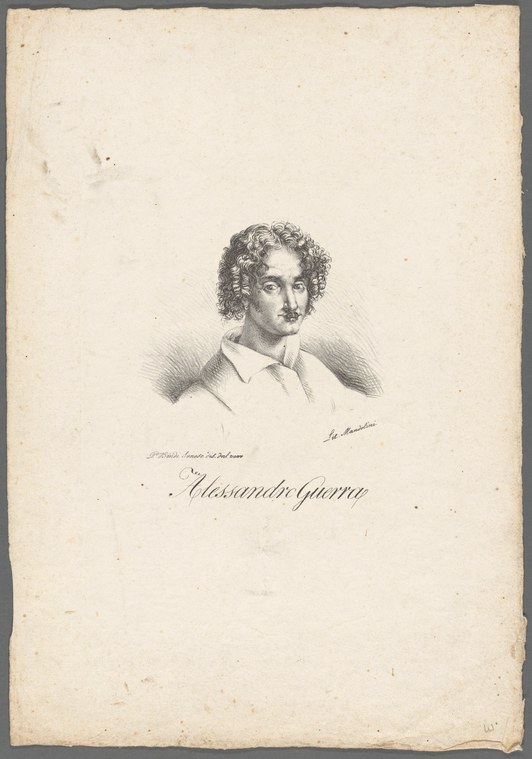
Alessandro Guerra
Unknown artist
- Collection:
- Prints depicting dance
- Source:
- New York Public Library
- Rights:
- Public domain — free to use, share and adapt.
- Recorded as:
- Public Domain
The inclusion of this portrait in a dance archive indicates that Alessandro Guerra was a figure significant enough to warrant formal portraiture and print distribution. Establishing his identity and role in dance history would clarify whether this represents a celebrated dancer, a noted dance master, or another figure in the dance world of his era.
What you are looking at
A three-quarter-length portrait of a young man with dark, curled hair, shown in bust form against a plain background. He wears a white collared shirt and appears to be dressed in early 19th-century style. The figure is rendered in fine engraving technique with careful cross-hatching to create volume and shadow, particularly around the face and shoulders. The subject gazes slightly to the viewer's left with a composed, dignified expression. Below the portrait, in elegant script, appears the name "Alessandro Guerra," with what appears to be a subtitle identifying him further, though the exact text is difficult to read in the reproduction. The work is a formal portrait of a named individual, likely a public figure of the period.
The dancing
The figure is static and frontal—this is a portrait, not a depiction of movement or dance. The head is turned slightly three-quarter view, the shoulders relaxed and square to the picture plane. There is no bodily gesture that suggests dance vocabulary, and no attempt to capture a moment of motion or choreographic action.
The dance depicted
This is not a dance image. It is a portrait of a person named Alessandro Guerra. Without additional information about who this individual was, it is impossible to establish whether he was a dancer, choreographer, dance master, composer, or public figure of another profession entirely. The portrait format and formal engraving technique suggest he was a notable person worthy of circulation in print, but the image itself contains no visual evidence of dance knowledge or practice.
How it was made
This is an engraving, rendered in the classical portrait style typical of early-to-mid 19th-century printmaking. The artist has used fine parallel lines and careful cross-hatching to model the face and create atmospheric depth, a technique characteristic of steel or copper engraving. The precision and quality of line suggest this was a work intended for wide circulation, likely accompanying a publication or issued as an independent portrait print for collectors and admirers of the named subject.
About this work
This is a formal portrait engraving of Alessandro Guerra, a named individual of the 19th century. The work does not depict dance activity or dancers in motion; it is a straightforward portrait in the neoclassical style. Its presence in a dance-focused collection suggests that Guerra himself was connected to dance—possibly as a celebrated performer, teacher, or choreographer—but the image itself provides no direct evidence of this connection. The work belongs in a dance collection only by association with the subject's identity, not by its visual content.
How to look at it
Observe the careful attention to facial feature and character: the artist has prioritized a clear, dignified likeness rendered through disciplined line work. The neoclassical style emphasizes restraint and clarity rather than Romantic expressiveness. This is the language of official portraiture—the formal apparatus of fame and documentation.
The artist
The artist is not recorded. The engraving style and presentation suggest a professional printmaker working in the early-to-mid 19th century, likely attached to a publishing house or working on commission for the subject or his circle. The quality of execution indicates skilled, trained work rather than amateur effort.
The period
The formal portrait engraving was a standard medium for commemorating notable public figures in the 19th century, before photography supplanted it. If Guerra was indeed a dancer or dance professional, his portrait would have circulated among patrons, students, and collectors of theatrical and musical arts. The style of dress and hair, along with the engraving technique, places the work in the 1820s–1850s period approximately.
Where it lives
The work is held in the New York Public Library's collection of prints depicting dance. Its classification within that collection indicates an archival judgment that the subject, Alessandro Guerra, was connected to dance history, though the catalogue record contains minimal metadata to support or clarify that connection.
Questions about this work
Who was Alessandro Guerra?
The catalogue record does not identify him beyond his name. His inclusion in a dance-focused print collection suggests he was a dancer, choreographer, or dance teacher of note in the 19th century, but further research in NYPL holdings or external historical sources would be needed to establish his specific role and significance.
Is this a portrait of a dancer?
The image itself is a formal portrait with no depiction of dance or movement. It documents the appearance of a named individual. His profession cannot be determined from the portrait alone, but the archival context—his presence in a dance collection—suggests he was active in dance.
Who created this engraving?
The artist is not recorded in the catalogue. The style and quality suggest a professional printmaker of the early-to-mid 19th century, but attribution would require additional documentation or research.
More dance artwork





