49 works in this view — arrow keys or swipe to move between them.
Dance in Art
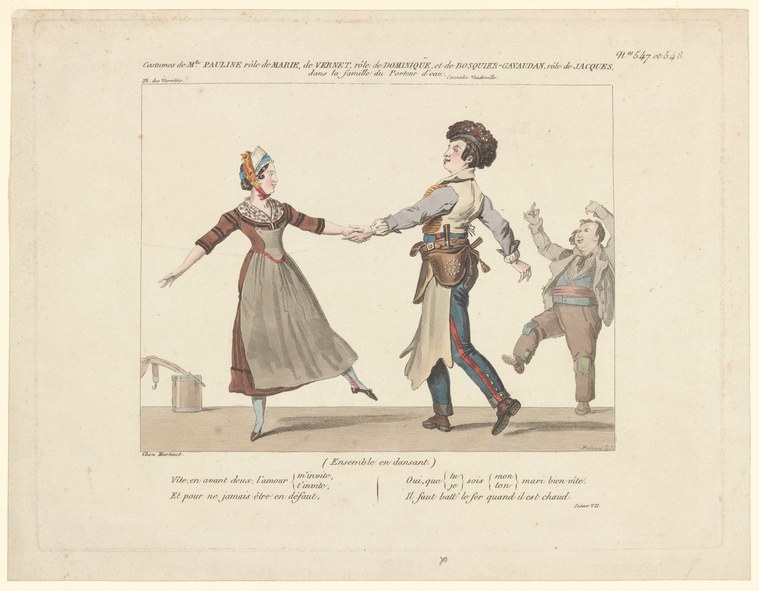
Costumes de Mlle. Pauline, rôle de Marie, de Vernet, rôle de Dominique, et de Bosquier-Gavaudan, rôle de Jacques, dans la famille de Porteur d'eau. Comédie vaudeville, Th. des Variétés
Unknown artist
- Collection:
- Prints depicting dance
- Source:
- New York Public Library
- Rights:
- Public domain — free to use, share and adapt.
- Recorded as:
- Public Domain
This engraving documents the physical vocabulary of early 19th-century French theatrical comedy and the relationship between costume, character, and bodily expression in performance. It shows how theatrical gesture operated as a form of non-verbal storytelling in popular theater, and provides a precise record of how performers used space, posture, and hand gesture to create narrative and comedy. For historians of theater and physical performance, it is evidence of a moment when theatrical movement was as much pantomime as it was structured dance.
What you are looking at
A hand-colored engraving depicting a scene from a French vaudeville comedy, showing three figures in a moment of theatrical interaction. On the left, a woman in folk or peasant costume—brown bodice, white apron, patterned headdress—gestures expressively with one arm extended. In the center, a man in military dress uniform with epaulettes and a decorative belt holds her hand, his body angled away in a pose suggesting comic resistance or surprise. On the right, a younger figure in similar military attire watches the interaction with animated posture. The setting is spare and stage-like, with minimal background detail, emphasizing the figures' positions and gestures. The print is finely colored in muted tones—ochres, blues, browns—and the line work shows the precision of late-18th-century engraving technique.
The dancing
Three figures are arranged in a diagonal composition across the space. The woman on the left adopts an open, inviting stance with her weight shifted and one arm extended in a gesture of appeal or seduction. The military officer in the center leans back slightly, hand clasped with the woman's, his posture reading as reluctant or coy—a classic comic pose of feigned resistance. The third figure stands at a distance, knees slightly bent, leaning forward with hand raised in a gesture of encouragement or commentary. The grouping suggests a moment of comedic courtship or flirtation, with clear spatial and postural differentiation between the three players.
The dance depicted
This is not a depiction of formal dance movement, but rather theatrical gesture and pantomime within a comic stage scene. The title identifies this as a costume design for a vaudeville production, and the gestures shown are those of dramatic acting rather than choreography. The woman's pose and the man's resistant posture suggest a scene of courtship or romantic comedy typical of early 19th-century theatrical comedy. While the figures are animated and the composition theatrical, there is no evidence of structured dance steps, holds, or formations. This is performance art captured as costume and character study rather than dance documentation.
How it was made
This is a hand-colored engraving, evident from the fine parallel lines defining form and the visible hatching that creates shadow and volume. The coloring is applied by hand in watercolor or gouache, with distinct pigments for the costumes and flesh tones. The technique allowed for precise draftsmanship and reproduction—such prints served as both documentation of stage design and costume and as affordable theatrical ephemera for a broad audience. The print would have circulated among theater-goers, costumiers, and designers, making it a record of early 19th-century French theatrical practice.
About this work
This hand-colored engraving documents a moment from a French vaudeville production of the early 19th century, showing three performers in costume and character. Rather than depicting dance, it captures theatrical gesture and comic interaction—the moment of a scene rather than a choreographed movement. It belongs in a dance collection as evidence of how theater, costume, and physical comedy interacted during a period when vaudeville and theatrical pantomime were central forms of popular entertainment and when the boundary between dance and dramatic gesture was fluid. The work reveals the visual conventions performers used to convey character, emotion, and narrative in comic theater.
How to look at it
Attend to the precise positioning of the three figures and how the engraver has used posture and gesture to convey character and narrative. The woman's open, extended posture contrasts sharply with the man's reclined resistance; the third figure's forward lean and raised hand supply a commentary on the action. Notice how the artist has used the white space of the paper to isolate the figures and emphasize their theatrical relationship. The moment captured is not one of movement but of held tension—the frozen instant before a response, which is the classical theatrical method of conveying emotion and intention without dialogue.
The artist
Unknown. The print credits the costume designer as "Mlle. Pauline, rôle de Marie, de Vernet, rôle de Dominique, et de Bosquier-Gavaudan, rôle de Jacques," but these are the performers and characters, not the artist. The engraver is not identified in the visible inscription. Such theatrical costume engravings were a standard output of French print shops in the early 19th century, often commissioned by theaters or published independently to promote productions and circulate knowledge of costume and staging.
The period
This engraving dates to the period when vaudeville and theatrical comedy were at their height in Paris, drawing large audiences and commanding significant cultural attention. Theatrical costume prints circulated widely as both documentary records and consumer goods, allowing people who had not seen a production to know how its stars appeared on stage. The Théâtre des Variétés, named in the inscription, was one of the major venues for such entertainment in Paris during the Restoration and early July Monarchy. The print's style—refined line work, subtle color—reflects the sophistication of Parisian print culture at this moment.
Where it lives
This engraving is held by the New York Public Library as part of its collection of theatrical prints and dance imagery. It is a specimen of the kind of theatrical documentation that circulated widely in the early 19th century, both as a record of specific productions and as a source for performers, designers, and theatergoers.
Questions about this work
Is this a dance scene?
No. This is a theatrical comedy scene from a vaudeville play. It shows dramatic gesture and comic interaction rather than choreographed dance movement. It belongs in a dance archive as evidence of how theatrical gesture and physical comedy functioned as performance art in the same historical moment as theatrical dance.
What is vaudeville and when was it popular?
Vaudeville (in French: théâtre des variétés or théâtre du vaudeville) was a form of popular comedy theater that flourished in Paris from the late 18th century onward. It combined spoken dialogue, physical comedy, pantomime, and often musical interludes. The Théâtre des Variétés, mentioned in this print's title, was the major Paris venue for such work during the period when this engraving was made.
Who were these performers?
The inscription names Mlle. Pauline, Vernet, and Bosquier-Gavaudan as the performers and their character names (Marie, Dominique, and Jacques). They appear to have been stars of the Théâtre des Variétés in the early 19th century, but biographical detail about them is limited in surviving records. Their names appear in playbills and prints from the period, indicating they were popular enough to be featured in costume engravings circulated to the public.
More dance artwork





