49 works in this view — arrow keys or swipe to move between them.
Dance in Art
Polkamania
Unknown artist
- Collection:
- Prints depicting dance
- Source:
- New York Public Library
- Rights:
- Public domain — free to use, share and adapt.
- Recorded as:
- Public Domain
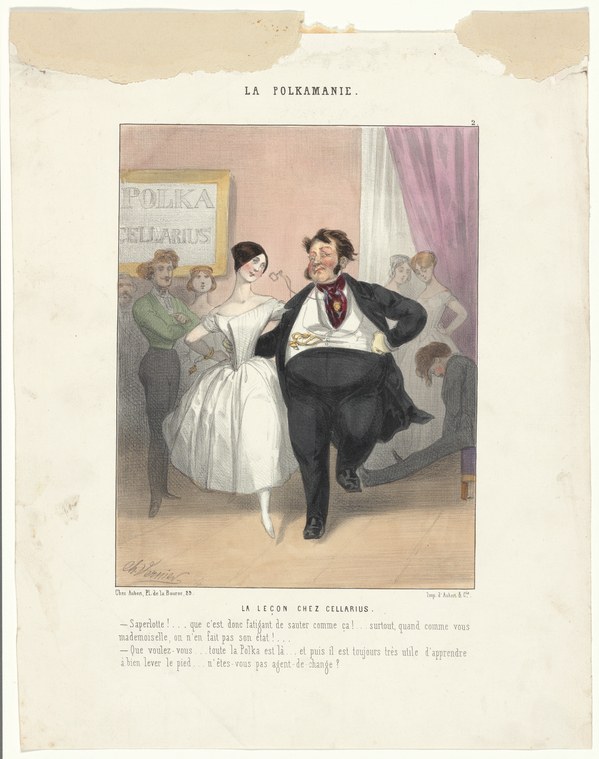
The polka was the first truly global social dance phenomenon of the mass-media age, and Cellarius's standardization of its technique made it teachable and safe for respectable society. This print captures that exact moment of social anxiety and aspiration—the craze, the teacher, the gentleman's pride in acquiring a fashionable skill. For historians of ballroom dance, of 19th-century gender roles, and of how dance becomes commodified and taught, this image is documentary evidence of a pivotal transition.
What you are looking at
A lively ballroom scene of the 1840s-50s captured in colored engraving or lithograph. A well-dressed couple dominates the foreground: a woman in a white muslin ball gown with a fitted bodice and full skirt stands beside a stout gentleman in black tailcoat, patterned waistcoat, and red collar detail. He gestures expansively to one side, his body turned in profile, displaying the exaggerated posture of social pride or courtship. Behind them, a poster on the wall reads "POLKA CELLARIUS" (visible though partially obscured), and several figures in formal dress occupy the background—some seated on gilt chairs, others standing or observing. The setting is an elegant interior with rose-colored walls, draped purple fabric suggesting a curtain or doorway, and the warm domestic lighting typical of period ballroom scenes. The title "La Polkamanie" (Polka Mania) appears at the top, anchoring this as satirical commentary on the social phenomenon sweeping Europe.
The dancing
The central male figure stands with weight shifted, one hand raised to his chest in a theatrical gesture suggesting pride, vanity, or demonstration—his posture is vertical and emphatic rather than genuinely engaged in the dance. The woman beside him stands poised but passive, her body aligned toward him, her white gown dominating the composition through its volume and pale tone. Her hands are positioned neutrally at her sides or lower body. Neither figure is in a clear dance hold or mid-movement; instead, they occupy the moment before, after, or apart from active dancing. The attendant figures in the background are largely static, seated or standing as observers and participants in the social occasion rather than active dancers.
The dance depicted
This is a polka scene, explicitly identified by the "Cellarius" reference visible in the poster—Joseph Cellarius was the most famous polka teacher and choreographer of the 1840s-50s, whose simplified, standardized polka technique made the dance accessible to ballroom society across Europe and America. The image captures not the dance itself but the social theater around it: the advertisement of technique, the performance of fashion and status, and the male's display for an audience. The woman's passivity and the onlookers' focus suggest the polka as a spectacle of courtship and social aspiration rather than a genuinely shared dance experience. Cellarius's codification meant polka became teachable, fashionable, and above all, a marker of belonging to modern ballroom society.
How it was made
This is a hand-colored engraving or lithographic print, a common format for popular satirical and social commentary in the 1840s-50s. The technique allowed for rapid reproduction and wide circulation, reaching middle-class homes and ballrooms across Europe—this was not a luxury item but a mass-market cultural document. The hand-coloring (visible in the selective, sometimes uneven application of tone to the woman's dress, the walls, and faces) suggests it was added after printing, indicating either a popular edition or a copy made for individual distribution. The style and palette are consistent with mid-century French popular prints, particularly those satirizing social manners and fashion crazes.
About this work
"La Polkamanie" is a satirical engraving documenting the polka craze that swept Europe in the 1840s-50s, a moment when a simple, teachable couples' dance became a marker of modern social identity and masculine display. The image is less a depiction of the dance's technique than of its cultural work: the performance of status, the advertisement of instruction (via Cellarius's name), and the gendered dynamics of ballroom courtship. The work belongs in any history of how dance becomes fashion, how instruction codifies social dancing, and how popular prints mediated anxieties about modernity, class, and behavior in the industrial era.
How to look at it
Notice first the male figure's theatrical posture: his gesture is not the hold of an actual polka dancer but a display for the room, a performance of mastery. The woman is almost incidental to this scene—her gown dominates visually, but her agency is minimal. Look at the Cellarius poster on the wall: the artist has made the instruction and codification of the dance part of the subject, not just the dancing. The background figures, though small, anchor this as a ballroom social scene, not a performance stage. Finally, observe the engraving's hand-coloring: the deliberate, uneven application suggests popular reproduction aimed at a middle-class market, making this both art and ephemera.
The artist
The print is attributed to Alophe, a prolific French artist and lithographer active in the 1830s-50s, known for satirical and morally pointed social commentary in color. His subject matter ranged from political caricature to domestic manners and fashion. The hand appears in the lower left corner of the image ("Alophe" visible in the inscription), confirming attribution. No other details of biography or training are securely established in the current record.
The period
The polka arrived in Paris from Prague around 1840 and became an immediate craze, spreading to London, Vienna, and America within five years. Unlike earlier couple dances (the quadrille, the cotillion), the polka was perceived as modern, energetic, and slightly risqué—its close hold and rapid tempo scandalized conservatives and fascinated youth. Joseph Cellarius's "The Drawing Room Dances" (1847) codified the polka into a teachable technique, democratizing ballroom dancing and making it a commodity taught by dancing masters to aspiring middle-class people. The simultaneous rise of satire about the "polka mania" (this print's title) reflects the mixture of enthusiasm and social anxiety the dance provoked—a perfect subject for popular satirists like Alophe, who documented fashion, behavior, and social aspiration with a sharp eye.
Where it lives
The print is held in the New York Public Library's collection of prints depicting dance, a broad topical holding that documents social dance, performance, and the visual culture of movement across centuries. The source code "nypl" confirms the Library as the current holding institution. The era and artist attributions derive from the visual evidence of the print itself rather than from a secure archival record.
Dance in this work
Questions about this work
What is the Cellarius poster in the background?
Joseph Cellarius was a Prague-born dancing master who revolutionized ballroom dance instruction by codifying and standardizing polka technique. His published teaching method, "The Drawing Room Dances" (1847), made the polka teachable and respectable, transforming it from a street dance into a ballroom staple. The poster's presence in this satirical scene underscores how instruction and commodification were central to the dance's social role.
Why is this called 'Polka Mania'?
The title reflects the rapid, intense adoption of polka dancing across Europe in the 1840s, which provoked both enthusiasm and alarm. The dance was seen as modern, energetic, and slightly transgressive (particularly its close hold), making it an ideal target for social satire. The print documents not just a dance but a cultural phenomenon—and the anxiety it provoked.
Is this actually showing people dancing?
Not quite. The foreground couple is posed and performing rather than actively dancing—the male figure is displaying himself to the room, and the female is presented as a decorative object. The background contains observers and seated guests. The artist has captured the social theater around polka dancing (instruction, display, courtship) rather than the kinaesthetic moment of the dance itself.
What makes this a lithograph or engraving?
The fine line-work, the hand-coloring applied after printing, and the style are consistent with colored lithography or engraving typical of French popular prints of the 1840s-50s. This technique allowed for rapid reproduction and wide distribution to middle-class homes—it was a mass medium, not a luxury object, making it a valuable document of popular culture.
More dance artwork





