49 works in this view — arrow keys or swipe to move between them.
Dance in Art
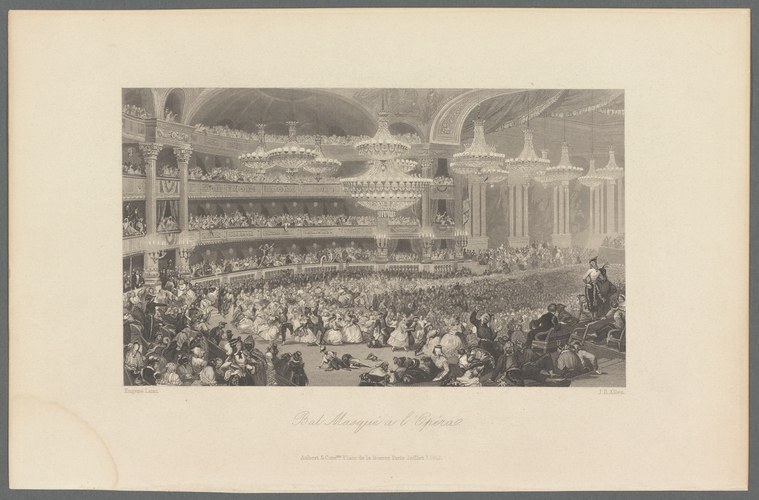
Bal masqué à l'Opéra
Unknown artist
- Collection:
- Prints depicting dance
- Source:
- New York Public Library
- Rights:
- Public domain — free to use, share and adapt.
- Recorded as:
- Public Domain
The bal masqué represents a crucial moment in the history of social dance, when ballroom dancing moved from the formal, carefully choreographed court dances of the baroque and classical periods into the more spontaneous and democratized forms of the 19th-century ball. This image shows that context—the architectural grandeur that framed social dancing, the presence of the masked and the anonymous, and the mixing of strangers that the masquerade permitted. For historians of dance, fashion, and 19th-century social life, this is primary evidence of how dancing was actually experienced and displayed in high society.
What you are looking at
This is a grand masked ball at the Opera, rendered as an engraving showing a vast interior filled with hundreds of figures in formal evening dress and dominoes (the traditional masks and cloaks of the bal masqué tradition). The space is architectural and palatial—the perspective emphasizes the scale, with multiple tiers of galleries running along the walls and a coffered or decorated ceiling from which hang enormous crystal chandeliers that illuminate the scene. The floor is crowded with dancers and socializers in no single organized formation; some are in conversation, others appear to be dancing or promenading. The masked guests wear dark formal clothing relieved by the lighter tones of the women's dresses, and many carry the traditional attributes of carnival masquerade—capes, tricorn hats, and dominoes. The composition is theatrical and busy, capturing not a single moment of choreographed dance but rather the social spectacle of the ball itself, with the architecture as much a subject as the figures.
The dancing
The figures are scattered across the floor in small groups and couples rather than in a unified dance pattern. Most are upright and in walking or standing posture rather than in any formal closed hold. Women wear long gowns appropriate to formal evening wear of the 19th century; men are in dark tailcoats and evening dress. The masqueraders wear dominoes—loose hooded cloaks—over their formal clothes, and many carry masks on sticks or wear them on their faces. The gestures are social and relaxed: people gesture toward one another, turn to converse, and move through the space without the rigid frame or coordinated hold of a ballroom dance.
The dance depicted
This depicts the social institution of the bal masqué, or masked ball, a form of elite social gathering rather than a specific dance style. The bal masqué was a signature event of the Paris Opera (the Palais Garnier) and other grand European opera houses during the 19th century, particularly popular from the mid-1800s onward. While individual social dances—waltzes, quadrilles, and polkas—would have been danced at such an event, this image captures the spectacle of the ball as a whole rather than demonstrating any single dance form. The masquerade tradition allowed social transgression and anonymity, and the ball was as much about promenade, conversation, and social display as about dancing itself.
How it was made
This is a steel or copper engraving, a reproductive print technique that allowed wide circulation of images of fashionable society events. The fine parallel lines (hatching) create tone and shadow across the architectural setting and the crowd, and the artist has used the medium's precision to define both the grand architecture and the individual figures within it. The technique required significant skill to render perspective and to differentiate hundreds of figures while maintaining compositional clarity. Such prints were intended for educated middle and upper-class audiences and were often sold as individual sheets or collected in albums documenting high society.
About this work
This engraving documents the bal masqué, one of the most famous social institutions of 19th-century Paris, held at the Opera itself. The image is not a record of a specific choreographed dance but rather of the architectural and social spectacle of the masked ball—a gathering where the traditional social order was temporarily inverted by masks and dominoes, and where waltzes, quadrilles, and other ballroom dances would have taken place informally throughout the evening. The artist chose to depict the scale and crowding of the event, emphasizing the grandeur of the setting and the density of the masked crowd, rather than isolating individual dancers. This type of print served as a document of fashionable leisure for those who attended and as a window into elite social life for those who did not.
How to look at it
Look first at the architecture: the artist has used one-point perspective to draw the eye through the space and emphasize the grandeur of the Opera interior. Notice the chandeliers—outsized and brilliant, they serve as light sources within the fictional space and draw attention upward to the decorated ceiling. Then observe the crowd: no two figures are posed in exactly the same way, and the masquerade dress—the dominoes, capes, and masks—makes individuals both visible and anonymous. Look for the moment of the ball itself: this is not a choreographed ensemble piece but rather a captured moment of social circulation, in which dancing and socializing are continuous and undifferentiated. The artist has chosen a busy, populous moment, not a moment of rest.
The period
The bal masqué reached its height of fashion in Paris during the mid-to-late 19th century, particularly under the Second Empire (1852–1870) and the Belle Époque that followed. The Paris Opera (the Palais Garnier), which opened in 1875, became one of the premier venues for these events. The masked ball was a literary and artistic subject of considerable interest—Marivaux had written about them in the 18th century, and they appear in the work of Balzac and other 19th-century writers. Visually, the bal masqué fascinated artists and printmakers as a subject that combined architecture, fashion, spectacle, and the transgressive freedom of anonymity. The engraving technique ensured that images of these events could be widely distributed and consumed by a public increasingly interested in documenting fashionable life.
Where it lives
This engraving is held in the New York Public Library's collection of prints depicting dance. It is a reproductive print made for circulation and sale, likely to a middle and upper-class audience interested in fashionable society.
Dance in this work
Questions about this work
What is a bal masqué?
A bal masqué is a masked ball, a form of formal social gathering held at grand venues (especially opera houses) where guests wore masks and dominoes (hooded cloaks) to conceal their identity. This permitted a temporary inversion of social hierarchy and greater freedom of social interaction. Various ballroom dances—particularly waltzes and quadrilles—were danced throughout the evening, but the ball itself was as much about promenade, socializing, and spectacle as about dancing.
Where were the most famous bals masqués held?
The Paris Opera House (Palais Garnier) became one of the most famous venues for bals masqués, particularly after its opening in 1875. Opera houses in other major European cities also hosted them, and they remained a fixture of high society throughout the 19th century.
What dances would have been performed at this event?
Social ballroom dances of the era—primarily waltzes, quadrilles, polkas, and galops—would have been danced informally by couples and groups throughout the evening. This image does not show any single choreographed dance form, but rather the social context in which such dances took place.
Why is this scene so crowded?
The bal masqué was a prestigious and highly fashionable event, and the Opera House could accommodate hundreds of guests. The printmaker has emphasized the scale and density of the crowd as part of the spectacle—the grandeur of the event is partly demonstrated by its popularity and the crush of people.
More dance artwork





