49 works in this view — arrow keys or swipe to move between them.
Dance in Art
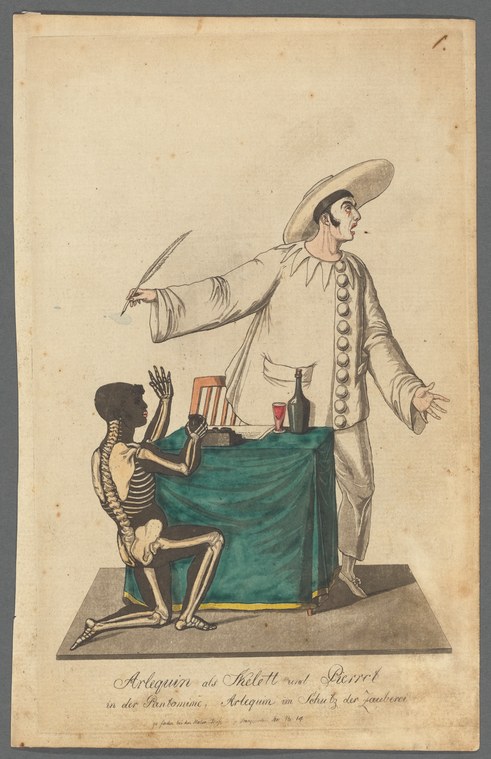
Arlequin als Skelett [Harlequin in a skeleton costume] und Pierrot in der Pantomime, Arlequin um Schutz der Zauberei, zu finden bei dem Maler Weise
Unknown artist
- Collection:
- Prints depicting dance
- Source:
- New York Public Library
- Rights:
- Public domain — free to use, share and adapt.
- Recorded as:
- Public Domain
This engraving captures a moment in the history of theatrical performance before the strict codification of ballet technique, showing how comedic and grotesque movement were staged and transmitted to audiences. It preserves evidence of how Harlequin—one of the most persistent figures in European performance—was physically embodied and visually marketed, and it demonstrates the centrality of gesture, costume, and spatial relationship to meaning-making in pre-balletic theatre.
What you are looking at
A standing figure in 18th-century dress—a wide-brimmed hat, coat with decorative buttons, and breeches—gestures toward a skeleton seated at a draped green table. The skeleton is posed with one arm raised, as if in animated conversation or performance. A bottle and goblet sit on the table. The composition suggests a theatrical tableau: the living figure commands the scene while addressing or animating the skeletal companion. The hand-colored engraving technique creates subtle tonal contrasts, with the skeleton rendered in black outline against the pale paper and the coat in warm cream, heightening the theatrical effect of this memento mori encounter.
The dancing
The standing figure maintains an open, presentational posture—one arm extended toward the skeleton in a gesture of instruction or summoning, the body turned in profile or three-quarter view, weight evenly distributed. The skeleton sits in a relaxed posture, one arm raised as if responding or participating, creating a visual dialogue between living and dead. There is no dance hold or partnership—this is an interaction between performer and animated prop, or teacher and student, rendered as a kind of grotesque duet.
The dance depicted
This depicts a pantomime tableau associated with the commedia dell'arte tradition, specifically the character Harlequin (Arlequin) in a skeleton costume. The title references 'Arlequin als Skelett' and positions this within pantomimic theatre where Harlequin commonly appeared in fantastical or supernatural scenarios. The skeleton costume and staged interaction suggest a plot turn from the stock commedia repertory—possibly a moment of magic, trickery, or moral transgression made visible through theatrical transformation. This is not social dance but theatrical dance-adjacent performance: the gestural vocabulary belongs to pantomime, the movement suggests narrative rather than pure kineticism, and the audience reads character through costume and spatial relationship.
How it was made
This is a hand-coloured engraving, likely 18th-century German production based on the German-language inscription and style. The engraver used fine parallel lines to establish form and shadow, with hand application of watercolour or gouache to add tonal warmth, particularly to the figure's coat. The technique allowed fine detail in the costume and facial features while the muted palette keeps focus on the narrative interaction. The small format and portable nature of coloured engravings made them suitable for theatrical advertisement, amateur collection, or scholarly documentation of performance styles—they circulated widely in German-speaking theatrical centres.
About this work
A hand-coloured engraving depicting a theatrical encounter between a living performer in 18th-century dress and an animated skeleton, positioned within the commedia dell'arte tradition of Harlequin pantomime. The work documents a specific performance convention—the supernatural or magical scenario—that was popular in German-speaking theatres. It belongs in a dance archive not because it shows conventional dance, but because it records how movement, gesture, and embodied character operated in theatrical performance before the dominance of ballet vocabulary. The skeleton costume and the gesturing figure together constitute a kind of animated partnership that was part of the dramatic and physical vocabulary of popular theatre.
How to look at it
Attend to the relationship between the two figures: the standing performer is the agent, the skeleton the object being activated. Notice the raised hand of each—the standing figure's gesture is directive, the skeleton's suggestive of response or participation. The theatrical framing is explicit: the figures occupy a narrow stage space, the table and props situate them in a specific narrative moment, and the absence of a ground line or architectural setting focuses all attention on the encounter itself. The print preserves a moment that was ephemeral in performance—a tableau vivant that would have lasted seconds on stage but that the engraver has frozen into a single intelligible image.
The artist
The engraver is not recorded. The inscription references 'bei dem Maler Weise' (with the painter Weise), suggesting either that Weise painted an original from which this was engraved, or that the print was sold through Weise's establishment. German theatrical engravings of this period were commonly produced by anonymous artisans working in urban centres; attribution often depended on publisher or printer marks rather than artist signatures.
The period
In the 18th century, commedia dell'arte was in transition—traditional Italian improvised comedy was being reformulated for German and Austrian stages, where it became increasingly literary and staged. Harlequin (Arlequin/Harlekin) was undergoing transformation from improviser to fixed character type, and the supernatural and grotesque scenarios common to Harlequin narratives were being documented through prints to advertise performances and preserve theatrical repertory. This period also saw the rise of theatrical prints as a distinct commercial category, particularly in Germany, where they served both as souvenirs and as a form of performance documentation before photography.
Where it lives
The print is held in the New York Public Library's collection of prints depicting dance. The inscription indicates German origin and theatrical circulation; such prints were commonly sold near theatres, by performers themselves, or through print sellers' shops.
Questions about this work
Is this actually a dance?
It documents theatrical performance and gesture rather than social or concert dance. The skeleton costume and the protagonist's gesturing are part of the physical and visual vocabulary of commedia dell'arte pantomime, which used movement, posture, and spatial relationship to convey character and narrative. It belongs in a dance archive because it shows how bodies were trained, moved, and presented in popular theatre before ballet became dominant.
Who was Harlequin and why the skeleton?
Harlequin was a stock character from commedia dell'arte—traditionally a wit, trickster, or magical figure. The skeleton costume suggests either a moment of supernatural transformation (Harlequin has magic powers and can animate the dead) or a moral allegory (death confronting the living). German theatrical traditions often adapted commedia plots to include fantastical and supernatural elements, and Harlequin frequently appeared in such scenarios.
What does 'in der Pantomime' mean in the title?
It marks this as a pantomime scene—a narrative moment told through gesture, movement, and visual metaphor rather than dialogue. Pantomime was central to commedia dell'arte performance and remained a dominant mode of popular theatre in 18th-century Germany, distinct from emerging forms like opera and spoken drama.
More dance artwork





