49 works in this view — arrow keys or swipe to move between them.
Dance in Art
No. 98, Bernoise
Unknown artist
- Collection:
- Prints depicting dance
- Source:
- New York Public Library
- Rights:
- Public domain — free to use, share and adapt.
- Recorded as:
- Public Domain
This print is one of thousands of similar costume studies that shaped how ballroom dancers of the 1840s–1860s understood and performed 'folk' dances imported from the Alpine regions. It shows not what Bernoise dancing actually was in its native setting, but rather how it was packaged and authorized for consumption in European metropolitan centers. For dance historians, it documents the aesthetic conventions of the Romantic era—the idealized figure, the ethnographic framing, the elevation of 'regional authenticity' as a source of ballroom novelty.
What you are looking at
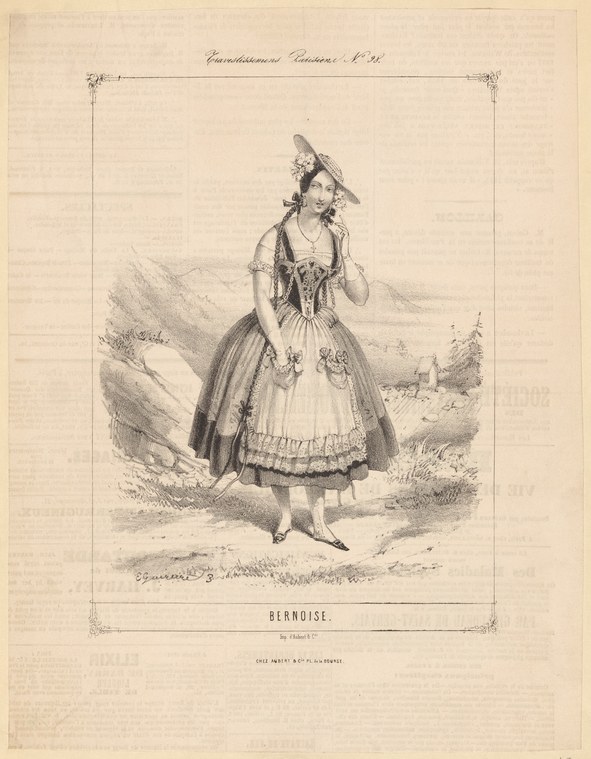
A young woman in Alpine folk dress stands alone in a mountainous landscape, posed as if caught mid-performance or at rest between dances. She wears a white linen chemise with short puffed sleeves, a dark corseted bodice laced across the front, and a full skirt with a wide white lace-trimmed apron. Her blonde hair is crowned with a decorative hat or bonnet with a large plume. The background, rendered in soft wash, shows rocky outcrops and distant peaks suggesting the Swiss Alps. She stands with her weight slightly shifted, one arm raised loosely, the other at her side, in an attitude of graceful ease rather than active movement. The engraving's light tonality and careful attention to textile detail—the crisp folds of the apron, the delicate sleeves—suggests this is a costume study or ethnographic portrait rather than a narrative scene of dance in progress.
The dancing
A single figure occupies the composition, centered and presented in three-quarter view. Her posture is upright but not rigid; the raised arm and slightly tilted head suggest a moment of pause or reflection rather than active dancing. The body appears relaxed, with weight evenly distributed, and the overall silhouette emphasizes the volume of the skirt and the fitted bodice rather than dynamic motion. There is no partner or group interaction; this is a solo study of costume and bearing.
The dance depicted
This appears to be a representation of Bernoise dance or the folk costume associated with Bern and the surrounding Alpine regions of Switzerland, likely from the mid-19th century. The title 'Bernoise' (or variations such as 'La Bernoise') referred to a regional dance and its characteristic costume, which became popular in European ballrooms and theatrical settings during the Romantic era. The image preserves the costume with ethnographic precision but does not depict active dancing; instead it functions as a costume document—the kind of idealized portrait that circulated in dance manuals and popular prints to establish and canonize regional 'types.' The figure's relaxed pose may suggest the opening or closing moment of such a dance, or may simply present the costume as an object of visual study.
How it was made
This is an engraving or lithograph (likely a lithograph based on the soft tonal transitions and the handling of shading), printed and hand-colored or tinted with watercolor wash. The technique allowed for the delicate rendering of lace, fabric texture, and the atmospheric landscape background, which would have been impossible in a simple line engraving. The work appears to be from a series or portfolio of costume studies—a common publishing format in the 1830s–1850s—designed for circulation among educated urban audiences interested in European regional traditions. The careful preservation of ethnographic detail suggests an intended use as both entertainment and documentary record.
About this work
No. 98, Bernoise is a hand-colored engraving or lithograph from the mid-19th century depicting the folk costume and dance traditions of Bern, Switzerland. It captures a young woman in full Bernoise dress—the white chemise, dark corseted bodice, voluminous lace-trimmed skirt, and feathered bonnet that defined the type. Rather than showing the dance in full execution, the print presents a composed portrait of the costumed figure, posed with the grace and calm authority typical of ethnographic fashion studies of the Romantic era. This approach—treating regional dance costume as a vehicle for aesthetic and cultural documentation—reflects how European folk traditions were being domesticated and canonized for fashionable urban consumption during the first half of the 19th century.
How to look at it
Attend first to the quality of the costume: the artist has lavished attention on the texture of linen, lace, and silk, and the proportions and construction of the garments. The pose—upright, poised, but not actively dancing—was typical of such costume prints; it allowed the viewer to study the dress without distraction. The mountainous background, though faint, places the figure in the Alpine landscape, anchoring the costume to a place of origin. The expression and bearing suggest refinement and composure rather than vigor or exuberance, reflecting how metropolitan audiences imagined 'folk' elegance. Notice that this is a document of fashion and ethnography as much as of dance.
The period
The Bernoise and similar Alpine dances entered European ballroom culture in the early 19th century as Romanticism cultivated an appetite for regional exoticism and 'natural' movement. Swiss and Tyrolean dances were marketed to urban audiences as expressions of authentic, pre-industrial culture—a counterpoint to the refined geometry of classical ballet and the formalized codes of Regency quadrilles and contredanses. Costume prints like this one were essential tools: they standardized and authenticated the 'look' of such dances, making them recognizable and teachable to dancers across Europe. The fact that the figure is shown alone, in landscape, and in a moment of repose reflects the Romantic valorization of solitude and nature, even as the costume itself speaks to careful artifice and urban fashion.
Where it lives
The work is held in the New York Public Library's collection of prints depicting dance. It is catalogued as No. 98 and titled 'Bernoise,' suggesting it was part of a numbered series or portfolio, a common publishing practice for costume and dance studies in the 19th century.
Dance in this work
Questions about this work
What is a Bernoise dance?
The Bernoise (also called La Bernoise) was a Swiss Alpine folk dance and its associated costume that became fashionable in European ballrooms during the Romantic era, roughly 1830–1860. It belonged to a family of Alpine and Tyrolean dances that offered metropolitan audiences a taste of regional exoticism. The dance itself typically featured moderate tempo and flowing movement, though specifics varied; what unified it was the costume—the white chemise, dark bodice, voluminous skirt, and decorative bonnet shown here—which metropolitan dancers learned from prints like this one.
Why is she not dancing?
This is a costume study, not a narrative scene. The print served as a visual guide for dancers and dressmakers who wanted to know what 'Bernoise' costume looked like. By posing the figure in a relaxed, poised attitude rather than mid-movement, the artist made it easier to see the construction and detail of the dress. This approach was standard in the costume print tradition of the 1840s–1850s.
Who wore this costume and where?
The costume is based on authentic Bernoise folk dress, but this print reflects how it was adapted and idealized for European ballroom dancers in major cities. Urban ballroom dancers learned these dances from prints and dance manuals; they performed them at balls and soirées as fashionable 'folk' dances, not in the Alpine villages where the traditions originated. The print thus documents a moment of cultural translation—the process by which rural traditions were captured, standardized, and sold as metropolitan entertainment.
More dance artwork





