49 works in this view — arrow keys or swipe to move between them.
Dance in Art
Fanny Elssler
Unknown artist
- Collection:
- Prints depicting dance
- Source:
- New York Public Library
- Rights:
- Public domain — free to use, share and adapt.
- Recorded as:
- Public Domain
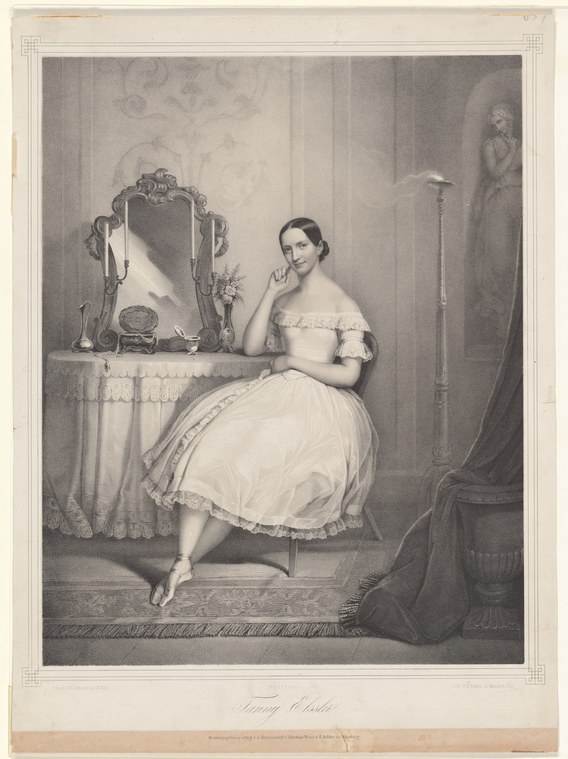
Fanny Elssler was one of the defining figures of Romantic ballet and a cultural phenomenon across Europe and America in the 1830s and 1840s. This portrait engraving testifies to her fame and the appetite for her likeness among the public; it also reveals how the nineteenth-century dancer was marketed and consumed as a personality, not only as a technician. The choice to show her in a moment of private contemplation rather than public performance raises questions about how the dancing body was understood and represented in this period.
What you are looking at
A woman sits at a dressing table before a large ornamental mirror, her body turned three-quarter toward the viewer in a moment of pause or self-regard. She wears a white off-shoulder dress with a full skirt gathered at the waist, the fabric falling in soft folds to her ankles. Her dark hair is parted and drawn back simply. The table before her holds a mirror with elaborate carved ornament, a small round box or compact, and flowers in a vase; a lit candle on a tall stand illuminates the scene from the right. Behind her, the interior space recedes into shadow—a draped curtain, a sculpture or bust barely visible in the background. The engraving is finely detailed in mid-tone grays, with careful attention to fabric texture and the play of light across the woman's shoulder and face. This is a private moment rendered in the style of early nineteenth-century salon portraiture.
The dancing
A single seated female figure occupies the composition, her weight settled on the chair, her body inclined slightly forward in a posture of contemplation or adjustment. Her right arm rests across her lap; her left hand is raised to her face or neck in a gesture of thoughtful repose. The pose is naturalistic and intimate rather than performative—there is no suggestion of the formal, upright carriage demanded by dance. The figure's frame is entirely still, the moment one of preparation or reflection rather than motion.
The dance depicted
This image does not depict dance. The seated, contemplative pose, the private dressing-room setting, and the absence of any musical or performative context place this firmly in the genre of portrait and domestic interior rather than dance imagery. The title references Fanny Elssler, the celebrated Romantic-era ballet dancer, but the image shows her in a moment of private preparation or reverie, not in performance or in the characteristic postures of ballet technique.
How it was made
This is an engraving, recognizable from the linear hatching used to model form and shadow, the absence of color, and the fine detail achievable only in print media from a copper or steel plate. The technique allows for precise representation of fabric texture and facial feature, and the delicate gradations of tone suggest a skilled hand with both burin and needle. As a portrait engraving, it would have circulated among the middle and upper classes as a collectible print, likely issued singly or bound in portfolios of theatrical or society portraits.
About this work
This is a portrait engraving of Fanny Elssler, the Austrian-Italian dancer who became one of the most celebrated ballet artists of the Romantic era. Rather than capturing her in performance—en pointe, in a gesture of classical technique—the engraver chose a moment of private domesticity: Elssler at her dressing table, in the moments before or after the curtain, preparing herself or reflecting in the mirror. The work belongs in a gallery of dance in art not because it documents a dance itself, but because it captures the celebrity culture surrounding dance and the way Romantic-era artists and audiences were fascinated by the private personhood of the dancer. Elssler's fame was so complete that even a portrait of her in repose became a desirable, collectible image.
How to look at it
Attend to the carefully rendered textures: the play of candlelight on silk, the fine detail of the carved mirror frame, the delicate cross-hatching that suggests shadow on the face and neck. Notice the pose—alert, poised, but entirely at rest—and the way the engraver has chosen a moment of inward focus rather than outward display. The mirror within the image echoes the portrait itself, a layering of the idea of reflection and self-regard. The engraver's technique transforms what could be a simple sitting into a meditation on the private self behind the public performer.
The artist
The engraver is not recorded. The style and execution suggest a professional London or Paris print shop of the 1830s–1840s, a period when portrait engravings of theatrical celebrities were a standard commercial product. Such prints were typically executed by journeyman engravers working from drawings or paintings by portrait artists; the separation of the engraver's name from the original artist's was common practice.
The period
This engraving dates to the height of the Romantic ballet era, when dancers such as Elssler and Marie Taglioni were celebrated across Europe and the Americas as artists and celebrities. The image reflects the Romantic fascination with the inner life and personality of the performer—a shift from earlier eighteenth-century practice, when the dancer was primarily valued as a technical and decorative element in a larger spectacle. Elssler's career, which spanned the 1830s and 1840s, coincided with the rise of the commercial print market and the mass circulation of celebrity portraits. The aesthetics of the image—the soft lighting, the intimate interior, the emphasis on feminine grace and refinement—align with Romantic-era values and the conventions of portrait engraving.
Where it lives
The print is held in the New York Public Library's collection of prints depicting dance. It is listed as a portrait engraving with the title 'Fanny Elssler' but without recorded artist, date, or medium information in the catalogue.
Questions about this work
Who was Fanny Elssler?
Fanny Elssler (1810–1884) was an Austrian-Italian ballet dancer who became one of the most celebrated performers of the Romantic ballet era. Known for her technical virtuosity, dramatic presence, and charisma, she performed across Europe and made a triumphant American tour in 1840–1842. She specialized in dramatic roles and was a rival to the ethereal Marie Taglioni.
Why would a portrait of a dancer sitting down be included in a collection of dance imagery?
Dance in art is not limited to images of movement. Portraits of celebrated dancers are part of the visual history of dance because they document the stars who shaped the art form and reveal how dancers were understood and valued by their era. This image is especially valuable because it shows how Elssler was marketed as a personality and celebrity, not merely as a body in motion.
What is the difference between an engraving and other types of prints?
An engraving is made by incising lines into a metal plate (usually copper or steel) with a tool called a burin, then inking and printing the plate. Unlike etching, which uses acid to create lines, engraving relies entirely on hand-cutting. The technique allows for fine detail and precise tonal gradations through closely spaced parallel lines (hatching), which is visible throughout this portrait.
What does the mirror in this image symbolize?
The mirror is a traditional symbol of vanity and self-reflection, but in Romantic art it often carries a deeper meaning: the idea of interiority, the private self hidden behind public performance. Here, Elssler's gaze into the mirror might suggest both literal preparation and a moment of introspection—a glimpse of the person beneath the celebrated performer.
More dance artwork





