49 works in this view — arrow keys or swipe to move between them.
Dance in Art
Men dancers and choreographers in prints
Unknown artist
- Collection:
- Prints depicting dance
- Source:
- New York Public Library
- Rights:
- Public domain — free to use, share and adapt.
- Recorded as:
- Public Domain
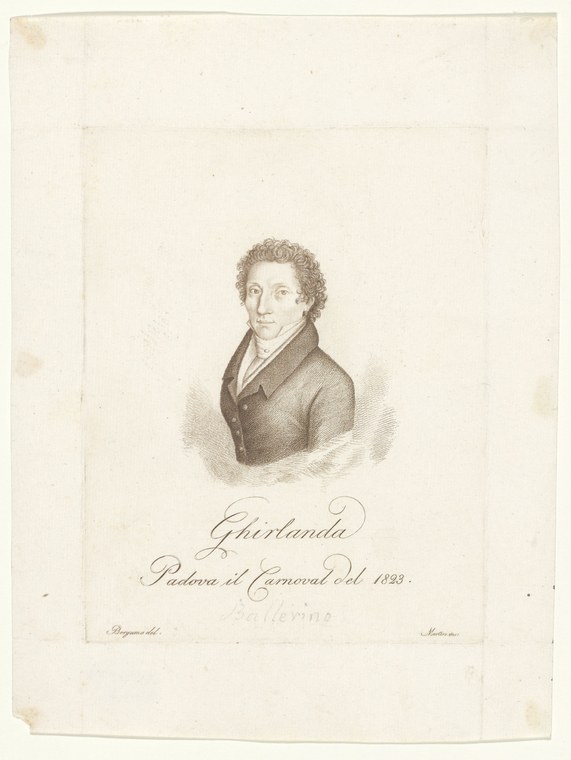
Prints like this are primary evidence for how individual dancers were promoted and remembered in the early 19th century, before photography made portraiture ubiquitous. The inscription dates and names the performer, anchoring the image to carnival dance tradition in Venice and providing a rare named record of a working dancer from the period.
What you are looking at
A three-quarter-length portrait of a young man, rendered in sepia tones with fine cross-hatching that suggests an engraving or stipple print. He is shown from roughly mid-thigh upward, facing slightly left of center with his head turned toward the viewer. His curled dark hair is swept back from his forehead in the Romantic style of the early 19th century. He wears a dark coat with a high collar and a white shirt beneath, dressed in the formal attire of a gentleman of the period. The background is plain cream, with no setting or spatial context provided. Below the portrait, in flowing cursive script, appears the name "Ghirlanda" followed by "Ballerini il Carnevale del 1823"—identifying him as a dancer performing in carnival celebrations in 1823.
The dancing
The figure stands in a relaxed, three-quarter pose with his weight balanced and his shoulders held at ease, characteristic of formal portraiture rather than a dynamic dance pose. There is no suggestion of movement, lifted elevation, or active footwork. His bearing is that of a gentleman at rest, dignified and composed. The absence of any theatrical gesture or body alignment suggests this is a portrait of a dancer in his everyday presentation, not frozen mid-performance.
The dance depicted
This is a portrait of a named dancer, Ghirlanda, identified by inscription as performing in the Carnival of 1823. Carnival dancing in early 19th-century Italy would have encompassed social dances of the period—minuets, contredanses, and country dances—and theatrical forms including pantomime and the emerging Romantic ballet vocabulary. The portrait records an individual performer's identity and professional status at a specific moment, but the image itself does not depict dance movement or reveal the particular style in which he worked. The formal dress and dignified bearing suggest he may have been a principal dancer or ballet master of some standing.
How it was made
This is a stipple engraving or fine-line engraving, rendered entirely in sepia or brown ink on cream paper, built up through careful parallel lines and dots to create tonal gradation. The technique was characteristic of late 18th- and early 19th-century portraiture, allowing for subtlety in rendering facial features and the texture of fabrics while remaining economical for reproduction and distribution. Such portraits were typically issued as single prints, suitable for framing or pasting into albums, and would have circulated among theater enthusiasts and collectors of theatrical ephemera.
About this work
This is a formal portrait print of an early 19th-century Italian dancer named Ghirlanda, documented as performing in the Venice Carnival of 1823. It belongs to a category of theatrical portraiture that recorded performers' likenesses for audiences and patrons during the Romantic era, when dancers were becoming recognized as individual artists worthy of celebrity. The work is part of a broader tradition of dance documentation through prints and engravings—a means of capturing and circulating the identities and prestige of performers in an era before photography. The print serves simultaneously as portraiture, theatrical documentation, and souvenir, marking both a performer and a specific historical moment in carnival celebration.
How to look at it
Attend to the inscription as the work's primary claim: this is not a generic "ideal" figure but a specific named performer at a specific moment in carnival history. Note the absence of stage props, dancers beside him, or any choreographic notation—the artist chose to present Ghirlanda as a dignified individual, not a character in action. The formal clothing and composed bearing suggest he was a principal dancer of standing, a fact the portrait was designed to affirm.
The artist
The artist is not recorded in the catalogue. The style and technique are consistent with professional printmakers working in Italy in the early 19th century who specialized in theatrical portraiture, but no signature is visible in the image. Such prints were often produced by engravers whose work appeared in theatrical programs or was sold as single sheets; their names were frequently not prominent, and attribution often depends on stylistic analysis or archival records.
The period
In the 1820s, Romantic ballet was emerging as a dominant theatrical form in Europe, and ballet dancers were beginning to achieve celebrity status comparable to opera singers. Venice's carnival tradition, though suppressed during Napoleonic rule, was being revived and reinvented in the early Restoration period. Social dance and theatrical dance remained intertwined; performers like Ghirlanda likely worked in both contexts. The print format reflects the period's appetite for theatrical documentation and the growing market for performers' portraits as collectible souvenirs.
Where it lives
This print is held in the New York Public Library's collection of prints depicting dance. It is catalogued as part of a broader collection of theatrical and dance-related prints from the 18th and 19th centuries.
Questions about this work
Who was Ghirlanda?
Ghirlanda is identified in the inscription as a dancer performing in the Venice Carnival of 1823. Beyond the date and location on this print, little may be documented in accessible sources. He was likely a professional dancer working in Italian theatrical and carnival contexts during the Romantic era, when such figures enjoyed growing celebrity.
What kind of dance did he perform?
The portrait itself does not depict dance movement or reveal his specific style. In 1823, an Italian dancer of standing would likely have performed both social dances (minuets, contredanses) and theatrical forms (ballet, pantomime). The formal dress suggests he may have been a ballet master or principal dancer rather than a speciality or character dancer.
Why is this a print rather than a painting?
Prints were the standard medium for theatrical portraiture and celebrity marketing in the early 19th century. They were cheaper to produce and easier to distribute than paintings, making them accessible to broader audiences. A single engraving plate could yield hundreds of impressions, turning a performer's likeness into a collectible commodity.
More dance artwork





