49 works in this view — arrow keys or swipe to move between them.
Dance in Art
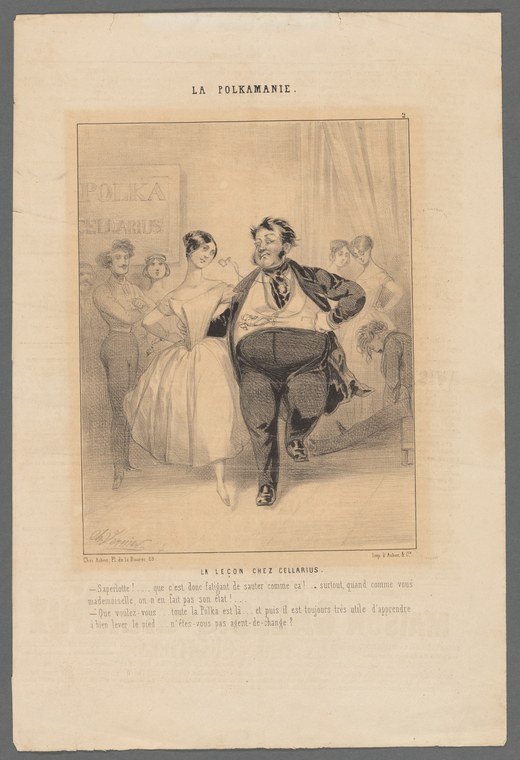
La polkamanie: la leçon chez Cellarius
Unknown artist
- Collection:
- Prints depicting dance
- Source:
- New York Public Library
- Rights:
- Public domain — free to use, share and adapt.
- Recorded as:
- Public Domain
This print is a primary document of the polka's arrival in Europe and the professionalization of ballroom instruction through celebrity masters. It shows us not the polka as performance but as pedagogy, capturing the social reality of how a new dance was transmitted and consumed. For historians of dance, fashion, and 19th-century Paris, it is invaluable evidence of both the physical vocabulary of the polka and the culture of aspiration and comedy surrounding it.
What you are looking at
A satirical scene of a polka lesson at the studio of the famous Parisian dance master Cellarius. A portly gentleman in dark coat and trousers dominates the center of the composition, captured mid-step in an ungainly posture—his weight forward, one leg extended, his upper body leaning back at an awkward angle. He is flanked by a woman in a pale gown with bare arms and shoulders, positioned as his dance partner, and surrounded by other pupils and onlookers in period dress. The setting is a dance studio with tall curtains in the background and what appears to be mirrors or wall panels. The lighting is diffuse, characteristic of the print medium, with careful hatching defining the figures' volume and the spatial recession. The composition captures both the mechanical instruction of the dance and the comedy of the gentleman's obvious discomfort and lack of grace.
The dancing
The central male dancer holds what appears to be a basic closed or promenade position with his partner, though his posture is distinctly clumsy: his torso is tilted backward, his legs are not aligned with proper ballroom carriage, and his overall frame suggests resistance or strain rather than fluidity. The woman maintains a more composed stance, her arm raised in holding position. Two other couples and several spectators are visible in the background, some seated, others observing. The artist has used the contrast between the woman's composed elegance and the man's physical awkwardness as the visual joke of the print.
The dance depicted
This is a polka lesson, explicitly identified in the title as taking place at Cellarius's studio—a real and celebrated institution in 19th-century Paris. Cellarius (Louis Stanislas Xavier de Négreumonts, 1814–1862) was the most prestigious dance master of the era and author of the influential *L'art de conduire et de figurer les contre-danses* (1847). The print satirizes the polka craze that swept Paris in the 1840s–1850s (the mania referenced in the title *La Polkamanie*), mocking both the dance's sudden popularity and the hapless attempts of older gentlemen to master its steps. The awkward posture of the central figure suggests the polka required a new, less rigid physical approach than earlier ballroom dances.
How it was made
This is a lithograph or engraving—the catalogue does not specify, but the fine parallel hatching, tonal subtlety, and the evidence of multiple runs on the stone or plate are consistent with a commercial lithograph. The technique allowed for relatively rapid reproduction and wide circulation, making satirical prints of this kind an ideal medium for commenting on fashionable society. The care taken with the faces and the fabric suggests a professional hand, likely engraved or drawn on stone by an artist working in the tradition of fashion and society caricature popular in mid-19th-century Paris. The work would have been affordable and collectible, aimed at educated urban audiences amused by the social follies of polka mania.
About this work
This is a satirical lithograph documenting a moment in the history of European ballroom dance—the polka craze of the 1840s–50s and the commercial dance education industry it spawned. The print immortalizes the studio of the celebrated Master Cellarius and the social spectacle of middle-class Parisians attempting to acquire what was then a fashionable new skill. By freezing the moment of instruction, the artist captures not just the steps of the polka but the social tensions surrounding it: the gap between aspiration and ability, the pretension of the amateur, and the comic dignity of the gentleman struggling to master a dance that seemed so easy and so necessary to master. The work belongs in a dance gallery as evidence of how dance was taught, commercialized, and satirized in the urban culture of the industrial age.
How to look at it
Notice the artist's choice to freeze the gentleman at the most ungainly moment of his step—torso back, weight unbalanced, legs not in alignment. This is deliberate comedy, not incompetence; the artist understood ballroom dance well enough to capture precisely what goes wrong when an untrained body attempts the polka. Observe the woman's serene face and stable posture, and the contrast with the man's strain. The background figures—some seated, some in proper instruction—reinforce the comedy of the central figure's public failure. The inscription below the image contains satirical verse (in French) further elaborating the humor. The work is typical of the French tradition of *Les Physiologies*—satirical anatomies of contemporary social types—rendered in graphic form.
The period
The polka originated in Bohemia in the 1830s and reached Paris around 1840, where it triggered a dance craze unprecedented in its speed and social penetration. Unlike the waltz, which had been resisted by conservative opinion in the 1810s–20s, the polka was rapidly adopted across European society. Louis Cellarius was the institution of Parisian ballroom dancing in this period; his studio on the Rue Saint-Honoré became a destination for anyone wishing to achieve social respectability through dance. The satirical tradition of mocking fashion crazes was well established in French graphic art by mid-century, and the polka—with its vigorous, bouncy rhythm and its demand that dancers acquire new muscle memory—was irresistible fodder for caricature. The print likely dates to the mid-1840s, at the height of polka mania.
Where it lives
The work is held in the New York Public Library's collection of prints depicting dance, catalogued as *La polkamanie: la leçon chez Cellarius*. It is part of a substantial 19th-century collection documenting ballroom dance, fashion, and social spectacle through commercial graphic arts.
Dance in this work
Questions about this work
Who was Cellarius?
Louis Cellarius (1814–1862) was the most celebrated dance master in Paris during the mid-19th century. His studio was the destination for anyone wishing to learn fashionable ballroom dancing. He authored influential treatises on dance and dance notation, and became a cultural icon synonymous with refinement and social aspiration.
Why is this image funny?
The print satirizes the polka mania that gripped Paris in the 1840s by showing a middle-aged man completely failing to master the steps, despite being under the instruction of the most famous teacher in Europe. The contrast between his clumsy posture and the grace of his partner, and the presence of other observers, amplifies the comedy of public failure and social embarrassment.
What does the polka look like in this image?
The polka is depicted as an upright, bouncy dance performed in closed position, with the partners facing each other. Unlike the gliding waltz, the polka required sharper footwork and a more energetic use of the legs. The gentleman's strained posture suggests the dancer needed significant muscle coordination to execute the rhythm properly.
Is this a real place?
Yes, Cellarius's studio was a real and celebrated institution in mid-19th-century Paris, located on the Rue Saint-Honoré. It became a symbol of fashionable society and social climbing. The artist has captured a recognizable place and a real cultural phenomenon.
More dance artwork





