49 works in this view — arrow keys or swipe to move between them.
Dance in Art
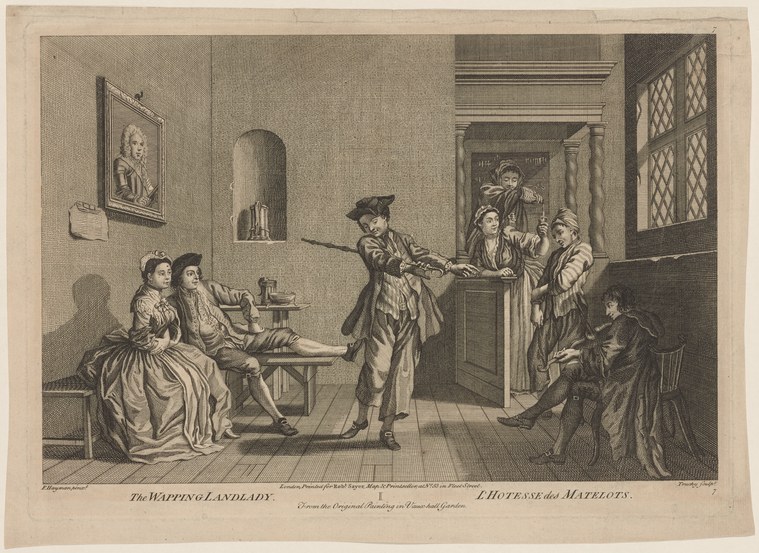
The Wapping landlady, l'hotesse des matelots, from the original painting in Vaux-hall garden.
Unknown artist
- Collection:
- Prints depicting dance
- Source:
- New York Public Library
- Rights:
- Public domain — free to use, share and adapt.
- Recorded as:
- Public Domain
This print documents a now-lost vernacular social dance or parlor game whose name and rules are no longer certain. It shows that not all 18th-century dance was courtly, formal, or preserved in written manuals—much was social, improvisational, and transmitted through prints like this. The work is also a rare example of how popular entertainment was commodified and re-circulated through engravings: Vauxhall Gardens created the painting; the engraving brought it to a mass market. For historians of social dance, leisure culture, and gender relations, it is a vital primary source.
What you are looking at
A tavern or public house interior from the 18th century shows a lively scene of social interaction and flirtation. In the foreground, a young man in a brown coat and tricorn hat extends a long stick or pole toward two seated women in elaborate silk gowns—the figure on the left leans back in animated response. Behind them, a woman stands at a counter or table in conversation with a man, while two more figures occupy the shadowed background near a window. The room is plainly rendered with stone walls, a barrel-vaulted ceiling, and leaded casements; a portrait hangs on the back wall. The engraving captures a moment of social comedy, with the man's gesturing stick the focal point of an elaborate pantomime of courtship or jest.
The dancing
The standing man's posture is the crucial detail: he thrusts a long stick horizontally toward the seated women in a pose that is emphatically theatrical rather than naturalistic. His body leans forward, weight on his front leg, arm extended in a broad arc—a classical comedic gesture of approach or provocation. The woman on the left rocks backward, her arms raised in mock alarm or exaggerated response, her silk skirts spread widely across the chair. The geometry of the exchange—thrust and recoil, advance and retreat—is balletic, not accidental.
The dance depicted
This depicts a social dance or parlor game from the Vauxhall Gardens era (1740s–1770s), likely a courting ritual or fashionable entertainment staged for spectators. The title references 'the Wapping landlady' and a "matelots" (sailor) context, suggesting this was a popular type scene—a genre print capturing recognizable characters and stock situations. The 'stick' is probably a prop used in a known game or figure; the energy and freeze-frame composition suggest this was derived from a painting displayed in Vauxhall's supper boxes, meant to amuse a broad audience. The dance content is social theater: flirtation performed for the room.
How it was made
This is an engraving, likely hand-colored, from the mid-to-late 18th century. The technique allows fine line work that renders fabric texture and shadow through hatching; the composition is shallow and stage-like, with figures arranged parallel to the picture plane in the manner of theatrical prints. Engravings of this type were mass-produced and affordable, circulating among the urban middle class. The inscription indicates this was copied after a painting in Vauxhall Gardens, a commercial pleasure garden where original paintings decorated the supper boxes; the engraving would have served as a souvenir or advertisement for visitors.
About this work
A hand-colored engraving showing a tavern scene of fashionable social flirtation, likely 18th-century London. The scene is frozen at the moment of a gestural exchange—a man extends a stick toward seated women, who respond with exaggerated recoil. This is a type scene: a genre print capturing a recognizable parlor game or entertainment that would have been familiar to the urban audience for Vauxhall Gardens attractions. The work sits at the intersection of social history, popular theater, and visual comedy, recording how the leisure classes performed courtship and wit for spectators.
The image belongs in a dance gallery because the 'game' or 'figure' being played is fundamentally kinetic: it is a stylized exchange of poses, responsive movement, and theatrical timing. The participants are not moving freely but rather executing a known sequence—the stick and the woman's response are choreographed as surely as any country dance figure. This is dance as social ritual and entertainment, embedded in the everyday leisure of the period.
How to look at it
Notice the geometry of the pose. The man's extended stick and forward lean, the woman's backward rock and raised arms—these form a symmetrical, balletic exchange. The artist has frozen a single moment in what is clearly a back-and-forth sequence. Look at the crowd's response in the background; they are watching the exchange as spectators, which tells us this is a staged performance, not a private moment. The composition is shallow and stage-like, emphasizing the theatrical nature of the scene. The fine engraved lines render the silk of the women's gowns and the detail of their faces with almost caricatural precision, inviting the viewer into a knowing wink at these fashionable figures at play.
The period
This engraving dates to the era of Vauxhall Gardens (1741 onwards), London's most celebrated pleasure garden. The gardens combined fine art, music, fireworks, and social spectacle; paintings by artists like Thomas Rowlandson and others decorated the supper boxes and were then engraved and sold as prints. Type scenes—representations of recognizable stock characters and situations—were enormously popular: the 'Wapping landlady,' the sailor, the coquette, the fop. These prints functioned as visual entertainment, social satire, and souvenirs. The style reflects a broader 18th-century interest in capturing contemporary social life and manners. In dance, this was the era of the cotillion, quadrille, and elaborate country dances; but it was also an age when informal, comic, flirtation-based social games flourished among the urban middle class.
Where it lives
This engraving is held by the New York Public Library as part of its collection of prints depicting dance and popular entertainment. The inscription states it was copied from a painting in Vauxhall Gardens, the celebrated London pleasure garden. Vauxhall paintings were often engraved and published to extend their circulation beyond the gardens themselves; this print is a typical example of that commercial practice.
Dance in this work
Questions about this work
What is the stick the man is holding?
The stick appears to be a prop used in a parlor game or social dance figure, now lost to record. Its role in the exchange—extended toward the women, met with exaggerated recoil—suggests it was a focal point of the game's choreography. Without access to period descriptions of such games, we cannot say with certainty what the game was called or how it was played.
Who were the 'Wapping landlady' and 'matelots'?
These were stock characters in 18th-century popular prints: the landlady a comic figure of the urban working class, the matelots (sailors) known for their bluff manners and rowdy social behavior. Type scenes featuring recognizable characters were enormously popular as mass-produced engravings. The scene may depict a known narrative or jest involving these characters, though the specific story is no longer clear.
Is this really a dance?
Yes, in the 18th-century understanding of the term. Social dance encompassed not only the formal figures of the ballroom but also parlor games, flirtation games, and theatrical entertainments that involved coordinated or responsive movement. The exchange shown here—advance and retreat, pose and response—follows the logic of a dance figure, even if it is performed in a tavern rather than a ballroom.
What is Vauxhall Gardens and why does it matter?
Vauxhall Gardens (1741–1859) was London's premier pleasure garden, a commercial space where music, paintings, fireworks, and social spectacle were combined for paying visitors. It was a site of fashionable entertainment and visual culture; paintings displayed there were then engraved and circulated as prints, extending their reach. The gardens thus functioned as both a site of live entertainment and a generator of mass-market imagery.
More dance artwork





