49 works in this view — arrow keys or swipe to move between them.
Dance in Art
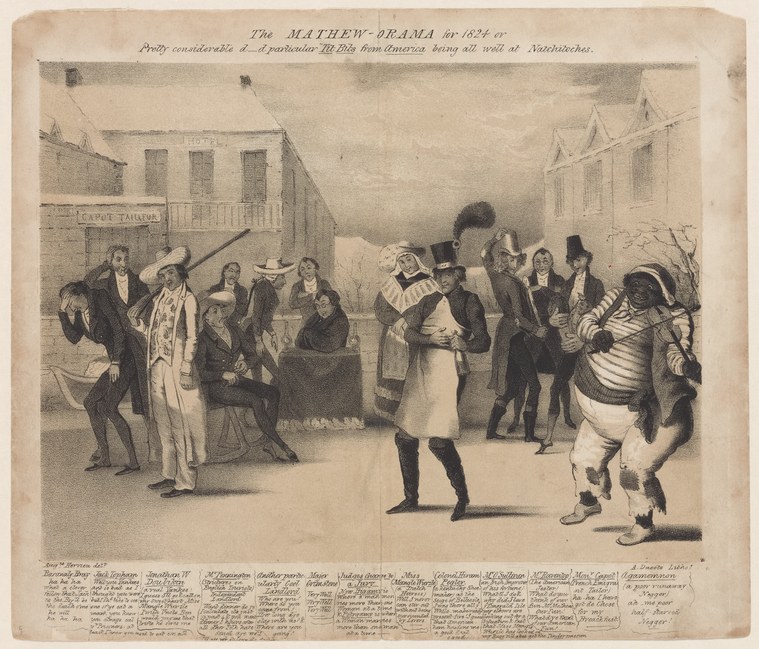
The Mathew-orama for 1824,: or Pretty considerable d--d particular tit bits from America being all well at Natchitoches
Unknown artist
- Collection:
- Prints depicting dance
- Source:
- New York Public Library
- Rights:
- Public domain — free to use, share and adapt.
- Recorded as:
- Public Domain
This print is a crucial document of how European audiences perceived American and colonial dance in the early 1800s, using bodily exaggeration to express anxieties about race, class, and national character. For dance historians, it reveals the power of movement imagery in political satire and shows how dance was deployed—and distorted—to advance ideological arguments about civilization and savagery. It is a rare surviving example of satirical dance imagery and demonstrates the entanglement of dance representation with colonialism and racial caricature.
What you are looking at
This is a satirical print depicting a chaotic outdoor scene in what appears to be early 19th-century America, likely referencing events in Natchitoches, Louisiana. A large crowd of figures in period dress—top hats, coats, and formal wear—cluster around a central space where several individuals are engaged in exaggerated movement and dancing. The composition is crowded and busy, with figures overlapping and arranged without classical perspective, creating a sense of tumultuous activity. In the background, simple buildings with peaked roofs suggest a frontier settlement. The print is executed in a sepia or brown tone, typical of hand-colored engravings of the period. At the bottom runs a detailed caption identifying numerous figures, suggesting this documents a specific (if satirized) historical event. The overall tone is one of mockery—the figures' postures are awkward and undignified, their expressions exaggerated, and the scene conveys social disorder rather than refined entertainment.
The dancing
The central dancers display loose, uncontrolled body positions: one figure in the middle appears to be jumping or kicking with legs splayed, while others around him assume postures that suggest flailing or uncoordinated movement. A woman in white dress stands with arms raised but without grace. The figures are densely packed with no clear spatial organization; bodies lean, twist, and contort in ways that parody rather than celebrate movement. There is no evidence of the closed holds or structured partnering of ballroom dance; instead, the bodies seem to tumble and lurch independently, suggesting either folk revelry or deliberate caricature of social dancing.
The dance depicted
This appears to be a satire of American frontier or creole social dancing, most likely depicting a real or imagined dance gathering that occasioned public controversy or ridicule. The title's reference to "pretty considerable d--d particular tit bits from America" and the Natchitoches location suggest this documents or mocks actual events among mixed social groups in Louisiana. The style of movement—wild, ungoverned, and lacking the refinement of European ballroom convention—may represent plantation dances, enslaved peoples' social gathering, or deliberate caricature of lower-class American revelry. The print does not depict a recognized formal dance but rather uses exaggerated bodily chaos to comment on American social life and racial mixing, which was itself the true subject of satire.
How it was made
This is an engraving or aquatint, hand-colored, typical of early 19th-century satirical prints in Britain. The technique allowed rapid production and circulation of topical commentary, and the sepia tone and line-work suggest English manufacture. Satirical prints of this type were widely distributed to middle and upper-class audiences and served as visual journalism, mixing social commentary with caricature. The dense captioning below the image—a feature of satirical engravings—anchors specific identifications and invites the viewer to decode the scene. The medium's accessibility and the print's subject matter suggest it was created for commercial sale and public consumption, not as fine art.
About this work
This is an early 19th-century British satirical engraving that uses dance and bodily chaos to mock American frontier society, likely referencing actual or imagined events in Natchitoches, Louisiana. Rather than depicting a coherent dance style, it shows movement as disorder and impropriety, weaponizing the image of ungoverned bodies to comment on race, class, and colonial anxieties about America. The work belongs in a dance gallery precisely because dance here is not the subject but the vehicle: the caricatured bodies and frantic movement convey social critique in a way that would lose force if rendered in still poses. It documents not what Americans danced but how British satirists imagined American bodies to move—and what they feared that movement represented.
How to look at it
Note the absence of any ballroom convention: there are no closed holds, no lines or squares, no spatial order. Instead, examine the individual body positions—the jumped legs, the raised arms without frame, the twisted torsos—and ask what statement they make about control, civilization, and propriety. The print's chaos is intentional and political. Compare the central dancers' postures to any image of ballroom dancing from the same period to see how thoroughly this work inverts the norms of respectable movement. Read the caption: it identifies specific figures, suggesting this satirizes particular people and events, though the visual exaggeration makes it impossible to recover the actual dancing.
The period
Early 19th-century British satirical prints were a thriving form of political and social commentary, popularized by artists like Gillray and Rowlandson. This print dates to a period of intense British interest in and anxiety about American independence, expansion, and racial politics. The reference to Louisiana and Natchitoches locates the satire in a region of French colonial legacy and enslaved labor, suggesting the print's humor turns on racial mixing and the perceived impropriety of cross-racial social dancing. In ballroom culture of the period, formal European dances (minuets, country dances, cotillions) marked social rank; the wild, uncontrolled movement depicted here would have signaled both primitivism and disorder to contemporary viewers.
Where it lives
The print is held in the New York Public Library's collection of prints depicting dance. It survives as a hand-colored engraving, a form that circulated widely in the early 19th century and was often sold individually or bound into satirical miscellanies. The NYPL attribution and dating suggest this is one of thousands of topical prints produced in London and exported or reprinted in America.
Questions about this work
Did people actually dance this way in Natchitoches?
Very unlikely. This is satire, not reportage. The exaggeration serves ideological purposes—to mock American society and reinforce ideas about racial and class difference. That said, the print may reference real dance practices or social events; the caption's specificity suggests some factual kernel. What actually happened cannot be recovered from this image alone.
What dance is this supposed to be?
It does not depict a named or formal dance style. It is a parody of social dancing in general, stripped of convention and propriety. The closest analogue might be folk or creole social dances, or improvisational movement in plantation or lower-class settings—precisely the kinds of dances that ballroom culture defined itself against.
Who made this and when?
The artist is not recorded in the catalogue, and the date is unknown, though the style, costume, and subject suggest early 19th century (c. 1810–1830). The print's technique and circulation pattern indicate a London publisher, but attribution and precise dating would require further research in print archives.
Why is this racist?
The print uses bodily chaos and exaggeration to suggest that people in Louisiana—likely including enslaved or freed Black people and Creoles—moved without refinement or self-control. This visual caricature was a standard tool of racial ideology in the period, implying that non-Europeans were inherently disorderly, uncivilized, and incapable of the bodily discipline that ballroom dancing required and symbolized.
More dance artwork





