49 works in this view — arrow keys or swipe to move between them.
Dance in Art
Pompeian Dance
Unknown artist
- Collection:
- Prints depicting dance
- Source:
- New York Public Library
- Rights:
- Public domain — free to use, share and adapt.
- Recorded as:
- Public Domain
This work illustrates a crucial moment in how dance and classicism were imagined together in 19th-century European art—not as formal technique, but as the expression of natural, innocent grace supposedly recovered from the classical past. The equation of children's play with 'Pompeian dance' reveals the period's deeper anxieties about training, authenticity, and the body, and shows how neoclassical archaeology became a vehicle for Romantic ideology about childhood and nature.
What you are looking at
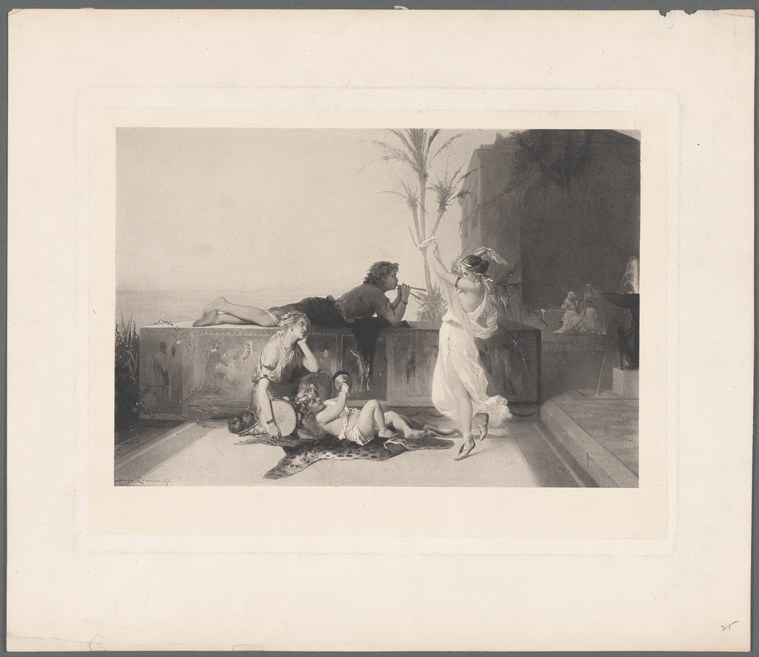
A neoclassical scene set on a sunlit terrace overlooking a Mediterranean landscape. In the foreground, two young children in white drapery play or dance freely on the stone pavement, their bodies relaxed and unselfconscious. Behind them, a woman in a diaphanous white dress stands at the balustrade, gazing outward; to her left, a man in dark clothing reclines or leans against the wall, watching. A potted palm suggests the classical setting. The light is soft and even, the palette warm creams and greys, and the mood is one of leisure and aesthetic repose. The composition draws the eye from the active children through the standing woman to the distant landscape, creating a sense of temporal and spatial depth. The work appears to be a print—possibly an engraving or etching—with fine tonal gradations achieved through careful line work.
The dancing
The two children move in unstructured play rather than formal dance: one crouches or bends forward with arms extending, the other stands upright with lighter, more open posture. Neither displays the rigid frame or positioned alignment of trained dancers. The woman's stance is contemplative and static, her body aligned vertically in a pose of aesthetic repose. The man's reclining posture is equally removed from active dance. The figures are related not by a dance frame but by spatial composition and narrative attention—they occupy a shared moment of leisure rather than a coordinated choreography.
The dance depicted
This is not a depiction of formal dance practice or performance, but rather a scene of childhood play that the title 'Pompeian Dance' locates within a classical or neo-classical imaginary. The children's movements are natural and unschooled, consistent with the Romantic-era ideal of innocence and freedom from social constraint. The scene evokes Pompeian frescoes and the neoclassical aesthetic that dominated European art from the late 18th century onward, when Pompeii's excavation sparked fascination with Greco-Roman life. The 'dance' here is conceptual—an embodiment of the classical world's supposed naturalness and grace—rather than a recognizable dance form.
How it was made
This is a print, almost certainly an engraving or possibly a lithograph, executed with considerable refinement. The fine hatching visible in the stone and drapery, the subtle gradations of tone, and the precise linear definition suggest traditional intaglio printing (engraving or etching) rather than lithography. The print is mounted on a cream card and measures approximately 25 × 30 cm. Such prints were produced for a cultivated middle-class market in the 19th century and circulated in portfolios, art publications, and private collections. The technique allowed wide distribution of classical imagery and reflected the period's deep engagement with neoclassical aesthetics.
About this work
This engraved or etched print stages a moment of leisure in a imagined Pompeian setting, where two children in classical drapery play freely on a sunlit terrace while adults observe in attitudes of aesthetic repose. The work belongs to the 19th-century neoclassical tradition that drew on Pompeian archaeology and Romantic ideology to create scenes of an idealized classical past. Although titled 'Pompeian Dance,' what is depicted is not structured dance practice but rather the embodiment of classical naturalness and grace through the unformed play of childhood—a distinctly 19th-century interpretation of antiquity.
For scholars of dance imagery, the work documents how the period conflated classical aesthetics with childhood innocence and positioned 'the dance' as a metaphor for natural, unschooled movement. It reflects the era's anxiety about artifice and training, and its idealization of a classical world imagined as more authentic and embodied than modern industrial life.
How to look at it
Notice the asymmetry between the title's promise and what is shown: the children are not dancing in any formal sense. Look at their postures—loose, weight distributed unevenly, no alignment or frame. Then observe how the artist positions them as the focal point of the composition, drawing the viewer's eye downward and inward, while the classical setting (palm, balustrade, distant landscape) frames them as specimens of an idealized world. The soft, even light and the warm tonality invite contemplation rather than action. This is a print meant to be studied and absorbed, not a record of movement but an evocation of a mood—the period's fantasy of what classical grace might look like when freed from the constraints of training and social convention.
The period
The print was created in an era (likely early-to-mid 19th century, given stylistic markers) when the excavation of Pompeii and Herculaneum had sparked European fascination with Greco-Roman domestic life and aesthetic ideals. Neoclassical art dominated high-culture aesthetics from the 1770s through the 1850s, promoting an ideal of antique simplicity, proportion, and naturalism as a corrective to perceived 18th-century excess. Simultaneously, Romanticism elevated childhood, nature, and feeling as repositories of authenticity in reaction to industrialization and rationalism. The scene conflates these two movements: it uses classical setting and costume to invest children's unschooled play with the gravitas of antiquity, while using childhood to represent the imagined naturalness of the classical world. In dance specifically, this period saw growing codification of ballet technique (Romantic ballet emerged in the 1830s–40s), making the idealization of 'natural' movement increasingly nostalgic and invented.
Where it lives
The work is held in the New York Public Library's collection of prints depicting dance, catalogued as 'Pompeian Dance' with unknown artist and date. It is a mounted print on cream-colored card, typical of 19th-century art collections and print portfolios.
Questions about this work
Why is this called a dance if the children aren't dancing?
The title reflects 19th-century neoclassical aesthetics, which used 'dance' as a metaphor for natural, graceful movement—especially childhood play. Excavations at Pompeii had sparked intense interest in how the ancients supposedly embodied grace and naturalness without artifice or training. For Romantic-era artists and viewers, a child's unschooled movement in a classical setting *was* a kind of dance: the expression of an ideal of human beauty supposedly lost to modern society.
Who was dancing like this in the 19th century?
No one—not formally. This is an imagined scene. However, it reflects anxiety about the increasing codification of ballet technique during the Romantic era (1830s onward). As ballet became more technical and rule-bound, artists and critics became nostalgic for an imagined world of natural, unschooled grace. The scene also fits within a broader 19th-century cult of childhood innocence that positioned children's bodies as repositories of truth and authenticity.
What does this tell us about how dance was understood at the time?
It reveals a deep split: formal dance practice (especially ballet) was becoming increasingly professionalized and technical, yet cultural taste valorized 'natural' movement and expression. This print shows artists trying to have it both ways—using classical costume and setting to invest unschooled childhood play with the dignity of 'art' and 'dance.' It exposes the period's anxiety about whether training and technique were enemies of authentic human expression.
More dance artwork





