49 works in this view — arrow keys or swipe to move between them.
Dance in Art
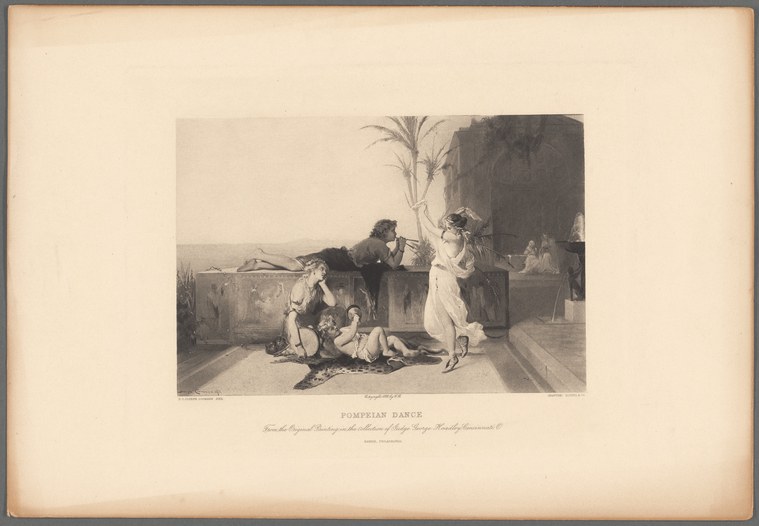
Pompeian dance, from the original painting in the collection of Judge George Hoadley, Cincinnati, O.
Unknown artist
- Collection:
- Prints depicting dance
- Source:
- New York Public Library
- Rights:
- Public domain — free to use, share and adapt.
- Recorded as:
- Public Domain
The image documents nineteenth-century ideas about ancient dance and performance—not ancient practice itself, but how artists and educated viewers of the period imagined classical entertainment. It reveals the period's investment in gestural, narrative-based performance as distinct from codified social dance, and shows how prints circulated knowledge about performance history and aesthetic ideals.
What you are looking at
A neoclassical interior scene depicts a group of figures in classical dress arranged on a terrace overlooking a distant landscape. At the center, a woman in a white draped gown stands elevated, arms raised in an expressive gesture. Around her, seated and reclining figures in earth tones and white observe her; one plays a lyre. The setting is framed by classical architecture—a dark wall or building mass at right, a palm tree suggesting Mediterranean geography, and a low wall opening to the landscape beyond. The lighting is soft and diffuse, creating an antiquarian atmosphere. The composition suggests a moment of entertainment or spectacle within an elite domestic or courtly setting.
The dancing
The central figure's posture—upright, with raised arms—suggests lyrical or gestural performance rather than balletic technique. The supporting figures form an attentive audience, seated or reclining in relaxed poses around the performer. No closed holds or partner work is visible. The overall frame is static and composed, not capturing rapid or weight-shifted movement; the bodies suggest sustained, controlled gestures suited to narrative or expressive performance rather than social dancing.
The dance depicted
This appears to depict a Pompeian or recreated Greco-Roman scene of social or theatrical entertainment, likely drawing from antiquarian knowledge of classical symposium culture. The title indicates it derives from an original painting by Judge George Hoadley, which suggests this is a nineteenth-century imaginative recreation of ancient practice rather than historical documentation. No specific dance form is identifiable; the raised arms and central positioning suggest declamation, mime, or rhythmic gesture-based performance within a classical revival aesthetic. The image reflects nineteenth-century Romantic interest in classical antiquity through the lens of neoclassical aesthetics.
How it was made
This is an engraving (established from the image, as the record does not specify medium). The fine linear work, tonal gradation achieved through close parallel lines and cross-hatching, and the monochromatic palette confirm the engraving technique. The print's formal composition and careful architectural perspective suggest it was intended for educated circulation—likely as an art reproduction or illustration accompanying text on classical antiquity. The technique allowed wide distribution of the refined original painting and positioned the image within scholarly and aesthetic discourse on ancient life.
About this work
This engraving presents a Romantic-era reimagining of classical Pompeian entertainment, depicting a central figure in expressive gesture before an attentive audience in an idealized Mediterranean setting. Created in the nineteenth century as a reproduction of an original painting, it reflects the period's fascination with reconstructed classical life and the role of performance within ancient society. The work sits at the intersection of antiquarian scholarship, neoclassical aesthetics, and theatrical interest in gestural and lyrical forms of entertainment.
How to look at it
Notice the compositional centrality and elevation of the performing figure—a deliberate choice that frames her as the focus of attention and suggests authority or special status within the scene. The surrounding audience's stillness and attentiveness emphasize the performance moment. Observe the drapery and pose of the central figure: the raised arms and upright stance convey expression and dignity rather than the specific technical vocabulary of later theatrical dance forms. The architectural framing and landscape background situate this as leisure and spectacle within an elite domestic or courtly world, inviting the viewer to imagine themselves as part of the observing group.
The period
The print belongs to the nineteenth-century neoclassical and Romantic movement, which was intensely invested in reconstructing and reimagining classical antiquity. This period saw the rise of Pompeian imagery following the continued excavation of Pompeii (major campaigns occurred in the 1860s–1870s), which stimulated artistic and scholarly fascination with Roman daily life and entertainment. Simultaneously, theatrical performance and gesture-based dance were being reconceived through Romantic ideology—movement freed from rigid courtly convention and invested with emotional and narrative meaning. The commissioning of such a work by an American judge (George Hoadley of Cincinnati) suggests the broad educated American interest in classical learning and artistic reproduction during this period.
Where it lives
The work is held in the New York Public Library's collection of prints depicting dance. It is a reproduction engraving derived from an original painting in the collection of Judge George Hoadley of Cincinnati, suggesting it was created for broader circulation as an art print in the nineteenth century.
Questions about this work
Is this a historical record of actual Pompeian dance?
No. This is a nineteenth-century Romantic-era artistic interpretation of what the artist imagined Pompeian entertainment might have been. While it reflects genuine scholarly interest in classical archaeology and performance, it is a creative reconstruction shaped by nineteenth-century aesthetic ideals, not evidence of ancient practice.
What dance form is being depicted?
No specific codified dance is identifiable. The image suggests gestural performance or mime—a sustained, expressive pose rather than the technical vocabulary of ballet or social dance. This reflects the period's understanding of classical performance as lyrical and narrative-based.
Why was this image made and circulated?
As an engraving reproduction of a painting, it belonged to the nineteenth-century market for high-quality art prints aimed at educated middle- and upper-class collectors. It participated in the period's scholarly and aesthetic fascination with classical antiquity and the role of the arts in ancient life.
More dance artwork





