49 works in this view — arrow keys or swipe to move between them.
Dance in Art
Polkamania
Unknown artist
- Collection:
- Prints depicting dance
- Source:
- New York Public Library
- Rights:
- Public domain — free to use, share and adapt.
- Recorded as:
- Public Domain
The polka marked a watershed in ballroom culture: it was the first dance craze of the mass-media age, documented and distributed through prints, sheet music, and essays in a way that earlier dances were not. This print is evidence of how visual culture participated in that craze, and it offers a precise record of how the polka was held, stepped, and socialized in mid-century salons. For dancers and historians, it is a primary source for understanding both the kinetics of the dance and the intensity of public enthusiasm it generated.
What you are looking at
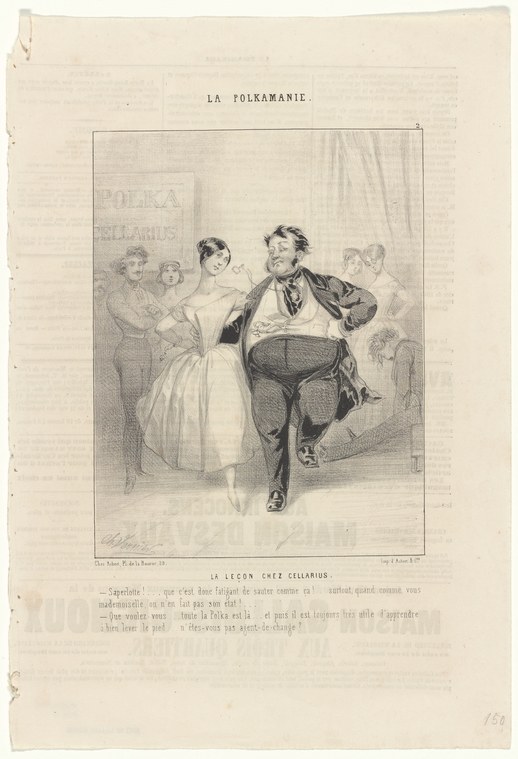
A lively ballroom scene rendered in lithographic style, dominated by a central couple in the foreground executing a polka. The man, in dark formal attire with a distinctive patterned vest or jacket, leans back with exaggerated motion, his body weight shifted dynamically; the woman opposite him in a pale full skirt mirrors his energy, caught in the upward lift of the step. Behind them, other couples and onlookers populate a decorated interior—some dancing, others watching or conversing—rendered in lighter tones that recede into the background. The setting appears to be an elegant ballroom or salon, with hints of architectural detail and what may be mirrors or wall decorations. The composition captures the moment of greatest extension in the polka's characteristic hop-step, with the central couple's bodies forming an angle that conveys the athletic, playful quality of the dance. The title "La Polkamanie" and the publication credit appear below, identifying this as a popular print.
The dancing
The lead male figure adopts an open, weight-back frame with his torso inclined away from his partner, arms extended in an unstructured hold typical of social polka. The female dancer's skirt flares and lifts with the vertical action of the step, her posture responsive to his lead. Both figures are rendered with anatomical clarity in the torso and legs, though the heads are more lightly sketched. The supporting couples in the background are less distinctly articulated but shown in similar open holds and in motion, establishing the social, group character of the dance.
The dance depicted
This is unquestionably a polka, identified by title, by the characteristic hop-skip rhythm suggested in the figures' poses, and by the social context. The polka was the dominant ballroom craze of the 1840s and 1850s across Europe, and this print documents both the dance itself and its mania—the obsessive public enthusiasm that seized respectable society. The dancers wear fashionable contemporary dress, the setting is a formal ballroom, and the energy is decidedly social and recreational rather than theatrical. The exaggerated backward lean and high lift of the lead figure capture the polka's liveliness and its departure from the stately restraint of earlier ballroom forms.
How it was made
This is a lithographic print, identifiable by the characteristic grainy tone, the soft modeling of form, and the linear handling of detail. Lithography was the dominant medium for popular dance imagery in the mid-19th century because it allowed rapid, economical production of large editions for a mass market. The technique here shows confident drawing in the foreground figures and looser, more suggestive handling in the background, a compositional hierarchy typical of entertainment prints. The medium's ability to capture both precise costume detail and atmospheric social context made it ideal for documenting fashionable dance crazes.
About this work
This is a commercial lithographic print documenting the polka craze that swept through European and transatlantic ballrooms in the mid-19th century. The title "Polkamanie" is itself evidence of the dance's cultural dominance: the polka was not merely danced but obsessed over, collected in prints, taught in academies, and debated in salons. The image captures a moment of pure social vitality—the central couple executing the characteristic hop with unbridled energy, their bodies angled and lifted in a way that signals athletic pleasure and social abandon. This is not a choreographed theatrical form but a vernacular social dance, and the print preserves both the physical technique and the convivial atmosphere that made it revolutionary.
How to look at it
Watch the angle of the male dancer's torso: his backward lean and the lift of his frame define the polka's characteristic energy and its departure from the upright formality of the waltz or minuet. Notice how the female dancer's skirt rises with the hop, a detail that both documents the realities of movement in full skirts and conveys the lightness and lift of the step. The background couples, rendered less distinctly, establish that this is a social occasion rather than a performance; the print documents a fashionable ballroom moment, not a staged spectacle.
The period
The polka emerged in Bohemia in the 1830s and reached Vienna, Paris, and London by the early 1840s, becoming the dominant social dance of the mid-century. It coincided with the rise of lithography and popular illustrated periodicals, creating an unprecedented visual record of ballroom dance. Unlike ballet, which was theatrical and hierarchical, the polka was democratic and reproducible—any couple could learn it—and this accessibility fueled its spread. The years 1840–1860 saw polka mania reach fever pitch, with polka fashions, polka furniture, and polka imagery ubiquitous in middle-class homes.
Where it lives
This print is held in the New York Public Library's collection of prints depicting dance. It appears to be a mid-19th-century lithographic publication, part of the mass-produced imagery that circulated through salons, drawing rooms, and commercial contexts during the polka's heyday.
Dance in this work
Questions about this work
What is polka mania?
The polka was a Bohemian dance that became a continental craze in the 1840s–1850s. The enthusiasm was so intense that it saturated popular culture: people bought polka prints, wore polka fashions, danced at polka balls, and read about polka in newspapers. The title "Polkamanie" captures this cultural obsession, treating the polka not merely as a dance but as a social phenomenon.
How is the polka different from the waltz?
The waltz was smooth, turning, and stately; the polka is bouncy, with a distinctive hop-step, and partners could move about the floor more freely. The polka also felt more democratic and less formally prescribed than the waltz, and it allowed for a looser, more playful hold. This print shows that open, energetic quality clearly in the lead dancer's inclined frame and lifted action.
Why was this dance so important historically?
The polka was the first social dance to become a mass-market phenomenon, documented and distributed through prints, periodicals, and popular media. It demonstrated that a simple, learnable dance could capture the enthusiasm of entire cities and cross social boundaries. For dance historians, it marks the beginning of modern dance culture.
More dance artwork





