49 works in this view — arrow keys or swipe to move between them.
Dance in Art
Men dancers and choreographers in prints
Unknown artist
- Collection:
- Prints depicting dance
- Source:
- New York Public Library
- Rights:
- Public domain — free to use, share and adapt.
- Recorded as:
- Public Domain
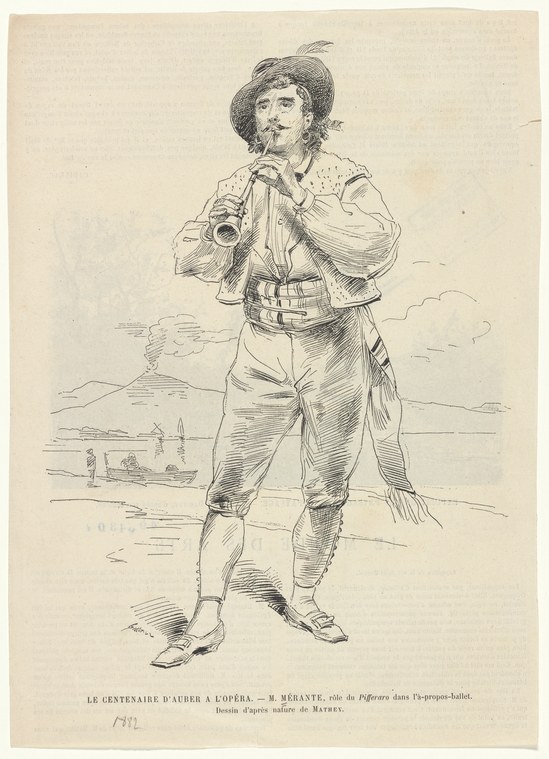
Character dances with instruments were a staple of 19th-century theatre and opera, yet images of them are scarce. This drawing offers direct evidence of costume, posture, and the relationship between music and movement in a type of dance that has largely disappeared. The inscription anchors the image to a specific historical event, making it possible to trace the work's context and understand how such entertainments were documented and remembered.
What you are looking at
A male figure stands in a confident pose against a lightly sketched landscape background. He wears a broad-brimmed hat with a feather, a patterned short-sleeved jacket, and fitted breeches gathered at the knee, with wrapped leg coverings and simple shoes—a costume of early 19th-century theatrical character dance. He holds a long wind instrument (possibly a musette or similar pipe) to his mouth with both hands, positioned diagonally across his body. His posture is upright and alert, with one leg bearing weight while the other is slightly advanced, as if caught mid-step or mid-performance. The background shows minimal detail: a distant horizon line, some lightly indicated landscape features, and what may be a small figure or stage element in the far distance. The figure dominates the composition, drawn with crisp contour lines and careful attention to fabric and musculature, set against the warm tone of aged paper.
The dancing
A single male dancer or character performer is depicted in a standing position with weight distributed between two legs, one advanced in a relaxed lunge. His torso is upright and his shoulders are squared. Both arms are engaged in playing the wind instrument, which occupies the upper half of his body and draws the eye upward. His gaze is directed toward or slightly above the instrument. The posture suggests a moment of active performance rather than a static pose—the body is alert and the advanced leg implies readiness to move.
The dance depicted
This appears to be a character dance from early 19th-century European popular or stage traditions, most likely French or Italian given the costume and the inscription in French. The figure resembles a *rustic character* or *peasant dancer* type common in theatrical spectacle and ballet divertissements of the 1800s. The combination of the wind instrument, the fitted breeches with leg wrappings, the feathered hat, and the alert posture suggests a *fife-and-drum* or *piper* character—a traditional figure in military or festive processions that was frequently adapted for the stage. Such characters often performed rhythmic, percussive footwork synchronized with the playing of instruments, though the artist has chosen to capture the moment of performance rather than emphasize footwork.
How it was made
This is a pen-and-ink drawing, likely a preparatory sketch or finished study, executed with fine linear hatching for shadow and volume. The technique shows confident line work and economical modeling—the artist builds form through parallel lines rather than heavy shading, a method typical of 19th-century theatrical or costume illustration. The paper is aged to a cream tone. Based on the style and the French inscription below, this may be a reproduction or printed version of an original drawing, possibly a lithograph or engraving for publication in a theatrical journal or program. The quality of the line and the deliberate composition suggest this was a finished work intended for circulation, not a quick notation.
About this work
This is a character-dance study from the early-to-mid 19th century, likely French, depicting a rustic or military figure playing a wind instrument as part of a theatrical performance. The inscription refers to a centennial opera celebration and identifies the figure as a specific character role. The work captures a moment of performance—the musician-dancer caught in the act of playing, with his body language and costume signaling both musical engagement and readiness for rhythmic movement. It is a rare documentary record of how theatrical character dances were costumed and composed, showing the integration of musical performance and physical presence that defined entertainment spectacle of the period.
How to look at it
Notice the energy in the pose despite its stillness: the advanced leg, the squared shoulders, and the alert tilt of the head all suggest imminent or ongoing movement. The instrument is not merely held but *played*—the artist has captured a moment of active performance, not a pose struck for the portrait. The costume details—the feather, the wrapped legs, the patterned jacket—are rendered with care and would have been recognizable to a contemporary audience as markers of a specific theatrical character type. This is a sketch of a *role*, not a generic figure.
The artist
The artist is not recorded. The style and inscription suggest a French theatrical illustrator or scene designer active in the mid-19th century, possibly working for an opera house or theatrical publication. The confident handling of figure anatomy and the clarity of the line work indicate professional training, likely in a tradition of theatrical costume and character design.
The period
In the early-to-mid 19th century, character dances—short theatrical pieces featuring specific social or national types—were popular entr'actes and divertissements in opera and ballet. Such dances often featured recognizable props: swords, fans, instruments, or regional costume. The wind instrument here connects the figure to military or rustic tradition, echoing both the *soldat* characters of earlier 18th-century ballet and the rising Romantic interest in folk and peasant life. Theatrical illustration was a growing profession, and images of dancers and characters were published in journals and programs to promote performances and commemorate special occasions.
Where it lives
The work is held in the New York Public Library's prints collection, specifically within a folder of prints depicting male dancers and choreographers. The French inscription and the apparent print technique suggest this may have been published as part of a theatrical journal, program, or commemorative collection.
Dance in this work
Questions about this work
What is the instrument he's playing?
The instrument appears to be a wind pipe or musette—a simple folk instrument used in rustic and military contexts. In theatrical dance of the 19th century, such instruments were often played by character dancers as part of the entertainment, combining music-making with rhythmic movement.
What does the French text say?
The inscription references a centennial celebration at an opera house and identifies the figure as a specific character—likely from a particular production. Without being able to read the full text clearly in this image, the precise details remain uncertain, but the inscription anchors the work to a known historical event.
Is this a real person or a fictional character?
This is a theatrical character—a role type rather than a portrait of an individual performer. However, the specificity of the costume and the inscription suggest it may have been inspired by or drawn to commemorate a particular production and possibly a well-known performer of the role.
What kind of dance would he have performed?
Character dances of this era typically featured percussive footwork, directional traveling, and energetic rhythmic movement synchronized with music or instruments. The alert posture here suggests the dancer would have moved with precision and snap, in contrast to the fluid, ethereal style of contemporary Romantic ballet.
More dance artwork





