49 works in this view — arrow keys or swipe to move between them.
Dance in Art
Der Tanzfex, Walzerlied von Gustav Pick
Unknown artist
- Collection:
- Prints depicting dance
- Source:
- New York Public Library
- Rights:
- Public domain — free to use, share and adapt.
- Recorded as:
- Public Domain
The image documents the social and commercial apparatus of ballroom dance in the 19th century: the domestic and public contexts in which the waltz was performed, the professional composer's role, and the design strategies used to sell dance music to a mass middle-class market. For historians of dance, waltz, and print culture, it is a primary source showing how the waltz was imagined, advertised, and consumed.
What you are looking at
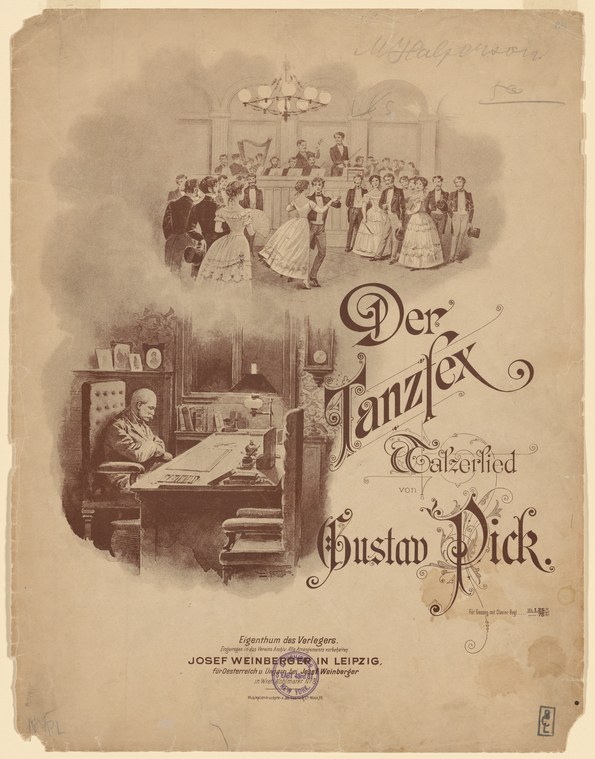
A two-part image advertising a waltz-song (Walzerlied) by Gustav Pick. The upper vignette shows an animated ballroom or concert hall scene: a large mixed gathering of fashionably dressed figures in mid-19th-century costume, centered on a platform or stage where musicians perform beneath an ornate chandelier and decorative arch. The crowd stands and mingles—some couples in social proximity, others observing—in the relaxed posture of an audience or salon rather than an organized line dance. The lower vignette depicts a solitary man seated at a writing desk in a study or office, pen in hand, suggesting the composer at work. Both scenes are rendered in soft brown and sepia tones, with careful cross-hatching to model form and create depth. The decorative typography of the title dominates the center, flanked by these complementary scenes of the social and creative acts of dance music.
The dancing
In the ballroom scene, figures are upright and loosely arranged rather than in formal couples' positions; some stand side by side in conversational attitudes, others face inward toward the performers. The women wear full skirts with visible crinolines, the men tailcoats and formal dress. No one is captured mid-leap or in an exaggerated dance frame; the overall impression is of restful sociability punctuated by music, rather than vigorous partnered movement. The seated composer at the desk adopts the contemplative, motionless posture of creative labor—a pointed contrast to the animation above.
The dance depicted
This is a waltz-song (Walzerlied), a hybrid vocal-instrumental form that combined a vocal melody sung by a soloist or small group with orchestral waltz accompaniment, popular in Vienna and German-speaking Europe from the 1820s onward. The image does not depict active dancing—no one is in a waltz hold or executing the characteristic turning, rising-and-falling movement of the waltz. Instead, it shows the social occasion and the creative process: a salon or ball where such music would be performed and danced, and the composer's study where it was written. The waltz itself is implied rather than shown.
How it was made
This is a chromolithograph or hand-colored lithograph (the technique cannot be determined with certainty from the image alone, but the soft tonal gradations, cross-hatching, and careful modeling of light are consistent with mid-19th-century lithographic printing). The use of warm sepia and tan creates an antiquarian, nostalgic feel appropriate to a commercial music cover or advertisement. The technique allowed for broad, gentle circulation—this was a sheet-music cover or poster, meant for sale to amateur musicians and dancers in the home and concert hall, making the waltz accessible to the middle class.
About this work
This is a cover or advertisement for a waltz-song by composer Gustav Pick, presenting two allegorical vignettes: the social milieu of the dance and the solitary creative act that produced the music. It is not a depiction of the dance itself, but rather a dual portrait of waltz culture—at the moment of social enjoyment and at the moment of artistic composition. The work belongs to a vast genre of 19th-century printed dance music marketed to amateur performers and ballroom-goers, a visual and commercial form now as historically significant as the music itself.
How to look at it
Attend to the contrast between the two scenes: the upper, social and collective (dancers as audience and participants in a shared event) and the lower, isolated and productive (the composer alone with his work). Notice that no one in the ballroom is actually dancing in any legible pose—the emphasis is on gathering, music-making, and social ease rather than on bodily virtuosity. The architectural setting (the arch, the chandelier) and the formal dress signal a place of refinement and leisure where this music would have been valued.
The artist
The work is credited to Gustav Pick as composer; the visual artist is not recorded. The lithograph was published by Josef Weinberger in Leipzig, a major music publisher of the 19th century. Weinberger's house was known for high-quality, aesthetically sophisticated packaging of popular music, and this cover exemplifies that investment in design and print as marketing.
The period
The waltz emerged as the dominant ballroom dance of the early 19th century, displacing earlier court dances and becoming the social dance of the middle class by the 1830s–1860s. Vienna was its capital, and Strauss, Lanner, and dozens of composers wrote thousands of waltzes for concert and ballroom. The waltz-song was a hybrid form that brought the waltz into the parlor and concert hall, allowing amateur singers and pianists to perform and enjoy it without a full orchestra. This image dates from the era when the waltz reached its commercial and cultural peak in Europe, and when printed sheet music was a major commodity.
Where it lives
This work is held in the New York Public Library's Prints collection, identified as a depiction of dance. The catalogue record provides minimal metadata; the artist and date are unknown, and the medium is not specified.
Questions about this work
Is this an image of people actually dancing the waltz?
No. The figures in the ballroom scene are standing and mingling rather than in closed hold or executing the turning motion of a waltz. The image shows the social context and occasion for waltz music—a salon or ball—rather than the dance itself in action. The composer's study below completes the picture: the music is created in solitude and enjoyed in society, but the actual dance is imagined rather than depicted.
What is a waltz-song (Walzerlied)?
A waltz-song is a 19th-century vocal form in which a melody is sung (usually by a solo voice or small group) over a waltz-rhythm orchestral accompaniment. It was very popular in Vienna and Germany, allowing the waltz to move from the ballroom into the concert hall and the parlor, where amateur singers and pianists could perform it. Gustav Pick was one of many composers who wrote such pieces for this mass market.
How was this image distributed?
This is a sheet-music cover or advertisement, printed by a major Leipzig music publisher and sold alongside or as part of the published score. Such covers were visual marketing tools designed to appeal to amateur musicians and home dancers, conveying sophistication, sociability, and access to fashionable European culture.
More dance artwork





