49 works in this view — arrow keys or swipe to move between them.
Dance in Art
Ruck-ruck-galop: hitch-hitch
Unknown artist
- Collection:
- Prints depicting dance
- Source:
- New York Public Library
- Rights:
- Public domain — free to use, share and adapt.
- Recorded as:
- Public Domain
This work documents a specific, named variation of the galop—a dance whose choreography was not standardized and which survives today almost entirely through prints, music, and written instruction. The 'ruck-ruck-hitch-hitch' subtitle suggests that novelty variations and playful renaming of galop phrases were common, a sign of how responsive and adaptable the dance was to fashion and local invention. For historians of social dance and ballroom culture, such prints are invaluable witnesses to the material reality of nineteenth-century dancing.
What you are looking at
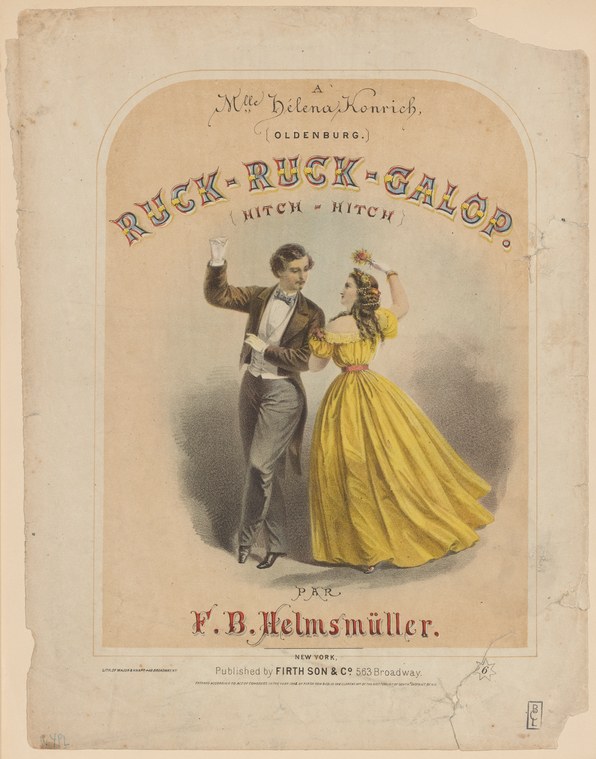
A man in formal evening dress and a woman in a bright yellow ball gown face each other in a moment of playful interaction. The man, wearing a dark tailcoat and bow tie, raises one arm in a gesture of invitation or salutation, while the woman in the voluminous yellow silk dress with puffed sleeves and an ornate bonnet raises her hand to her head in a mirroring gesture. The composition is intimate and theatrical, set against a neutral background with soft shading that creates depth. The woman's skirt dominates the lower half of the frame, its gathering and folds rendered in fine detail. This is a hand-colored lithograph, likely from a published sheet music cover or theatrical advertisement, executed with the delicate tonal gradations characteristic of mid-nineteenth-century color printing.
The dancing
The two figures stand at a slight distance, neither in a closed ballroom hold nor in the frame of a contra or country dance. Both have raised arms, creating a symmetrical visual relationship: the man's arm extended upward and outward in an emphatic gesture, the woman's hand raised near her bonnet in a coquettish or surprised response. The posture is upright and formal, the bodies angled to present themselves to the viewer rather than to each other. There is no visible footwork and no sense of weight transfer—these are posed figures, not captured mid-movement.
The dance depicted
The title 'Ruck-ruck-galop: hitch-hitch' identifies this as a variant or novelty version of the galop, a fast couple dance in 2/4 time that was enormously popular in the 1840s–1860s across Europe and America. The repeated words suggest a musical or choreographic phrase: 'ruck-ruck' may indicate a gathering or tucking motion (the woman's skirt is emphasized in the image), and 'hitch-hitch' a jerky or hopping step characteristic of the galop's energetic style. The image shows the dancers at a moment of social flirtation rather than in the heat of the dance itself—a convention of popular dance prints of this era, which favored the courtship narrative over the actual choreography.
How it was made
This is a hand-colored lithograph, a technology that allowed for rapid, economical production of music covers and theatrical advertisements. The color—particularly the brilliant yellow of the woman's dress—was applied by hand after the stone printing, which explains the slight unevenness visible in the shading and the way the color respects the printed outlines. Lithography's soft tonal range and capacity for fine detail made it ideal for fashion imagery and ballroom scenes. The publication information at the base (F.B. Helmsmüller, Firth Son & Co., New York) indicates this was a mass-produced sheet music cover, designed to appeal to amateur pianists and dancers buying the piece for home performance.
About this work
This is a mid-nineteenth-century sheet music cover for a galop variation, a ballroom dance that dominated the social calendar of the 1840s–1860s. The image does not depict the dance in action but rather the social ritual of invitation and acceptance that preceded it—a moment of eye contact and playful gesture between partners about to dance. The lithograph belongs to a large popular industry of music publishing and dance instruction, aimed at the middle-class ballroom. The titled dance form, the dress, and the style of printing all place it squarely in the Gilded Age, when the galop was one of the most danced figures in Europe and America, second only to the waltz in popularity.
How to look at it
This print captures not the dance itself but the moment of social negotiation that made the dance possible: the invitation, the acceptance, the flirtation. The raised arms and angled posture are theatrical rather than kinetic—the figures are posed for the viewer, not caught in motion. The emphasis on the woman's skirt and bonnet reflects both the fashion priorities of the era and the practical concern that a galop partner needed to see and manage a woman's voluminous skirts. The bilateral symmetry of the raised-arm gesture is a convention of mid-century dance prints, which favored balanced, decorative compositions over dynamic action.
The artist
The artist is not recorded in the catalogue. The work is attributed to F.B. Helmsmüller on the cover and published by the New York house Firth Son & Co., one of the major music publishers of the mid-nineteenth century. Helmsmüller may have been the composer, the lithographer, or both; without further research, the division of labor cannot be determined. The image is signed 'Hoff'—likely the lithographer's name—in the lower right. Such prints were typically produced by specialist commercial studios working at speed for the music and entertainment industry.
The period
The galop emerged in Germany around 1820 and reached peak popularity in America and Europe during the 1840s and 1850s. It was a dance of considerable energy and speed, performed by couples and often danced in chains or sets, and it represented a shift toward faster, more playful ballroom entertainment as the waltz began to stabilize into a more sedate form. The mid-nineteenth century saw an explosion of printed dance music and instructional materials for home use, driven by rising middle-class participation in ballroom dancing and the expansion of lithographic printing technology. Fashion prints from the same period show the same emphasis on women's dress—the balloon skirt, the bonnet, the gathered sleeves—indicating that this image is aligned with actual sartorial practice of roughly 1840–1860.
Where it lives
This lithograph is held in the New York Public Library's collection of prints depicting dance. It is a published sheet music cover, part of the vast archive of popular music and dance instruction materials that circulated in the United States during the nineteenth century. The Firth Son & Co. imprint confirms it was manufactured and sold through the commercial music trade.
Dance in this work
Questions about this work
What is a galop and how was it danced?
The galop was a fast couple dance in 2/4 time, consisting of a series of rapid sideways and backward steps performed in a closed hold or in chains across the room. It was energetic and playful, often danced after waltzes as a lighter, more amusing figure. The 'ruck' and 'hitch' references in the title suggest variations in the step pattern or gathering motions of the woman's skirt.
Why do these dance prints emphasize women's clothing so much?
Women's skirts in the mid-nineteenth century were constructed from layers of tulle, silk, and horsehair, creating enormous volume. These skirts moved dramatically during dance and required active management by both partners. Dance prints of the era were marketing both the dance and the fashionable dress worn to perform it, and the skirt's movement was inseparable from the visible success of the dance itself.
How common were novelty variations like 'ruck-ruck-hitch-hitch'?
Very common. The galop was one of the least standardized ballroom dances; there was no official choreography, and local musicians, dancing masters, and couples adapted the basic step pattern constantly. Novelty names and playful subtitle variations helped music sellers differentiate their publications and gave amateur dancers a sense of learning something new and fashionable.
Who would have bought and used this sheet music?
Middle-class households with a piano, parlor dancers, and amateur musicians. The lithographed cover made the music attractive as a domestic object, and the dance could be learned from the accompanying notation and instruction, or by attending a dancing master's class. Such publications were a major vector for the spread of ballroom dance knowledge in the nineteenth century.
More dance artwork





