49 works in this view — arrow keys or swipe to move between them.
Dance in Art
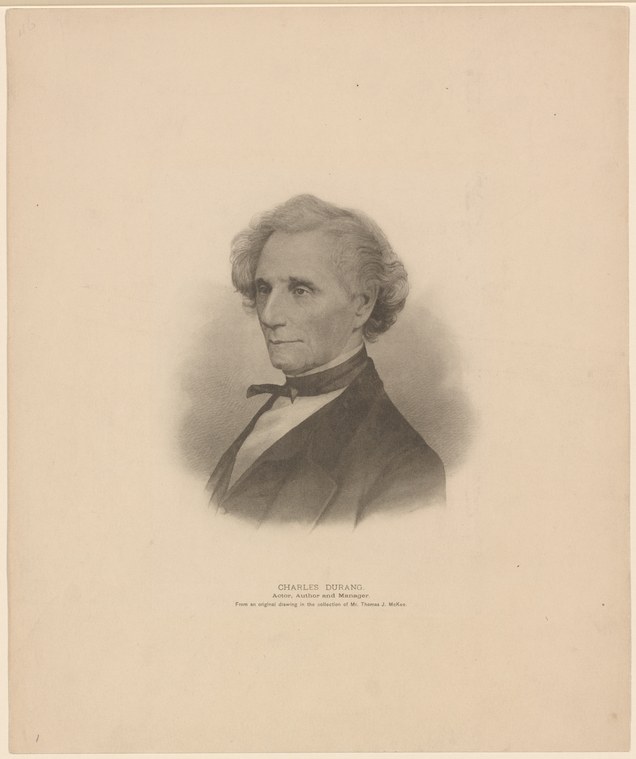
Charles Durang, actor, author and manager
Unknown artist
- Collection:
- Prints depicting dance
- Source:
- New York Public Library
- Rights:
- Public domain — free to use, share and adapt.
- Recorded as:
- Public Domain
Durang was a central figure in Philadelphia's theatrical life and a chronicler of American theatre history, but this portrait provides no visual evidence of dance content or technique. Its significance lies in the history of theatre rather than dance imagery.
What you are looking at
A three-quarter-length portrait of a gentleman in formal dress, rendered as a stippled engraving or lithograph in muted tones. The subject wears a dark coat with a bow tie, his hair styled in the swept-back fashion of the mid-19th century. The composition is conventional for theatrical portraiture of the period—a bust-length figure set against a plain background with subtle shading that creates depth around the shoulders. The treatment is restrained and dignified rather than dramatic, with no gesture or movement suggested beyond the turn of the head.
The dancing
The figure is static and posed frontally, with the head turned slightly to the viewer's left. There is no dancing posture, no weight shift, no arm position suggestive of theatrical movement or dance technique. The body is still and the hands are out of frame. This is a straightforward portrait of an individual, not a depiction of dance or physical performance.
The dance depicted
This work does not depict dance. It is a formal portrait of an individual identified in the inscription as Charles Durang. While Durang was a noted actor, author, and theatre manager in 19th-century Philadelphia, and theatre history confirms his involvement in theatrical productions that included dance, the portrait itself shows no dance action, costume, or movement. The catalogue record's assignment to 'dance' appears to reflect Durang's professional role in theatre rather than the content of the image.
How it was made
This is a stippled engraving or possibly a lithograph, executed in the standard reproductive technique of 19th-century theatrical portraiture. The soft tonal gradations and the absence of line engraving suggest a process suited to wide circulation—such prints were commonly distributed as theatrical playbills, memento mori, or biographical collections. The technique allows for the subtle modelling of the face and the suggestion of volume through tone rather than line, a method favoured for depicting identifiable individuals with dignity.
About this work
This is a formal mid-19th-century portrait print of Charles Durang, the Philadelphia actor, author, and theatre manager. Although Durang was a significant figure in American theatrical history and dance played a role in the theatrical productions he managed, this image is a conventional portrait of the man himself rather than a representation of dance or performance. It belongs in a historical record of theatre and theatre practitioners but not in a gallery primarily concerned with the visual documentation of dance as a practice.
How to look at it
Attend to the formal restraint of the composition—the plain background, the three-quarter pose, the soft modelling of the face. These choices signal respectability and authority rather than theatrical spectacle. The absence of any prop, costume detail, or gesture marks this as a biographical or commemorative portrait rather than an action image. The print's finish and circulation suggest it served as a calling card or historical record of a notable figure.
The artist
The artist is not recorded. The inscription states that the print was 'From an original drawing in the collection of Mr. Thomas J. McKee,' suggesting it was created as a posthumous or commemorative portrait based on an earlier drawing. The style and technique are consistent with mid-19th-century American reproductive portraiture, a commercial practice that made theatrical and public figures accessible to a broad audience.
The period
The portrait dates to an era when theatrical portraiture was a thriving commercial genre, particularly in cities like Philadelphia with active theatrical communities. The style reflects conventions established in the early 19th century, when reproductive prints served as the primary means of circulating images of performers and public figures before photography became widespread. By the mid-1800s, such prints occupied a space between fine art and ephemeral commercial material.
Where it lives
The work is held in the New York Public Library's print collection of works depicting dance, catalogued under the Library's subject system. The inscription credits the original drawing to the collection of Thomas J. McKee, suggesting 19th-century provenance.
Questions about this work
Did Charles Durang perform as a dancer?
The historical record indicates Durang was an actor, author, and theatre manager; he is best known as the author of a history of Philadelphia theatre. This portrait does not depict him performing dance, and his primary renown was as a theatrical organiser and chronicler rather than as a dancer.
Why is this portrait in a dance collection?
Durang's professional involvement in theatrical production—a field that included dance—likely prompted his inclusion in institutional dance collections. However, the image itself is a formal portrait and contains no dance content.
What printing technique was used?
The image appears to be a stippled engraving or lithograph, a reproductive technique suited to wide distribution. Such prints were commonly used for theatrical promotion and biographical circulation in the 19th century.
More dance artwork





