49 works in this view — arrow keys or swipe to move between them.
Dance in Art
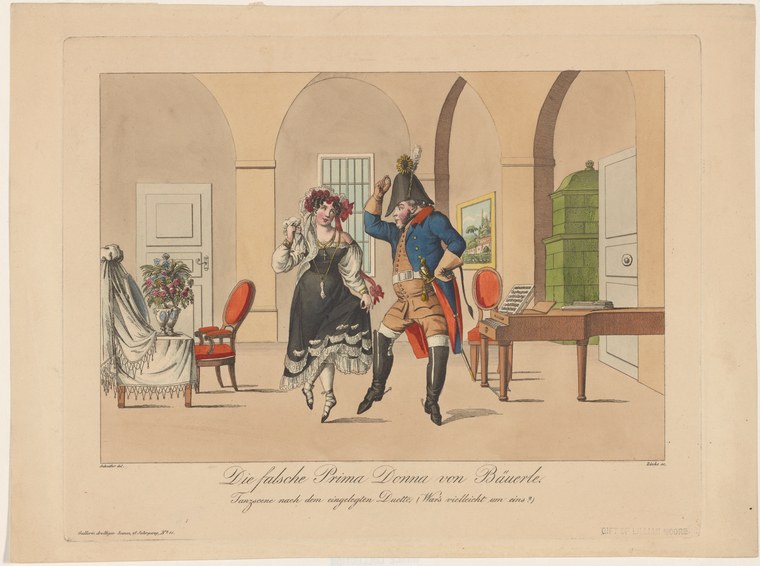
Die falsche Prima Donna von Bäuerle: Tanzscene nach dem eingelegten Duette "War's vielleicht um eins?"
Unknown artist
- Collection:
- Prints depicting dance
- Source:
- New York Public Library
- Rights:
- Public domain — free to use, share and adapt.
- Recorded as:
- Public Domain
This work documents the intersection of dance, theater, and comedy in early 19th-century European popular culture, showing how dance was deployed for comic effect and social satire on stage. It reveals that what circulated as theatrical imagery included not virtuosic or formally trained dance, but rather the burlesque and exaggerated movement that made audiences laugh, demonstrating that dance history must account for entertainment and humor, not only technique.
What you are looking at
A fashionable interior of the early 19th century, rendered in hand-colored engraving. A woman in an elaborate black dress trimmed with white lace sits at left, one hand raised to her face in a gesture of distress or surprise. At center, a uniformed military officer in blue coat and breeches executes a vigorous dance step, his body angled forward with one leg extended and arms positioned as if mid-movement. A second figure in similar military dress stands at right, watching. The room features classical architecture—arched ceilings supported by columns, a clock on the mantelpiece, a potted plant, and framed pictures on the walls. The lighting is even and cool, characteristic of the print medium, with careful hatching establishing form and shadow. The composition suggests a moment of social comedy: the woman's alarm, the officer's enthusiastic but perhaps clumsy performance, and the observer's reaction all point to theatrical rather than earnest dance.
The dancing
The primary dancer (center figure) displays an exaggerated, almost burlesque posture: legs are in a wide stance with one leg kicked or extended forward, the torso leans forward at an acute angle, and the arms are splayed in an uncontrolled manner suggesting either comic incompetence or high spirits. This is not the composed frame of trained classical dance. The woman's hand-to-face gesture reads as alarm or disbelief. The second officer's stance is upright and observant, his body language detached. The disparity in control and deportment between the dancing figure and the others marks this as a scene of social awkwardness or deliberate comedy.
The dance depicted
This appears to be a social dance of the Regency or early 19th-century ballroom context, but depicted with comic exaggeration. The figure's posture and energy suggest a vigorous, possibly improvised dance step rather than a formally trained performance. The title references a duet song ("War's vielleicht um eins?" — "Was it perhaps around one?"), indicating this scene is from a staged work, likely a Viennese farce or operetta. The exaggerated execution by the uniformed officer suggests either his incompetence as a dancer or a deliberate comic performance designed to shock or amuse the woman. This is not courtly baroque dance nor classical ballet, but rather social or theatrical comic dance of the popular stage.
How it was made
This is a hand-colored engraving, a common format for theatrical and literary illustration in the early 19th century. The technique allowed for detailed costume and setting information to be distributed widely and affordably. The precision of line work in the architectural details and the careful modeling of the figures through cross-hatching are typical of engraving. Hand-coloring was applied after printing, which explains the flat, decorative quality of the color fields. The medium assured circulation among theater-goers, readers of illustrated editions, and collectors of theatrical memorabilia.
About this work
This is a theatrical illustration documenting a scene from a Viennese stage work (identified by the German title and the reference to an embedded musical number). It captures a moment of social comedy in which a uniformed officer dances with deliberate or accidental clumsiness while a fashionable woman reacts with apparent shock. The work belongs to the tradition of early 19th-century theatrical documentation through prints, a format that allowed audiences to relive moments from plays and operettas, and that also served as marketing for theatrical productions. The image records not an actual dance technique but the performance of a character type—the bumbling soldier or the social misfit—which was a staple of popular European theater.
How to look at it
Attend first to the contrast between the composed, alarmed woman and the explosive energy of the dancing officer. Note the exaggeration in his posture—the extreme forward lean, the extension of the leg, the splayed arms—which reads as comic to a viewer of the period because it violates the neat, controlled frame of polite ballroom dancing. The artist has frozen not the execution of a genuine dance step but the moment of transgression, when the officer's behavior exceeds social expectation. The second officer's neutral stance emphasizes how anomalous the central figure's movement is.
The period
The early 19th century saw a boom in theatrical illustration across German-speaking Europe, particularly in Vienna and Berlin. Operettas, farces, and comedies were enormously popular, and publishers released hand-colored engravings documenting memorable scenes, which served both as souvenirs for theater-goers and as publicity for future performances. The Romantic period brought a fascination with spectacle and with the contrast between refined ballroom deportment and comic transgression. The uniform worn by the dancing officer suggests a post-Napoleonic setting, when military figures were frequent subjects of both admiration and satire in popular theater.
Where it lives
This work is held in the New York Public Library's collection of prints depicting dance. It represents the library's holdings of theatrical and social documentation from the 19th century, a category that bridges fine art, theater history, and cultural history.
Dance in this work
Questions about this work
Is this a real dance from the period?
No. The exaggerated posture and apparent lack of control indicate this is a comic or theatrical interpretation of dance, not a demonstration of actual ballroom technique. The artist has captured a character's movement, not an instructor's demonstration.
What is the 'false prima donna' referenced in the title?
The title indicates this scene is from a theatrical work, likely a farce or operetta, in which the term 'false prima donna' refers to a character who claims or is mistaken for a leading singer or performer. The scene shown is a musical duet embedded in the larger plot.
Why were theatrical scenes like this printed and hand-colored?
Theater-goers bought these prints as souvenirs, and publishers used them to advertise forthcoming productions. They were affordable mass-produced items that kept audiences engaged with theatrical culture between performances and helped promote popular works.
What does the military uniform tell us?
The uniform places the scene in a specific social context—likely Austro-Hungarian in setting, given the German text—and suggests that military figures, whether as characters or as audience members, were important to the social world the theater addressed. The contrast between military rank and comic physical incompetence may be part of the satire.
More dance artwork





