49 works in this view — arrow keys or swipe to move between them.
Dance in Art
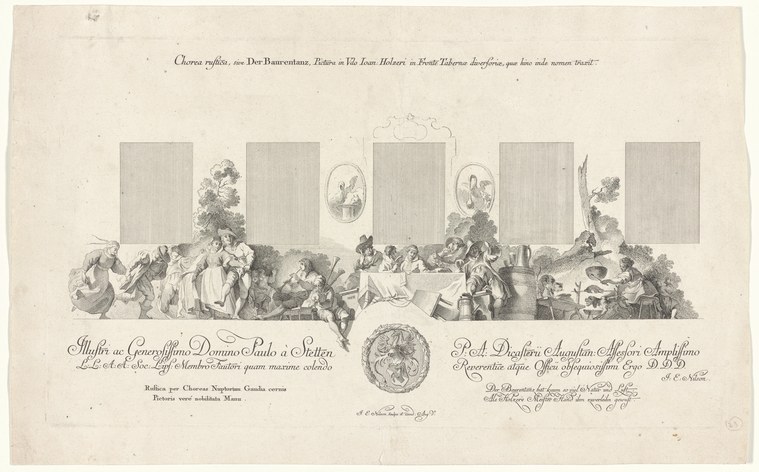
Chorea rustica, sive Der Baurentanz, Pictura in Vdo Ioan: Holzeri in Fronte Tabernæ diversoriæ, quæ hinc inde nomen traxit
Unknown artist
- Collection:
- Prints depicting dance
- Source:
- New York Public Library
- Rights:
- Public domain — free to use, share and adapt.
- Recorded as:
- Public Domain
Peasant-dance engravings are among the few visual records we have of how non-elite people actually moved and socialized in the early modern period. This print preserves the texture of rural festivity at a moment when such customs were still strong but already being viewed with urban curiosity and sometimes moral alarm by the educated classes.
What you are looking at
This engraving depicts a rustic village dance or fair, with dozens of figures arranged in a frieze across the composition. The scene unfolds before a row of five tall rectangular structures—possibly market stalls, booths, or temporary buildings—with smaller oval and semicircular inset scenes above them showing domestic or market activities. The foreground fills with a dense crowd of villagers in 17th-century dress: men in breeches, doublets, and hats; women in full skirts, bodices, and bonnets. The figures cluster in small groups and pairs, some dancing, others eating, drinking, or socializing. A musician or bagpiper stands among them. The entire composition is rendered in fine engraved lines with careful cross-hatching for tone, and the figures are animated but orderly, captured in a moment of community leisure or celebration.
The dancing
The dancers occupy various positions across the field, most in pairs or small groups rather than formal lines. Several couples appear to hold hands or stand in close contact, though without the controlled frame of court dance. Bodies are bent and relaxed; skirts swirl outward suggesting turning or spinning motion. Men gesture with arms raised or extended; women's postures are lighter and more buoyant. The overall impression is of social dancing rather than choreographed steps—partners seem to be responding to music and each other's movements rather than executing a learned form. Weight distribution suggests easy, informal stances rather than the upright carriage of formal dance.
The dance depicted
This depicts a peasant or village dance (*Baurentanz*—literally, "farmer's dance"), a staple of 16th and 17th-century Northern European genre art. Such dances were social occasions mixing celebration, courtship, and community gathering, typically occurring at fairs, harvest festivals, or village festivities. The engraving shows the characteristic informality of rural dance: couples moving in close, uninhibited energy, mixing with eating and drinking. No specific dance form is identifiable from steps or hold; the interest lies in capturing the social spectacle rather than technical performance. The tradition of depicting peasant dances in Northern Renaissance and early modern prints served both as entertainment for urban viewers and as a kind of ethnographic record of rural customs.
How it was made
This is a copper-plate engraving, executed with fine parallel lines and dense cross-hatching to build form and shadow. The technique allowed for precise rendering of detail—the individual faces, costume particulars, and spatial recession—and supported multiple impressions for wide circulation. Engravings of this type were among the most affordable and widely distributed images of the 16th and 17th centuries, reaching a popular audience far beyond the nobility. The high level of finish and the complexity of the composition suggest a professional printmaker of some skill, likely working from a design by a painter. The notation in German at top and the dedication script below indicate this was intended for a German-speaking market.
About this work
This engraving is a lively genre scene documenting rural dance and village festivity in the early modern period. It belongs to a well-established Northern European tradition of peasant-dance imagery that stretched from Bruegel through the 17th century, where prints of rustic merriment offered urban viewers a window onto (or caricature of) rural life. The work captures not the refinement of court or theatrical dance, but the energy and social function of communal celebration—the mingling of movement, music, food, drink, and courtship that made village festivals vital to rural society. It is a historical document of how ordinary people danced and gathered together.
How to look at it
Attend to the scattered, simultaneous action across the field: the engraver has not chosen a single moment of climactic movement, but rather a cross-section of an ongoing event, with dancing, eating, socializing, and music-making all proceeding at once. Look at the absence of formation or line—couples and groups are dispersed, responding to local music rather than following a choreographed pattern. Notice the skirts and the swirl they catch: the women's voluminous garments register the spinning and turning motion characteristic of peasant dance. The presence of the bagpiper (or musician) among the figures anchors the scene in the soundworld that drove the movement.
The artist
The artist is not recorded. The style, inscription, and German dedication suggest a professional Northern European engraver of the 16th or 17th century, possibly working in the Low Countries or German-speaking territories. The composition and subject fall within the Bruegel tradition of detailed, populous genre scenes translated into print form.
The period
Peasant-dance imagery flourished in Northern European prints of the 16th and early 17th centuries, reflecting both genuine ethnographic interest in rural customs and a long moralizing tradition that viewed peasant merrymaking with a mix of fascination and disapproval. In the broader context of dance history, this marks the period when court dance (the minuet, the galliard, the pavan) was becoming increasingly formalized and codified among the elite, while rural social dancing remained improvisational and unbounded. Prints like this registered the growing distance between elite and popular dance practices—a distance that would only widen as Baroque court culture intensified.
Where it lives
The work is held in the New York Public Library's collection of prints depicting dance, part of its broader print and drawing holdings. No accession information, date of acquisition, or prior provenance is recorded.
Dance in this work
Questions about this work
How do I know this is meant to be a peasant dance and not some other kind of celebration?
The title (*Chorea rustica, sive Der Baurentanz*) explicitly identifies it as a rural or farmer's dance. The costume—simple doublets, full skirts, work-worn hats—and the loose, informal groupings mark this as popular rather than courtly. The presence of a bagpiper and the setting at what appears to be a fair or village gathering all support this reading.
What dance steps are they doing?
None that we can identify from the image. The engraver was interested in capturing the social scene and the general energy of movement—the swirling skirts, the close partnering, the enthusiasm—rather than documenting specific steps or figures. Peasant dance of this period was largely improvisational and regionally variable, without the codified steps of courtly forms.
Why are there all these buildings and inset scenes at the top?
These appear to be market stalls or booths at a fair, with smaller domestic or market scenes depicted in the ovals above. The engraver was constructing a comprehensive picture of village festivity: the marketplace where people gathered, the goods and activities, and the dancing and socializing that took place. It situates dance within the broader social and economic fabric of rural life.
More dance artwork





