49 works in this view — arrow keys or swipe to move between them.
Dance in Art
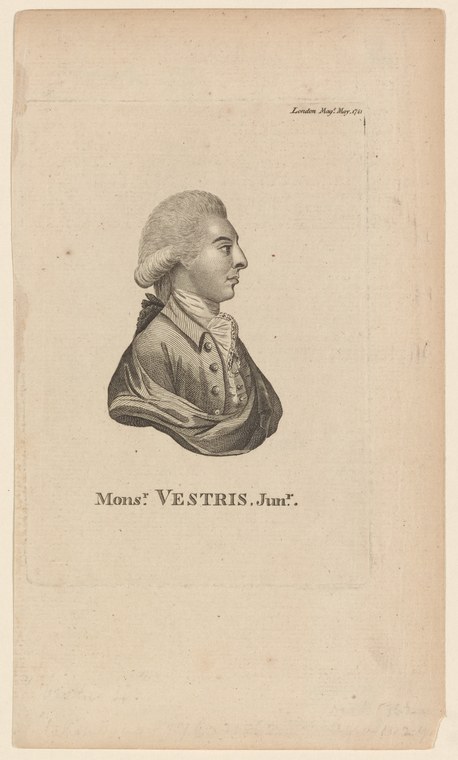
Monsr. Vestris, Junr
Unknown artist
- Collection:
- Prints depicting dance
- Source:
- New York Public Library
- Rights:
- Public domain — free to use, share and adapt.
- Recorded as:
- Public Domain
Vestris was a revolutionary figure—the first male dancer to achieve stardom comparable to female dancers, and a technical innovator who transformed what male dancing could accomplish. This print, issued during his London success, is material evidence of how his fame was packaged and sold, and of the role of engraved portraiture in creating and sustaining a performer's public identity.
What you are looking at
A profile bust portrait of a man in late 18th-century dress, rendered as an engraving. The figure wears a coat with a wide collar and decorative buttons, his hair dressed in the fashionable style of the period—pulled back and powdered. The bust is shown against a plain background, cropped at the chest. The inscription below reads "Monsr. VESTRIS Junr." in serif typeface. The date notation in the upper right corner reads "London Aug May 1789", establishing this as a commemorative print made during or shortly after a London engagement. The technique is fine-line engraving with careful attention to the texture of fabric and the modelling of the face.
The dancing
The head is turned to the viewer's right in classical profile, with a composed, dignified expression. The neck is long and elegant, the posture upright and formal. No limbs or body position are visible below the chest, so no dance posture can be assessed from the work itself. The image is a formal portrait, not a figure study of movement.
The dance depicted
This is a commemorative portrait of Jean-Auguste Vestris, known as "Vestris the Younger" or "le petit Vestris" (1760–1842), one of the most celebrated male dancers of the late 18th century. Vestris was the son of Gaétan Vestris and dominated the stage at the Opéra in Paris and, as this print documents, performed in London. The inscription and date indicate this was made to record a 1789 London season. Vestris was renowned for his technical brilliance and charisma as a dancer of the demi-caractère and noble styles within the ballet tradition, though the print itself shows only his face and dress, not his dancing body.
How it was made
The work is an engraving—evident from the fine parallel lines (hatching) used to model form and shadow, and the crisp, uniform line weight characteristic of the medium. Engravings were labour-intensive and expensive, indicating this was a significant commemorative object made for circulation among the London theatre-going public and collectors. The precise date annotation and printing technique suggest a professional London printmaker, likely issued during or immediately after Vestris's season to capitalize on his celebrity. Such prints served as both souvenirs and promotional materials.
About this work
This is a formal portrait engraving of Vestris the Younger, the dominant male dancer of late 18th-century European ballet, made to commemorate his 1789 London season. It belongs in a dance archive not because it depicts dancing, but because it documents one of history's most celebrated performers at a specific moment in his career, and because such prints were key to how theatrical fame was constructed and circulated in the period. The work is a primary source for the celebrity culture of late 18th-century dance.
How to look at it
The portrait follows the conventions of 18th-century celebrity portraiture: a three-quarter or profile view, fashionable dress worn with distinction, and careful attention to the face to convey character and celebrity status. The dated inscription and precise location anchor this to a specific historical moment rather than timeless fame. The elegance of the dress and the composed dignity of the pose underscore Vestris's status as a star of taste and refinement, not merely a physical performer. Note how the wide collar and fine buttons are rendered to display quality and fashion.
The artist
The engraver is not recorded in the catalogue. The print bears a London publisher's mark and a precise date, suggesting it was made by a commercial London print shop during Vestris's season. Such portraits were often executed by competent journeyman engravers working to demand, rather than by major independent artists; the quality and style suggest a professional metropolitan workshop.
The period
The late 1780s saw ballet transformed by technical innovation and male performers beginning to rival women in prestige and artistry. Vestris embodied this shift: he was celebrated for his elevation, his virtuosity in allegro steps, and his ability to command the stage with personality and presence. The fashion for engraved portraits of stage celebrities was at its height, with prints serving as the primary way most people encountered images of famous performers. London's print culture was thriving, and foreign stars visiting London—as Vestris did—were immediately immortalized in print for sale to the public.
Where it lives
The print is held at the New York Public Library as part of a collection of prints depicting dance. It is a commercial engraving of the late 18th century, the kind produced in quantity for theatrical audiences and collectors.
Questions about this work
Who was Vestris the Younger?
Jean-Auguste Vestris (1760–1842) was the son of Gaétan Vestris and one of the greatest male dancers of the late 18th century. He performed at the Paris Opéra and toured internationally, including to London, where this print was made. He was celebrated for technical brilliance, elevation, and personal magnetism, and helped establish male dancing as an art form equal in prestige to female dancing.
Why is this a document of dance history if it doesn't show him dancing?
This print is evidence of how dancers' fame was constructed and circulated in the late 18th century. It shows what Vestris looked like, what he wore, and how he was marketed to the public. For a performer of his era, such engravings were as important to his celebrity as photographs and video are today—they were the way most people could own an image of the star.
What is the date in the corner?
The inscription "London Aug May 1789" records that the print was made in London in May 1789, during or shortly after one of Vestris's guest seasons in the city. This documents a specific historical moment in his career and London's theatrical life.
More dance artwork





