49 works in this view — arrow keys or swipe to move between them.
Dance in Art
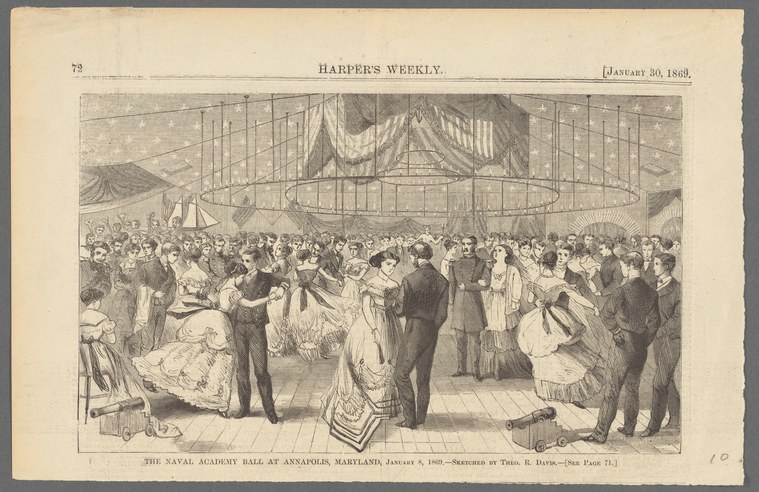
The naval academy ball at Annapolis, Maryland, January 8, 1869
Unknown artist
- Collection:
- Prints depicting dance
- Source:
- New York Public Library
- Rights:
- Public domain — free to use, share and adapt.
- Recorded as:
- Public Domain
The work documents the visual and social conventions of American ballroom dancing in the immediate post-Civil War era, showing not just the dance itself but the grandeur of the occasion and the formal codes that governed it. As a published engraving in a major national periodical, it reflects what Americans of the time considered worth recording and celebrating about their social life. It is evidence of the ballroom as a site of military pageantry and courtship ritual in the late 19th century.
What you are looking at
A grand ballroom filled with several hundred guests in formal evening dress, captured mid-dance at what appears to be a large ceremonial ball. The space is a high-ceilinged hall with a vaulted or domed roof supported by columns, draped with swags of fabric. Couples occupy the dance floor in the foreground and middle distance, while spectators line the sides and stand in clusters throughout. The men wear dark tailcoats; the women wear full-skirted gowns with fitted bodices, many with trains. The artist has paid particular attention to the swirl and volume of the skirts, which dominate the visual composition. A few seated figures are visible in the lower left, suggesting fatigue among the guests or designated rest areas. The engraving's perspective creates depth, drawing the eye back through the crowd to the far end of the hall. The overall impression is one of formal, organized social dancing—a state occasion rather than a private assembly.
The dancing
The dancing couples adopt the closed ballroom frame standard to the period: man's right arm around the woman's waist, her left hand resting on his shoulder, their outer hands joined at shoulder height. The bodies are upright and composed rather than animated. The women's skirts, rendered in fine parallel lines, dominate each couple's silhouette and appear to be the primary subject of the artist's technical effort. Most dancers face forward or are caught mid-turn, allowing the viewer to see both partners clearly. The posture throughout is formal and restrained—there is no visible exuberance, no high kicks or dramatic arm movements. The crowds of onlookers stand and watch with equal formality.
The dance depicted
This depicts social ballroom dancing at a military formal ball, almost certainly a waltz or possibly a quadrille given the date and the large-scale organized nature of the event. The Naval Academy Ball at Annapolis would have been a prestigious ceremonial dance where officers and their partners danced to live music in strict formation. The frame, posture, and dress all align with mid-19th-century American ballroom practice. The engraving captures not the technique of any single couple but the visual spectacle of the event itself—the massed formal dress, the architectural grandeur, and the social ritual. Specific footwork is not discernible, but the overall aesthetic suggests the Viennese waltz or the quadrille, both dominant in American ballrooms of 1869.
How it was made
This is a wood or steel engraving, identifiable by the fine parallel hatching used to render tone, shadow, and texture throughout—particularly visible in the depiction of the women's skirts and the ceiling drapery. The engraving technique allowed for precise architectural detail and fine gradations of light and dark. Engraved illustrations were the standard means of reproducing images in newspapers and weekly periodicals in the 1860s, and this work's publication in Harper's Weekly confirms that context. The technique required skilled hand-engraving from either a live sketch or a drawing supplied by the original artist (credited as Theo. B. Davis, the name visible in the caption). This format ensured wide circulation among the educated American readership of Harper's.
About this work
This engraved illustration documents the Naval Academy Ball held at Annapolis, Maryland, on January 8, 1869—a prestigious military social event captured for the readers of Harper's Weekly. It represents the ballroom dancing culture of the American Gilded Age, when such formal dances were major social occasions and worthy of illustrated coverage in the national press. The work is valued not as a technical study of dance movement but as a historical record of 19th-century American ballroom life: the dress, the setting, the scale of the gathering, and the formality of the social ritual. For historians of American dance, it offers visual evidence of how ballroom dancing was conducted and celebrated in elite military circles.
How to look at it
Observe the repetition of the closed ballroom frame across multiple couples—this formal, standardized hold is the signature of mid-19th-century American ballroom etiquette. Notice how the artist has devoted most technical effort to the rendering of the women's skirts and the architectural setting, not to the captured moment of the dance itself. The perspective and depth allow you to read the event as a social spectacle rather than a performance: the emphasis is on scale, formality, and the massed participation of the crowd. Look at how few faces are clearly individualized—this is a document of a social institution, not a portrait of dancers.
The artist
The engraving is credited to Theo. B. Davis, a staff artist and illustrator for Harper's Weekly during the 1860s. Davis was one of several artist-correspondents who provided on-the-spot sketches of newsworthy events for the publication. His style is typical of mid-century American periodical illustration: clear, detailed, and designed for reproducibility via engraving. Little is known of Davis's other work or training, but his presence at the Annapolis ball suggests he was trusted to document significant social and military events.
The period
In 1869, ballroom dancing was undergoing a gradual shift in American high society. The waltz, introduced earlier in the century and once controversial for its close partnership hold, had become fully respectable and dominant in formal settings. The quadrille and cotillion remained standard, but the waltz was the signature dance of fashionable American ballrooms by the 1860s. Military balls were ceremonial affairs, often involving formal formations and published guest lists; they were covered by illustrated press as events of national interest. This illustration appeared in Harper's Weekly, the most influential illustrated newspaper in America, which regularly documented social, military, and cultural events for its substantial readership.
Where it lives
The print comes from Harper's Weekly, the major American illustrated periodical of the 1860s. It is held in the New York Public Library's collection of prints depicting dance. The engraving was created for publication in the issue dated January 30, 1869, making it a journalistic artifact as much as a work of art.
Dance in this work
Questions about this work
What dance is being danced?
The image does not allow certainty, but the closed partnership frame, upright posture, and formal setting suggest either the waltz or the quadrille—both standard at American military balls in 1869. The overall spectacle and organization point more toward the waltz, which was the dominant fashionable dance of the era.
Why does this engraving exist?
It was commissioned by Harper's Weekly to document a newsworthy social event—the Naval Academy Ball was a major ceremonial occasion involving military officers and prominent guests. The engraving allowed the event to be illustrated in the national press and circulated to readers who had not attended.
What does the dress tell us about the dance?
The full skirts and fitted bodices of the women's gowns were designed to show off the turning and movement of ballroom dancing, especially the waltz. The voluminous skirts were a practical and aesthetic feature of mid-19th-century ballroom wear and required the controlled, upright posture visible in this image.
Is there anything unusual about the ballroom itself?
The scale and architectural detail—the domed or vaulted ceiling, the formal columns, the decorative drapery—suggest this was a purpose-built or specially decorated grand hall, likely within a military academy building or a hired assembly space. The grandeur reflects the importance of the event.
More dance artwork





